The short answer
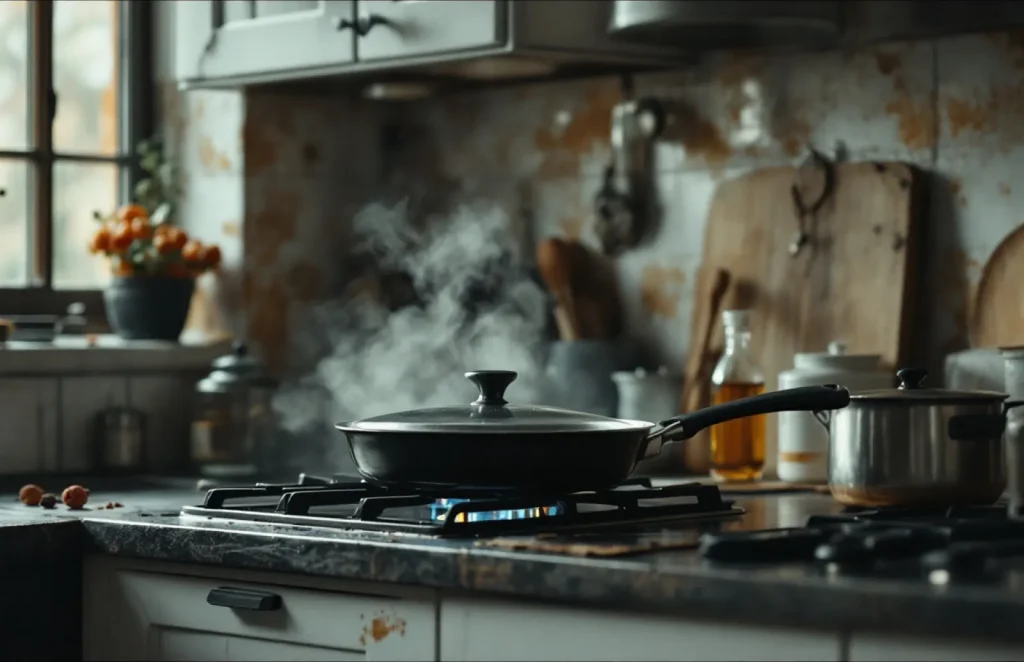
Grease fire cleanup starts only once the burner is off and the lidded pan is completely cool. Then ventilate, lift soot from porous walls and ceilings with a dry chemical sponge before any water, degrease hard surfaces with mild detergent or 4 to 6 tablespoons of TSP per gallon, rinse, and wash walls from the floor up, ceilings last.
Is the pan cool enough to start? Two checks before you touch anything
The NFPA Home Cooking Fires report gives one rule for the pan itself: a small oil or grease fire is smothered by sliding a lid over the pan and turning off the burner, and the pan should be kept covered until it is completely cool. Cleanup starts after that point, not while the pan is still hot under its lid.
The Broan BCSEK and BCDF range hood manual repeats the NFPA list for a fire that is still burning: never pick up a flaming pan, do not use water or a wet dishcloth because it can cause a violent steam explosion, and if the flames do not go out immediately, evacuate and call the fire department. This page does not cover putting a fire out beyond that sentence; the U.S. Fire Administration cooking fire page has the prevention side.
Second check: electrical. The LA County DPH fact sheet says not to use electrical appliances that have been near a fire and not to touch anything on the first walk through, so soot is not carried from item to item. FA-46 adds that appliances exposed to water or steam should be checked by a service representative before use, because steam can strip lubricant from moving parts.
What is the sticky film on the cabinets? Greasy residue versus dry soot
Not all smoke leaves the same deposit. The Los Angeles County Department of Public Health soot fact sheet, dated 1 January 2025, separates high oxygen fires, which typically leave dry dusty soot, from kitchen fires, where thorough cleaning is required because residue may not be readily visible. The same sheet states plainly that soot is oil, which is why a kitchen wipe that looks clean can still smear.
An IICRC technical tip published in Cleanfax (January 2022) explains where that residue goes. A protein or cooking fire produces little pressure, so the products of incomplete combustion drift to cool surfaces and condense there: behind cabinets, in appliance mounting cavities, in closets several closed doors from the stove, and inside cabinets and drawers. The tip adds that these residues tend to be acidic and that removing them by cleaning resolves the associated protein odor.
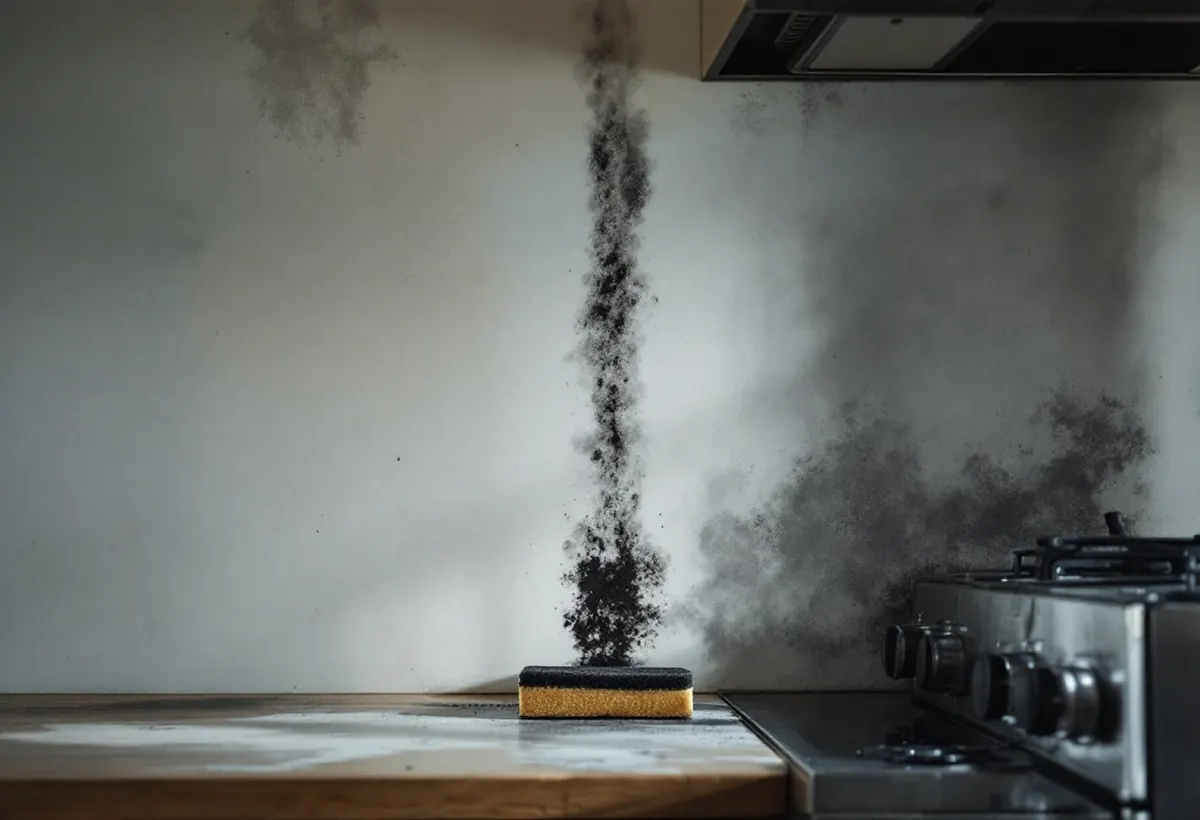
That is the reason water comes second. The LA County DPH fact sheet recommends a dry chemical sponge on porous materials (painted surfaces, wallboard, plaster, wallpaper, exposed wood) to remove as much soot as possible first, because this step can keep soot from being transferred deep into the surface, where it may show as a permanent stain. Less porous surfaces such as tile, countertops, sealed wood, glass, metal and appliances go straight to a sponge or towel with household detergent.
In what order do you clean a kitchen after a grease fire?
The sequence below follows the three public sources that set an order. The LA County DPH fact sheet puts ventilation and debris removal first and says deposits and odors must be cleaned and neutralized before any redecoration; USFA booklet FA-46, After the Fire! Returning to Normal supplies the wall wash and the floor up rule.
Empty the cabinets before you clean them. The LA County sheet says kitchen cabinets and drawer contents usually need to come out to reach hidden areas, which matches the IICRC technical tip published in Cleanfax list of where cooking residue settles. Wash dishes, pots and flatware with soapy water, rinse and polish them, as FA-46 directs.
Wear dishwashing gloves, long sleeves and long pants, and an N95 dust mask while you work, per the LA County DPH fact sheet; it also advises washing any ash off skin as soon as possible and keeping children with a relative while the cleanup runs. Cover cleaned items with clean sheets so they are not re-soiled while you work on the next area.
Surface by surface: what to clean, with what, and what to throw out
No public source puts every kitchen surface in one place, so the table below assembles the instructions of the LA County DPH fact sheet, FA-46, the Broan manual and the IICRC technical tip published in Cleanfax row by row. Each row cites where its instruction comes from; anything without a source was left out.
| Surface | How the residue behaves | Cleaner class | What to discard | Source |
|---|---|---|---|---|
| Painted walls, drywall, plaster | Oily soot; water first can drive it into the surface | Dry chemical sponge, then mild detergent or TSP wash, rinse | Nothing, unless heat damaged; repaint only when dry | LA County DPH fact sheet; FA-46 |
| Ceiling above the stove | Washed after every wall, per the booklet | Dry sponge, then wash last of all surfaces | Nothing, unless heat damaged | FA-46 |
| Cabinet interiors and drawers | Cool cavity where cooking residue condenses | Empty, then household detergent on sealed surfaces | Open food stored inside (see food row) | LA County DPH fact sheet; IICRC tip |
| Countertops, tile, glass, metal, appliance fronts | Less porous; residue wipes off | Sponge, towel or mop with household detergent | Nothing | LA County DPH fact sheet |
| Stainless steel hood and range | Film plus heat discoloration | Mild soap along the polish lines, rinse 2 or 3 times; vinegar for heat tint | Nothing; no steel wool or abrasive cleansers | Broan manual; LA County DPH fact sheet |
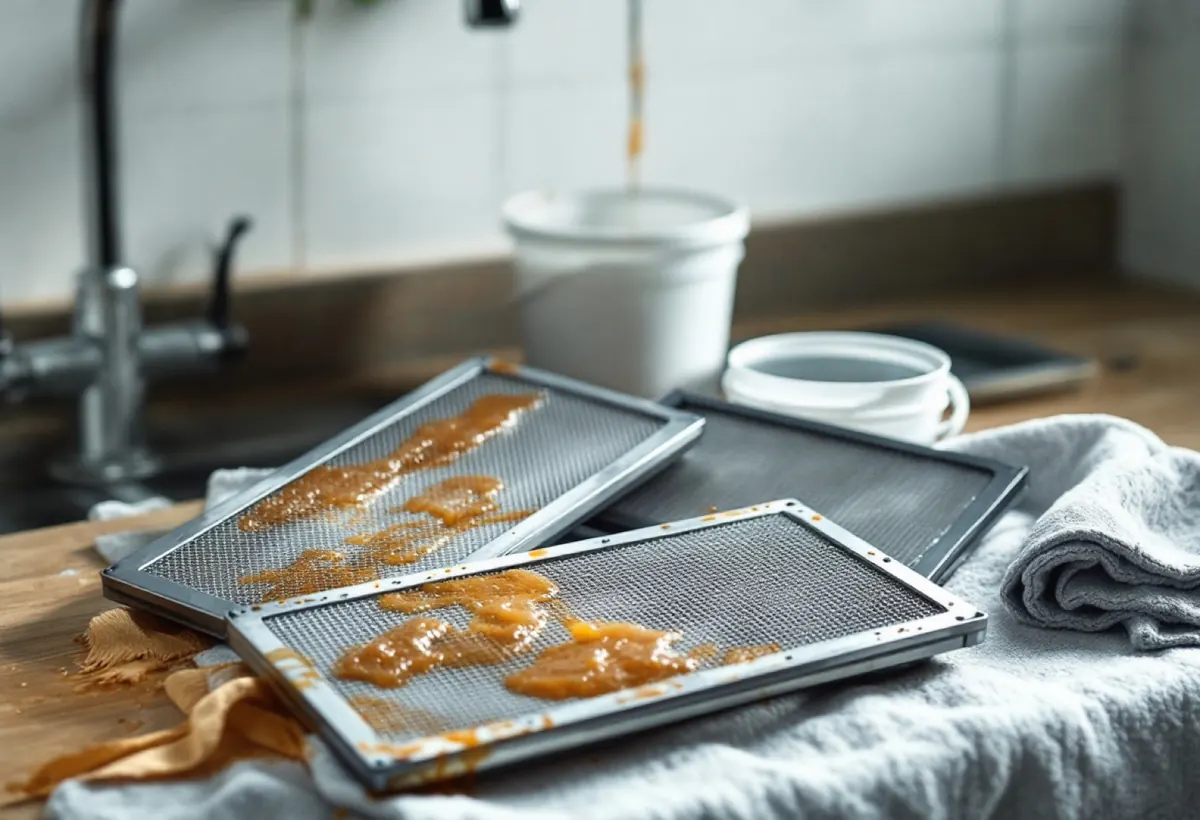
| Metal mesh grease filters | Grease must not accumulate here, per the maker | Warm dish detergent by hand, or dishwasher with non phosphate detergent | Nothing; phosphate detergent can discolor them | Broan manual |
| Recirculating charcoal filters | Listed as a replaceable part, not a washable one | Replace | Replace now (normal interval 3 to 6 months) | Broan manual |
| White painted trim, PVC window frames | Acidic soot can stain once moisture reaches it | Mild detergent soon | Nothing | LA County DPH fact sheet |
| Curtains and upholstery | Brushes push soot into fibers | Vacuum with the nozzle held just above the surface; no beater bar | Do not machine wash dry clean only items | LA County DPH fact sheet |
| Clothing and kitchen towels | Odor stays in fabric | Soak overnight in detergent, then wash normally | Nothing, if odor clears | LA County DPH fact sheet |
| Food, drinks and medicine | Exposed to heat, smoke, soot or water | None | Do not consume; wash cans and jars; discard bulged or rusted cans | FA-46 |
| Refrigerator interior | Takes on smoke odor | Baking soda in water, or 1 cup vinegar or household ammonia per gallon | Thawed frozen food: do not refreeze | FA-46 |
| Small appliances and electronics near the stove | Soot and possible water or steam exposure | Do not run them yet | Have them checked by a service representative | LA County DPH fact sheet; FA-46 |
Two rows carry the most weight. Food that sat in the smoke is the one category FA-46 tells you not to salvage at all, and the charcoal filter in a recirculating hood is the one hood part the Broan manual treats as replaceable rather than washable, with a normal interval of 3 to 6 months that frying shortens.
Why wash walls from the floor up and ceilings last?
USFA booklet FA-46, After the Fire! Returning to Normal gives the wall routine in four lines: wash a small area at a time, work from the floor up, rinse the wall with clear water immediately, and wash ceilings last. Starting low means dirty runoff falls onto wall that is still dirty instead of streaking wall that is already clean, which is how the LA County DPH fact sheet explains the same rule (starting from the floor up to prevent streaking).
The TSP mix in both documents is the same: 4 to 6 tablespoons of trisodium phosphate and 1 cup of household cleaner or chlorine bleach in 1 gallon of warm water, per FA-46. The booklet calls TSP a caustic substance, says to wear rubber gloves and keep it out of reach of children and pets, and lists plain mild soap or detergent as the first option. Read both product labels for mixing warnings before combining any cleaner with bleach.
Do not repaint until walls and ceilings are completely dry, says FA-46. Where staining survives the wash, the LA County DPH fact sheet suggests a specialized paint with anti bleed characteristics, typically a lacquer or oil based product, and warns that fragranced cleaning products only mask odor. Candle soot follows a lighter version of this routine, set out on our candle soot page.
The hood, the oven and the fan: what the maker’s manual says
The range hood sits directly above the burner. The Broan BCSEK and BCDF range hood manual says to switch power off at the service panel before servicing or cleaning the unit, to wash grease filters frequently in a warm dishwashing detergent solution, and that metal filters are dishwasher safe if run with a non phosphate detergent. The fan blade gets a cloth soaked in warm detergent solution.
The same Broan manual lists grease left on the fan, filters or exhaust ducts as a range top fire risk in its own right, which is the practical case for cleaning the hood before you cook on the stove again. If you cannot reach grease inside the duct run, that is the part to hand to a contractor rather than leave.
For the oven and cooktop, follow the cleaning method in your own range manual, because self cleaning cycles and coatings differ by maker and model. The LA County DPH fact sheet says not to use electrical appliances that have been near a fire until they are checked, and the same applies to the range itself if the fire reached its controls or wiring.
If a dry chemical extinguisher was used, that powder is a separate residue with its own steps on our extinguisher powder cleanup page. The Broan list reserves an extinguisher for a Class ABC unit, a small contained fire, a called fire department and an exit at your back.
How many grease fires are there? About 53,300 a year start with oil
According to the NFPA Home Cooking Fires report (September 2023), US fire departments responded to an average of 158,400 home cooking fires a year in 2017 to 2021. The report says cooking oil, fat and grease were the first item ignited in 51 percent of the fires that began with cooking materials, which works out to roughly 53,300 grease first fires a year on our arithmetic.
Most of those are cleanup jobs, not rebuilds: the NFPA Home Cooking Fires report reports that 80 percent were confined to the object or pan of origin and 97 percent stayed in the room where they began. It also reports that more than half of non fatal cooking fire injuries happened when people tried to control the fire themselves, and that grease hoods had the highest injury rate per 1,000 fires among cooking equipment, though those fires were less common.
The U.S. Fire Administration cooking fire page prints a different count for a single year, and the two should not be averaged. NFPA estimates a five year average across all reported home cooking fires; USFA reports calendar 2021, and adds that unattended equipment was the leading factor in 37 percent of nonconfined home cooking fires.
| Measure | NFPA (report dated September 2023) | USFA (cooking fire page) |
|---|---|---|
| Period | 2017 to 2021 average | 2021 only |
| Home cooking fires a year | 158,400 | 170,000 |
| Civilian deaths | 470 | 135 |
| Civilian injuries | 4,150 | 3,000 |
| Property loss | $1.15 billion a year | over $494 million |
When does a kitchen grease fire become an insurance claim?
USFA booklet FA-46, After the Fire! Returning to Normal lists what to do before cleaning goes too far: give the insurer immediate notice, ask what actions it requires of you, save receipts for any money you spend, and do not throw away damaged goods until after an inventory is made. It also says to discuss any inventory or repair contractor with your insurer first, and to be clear about who will pay a restoration company before it starts.
That means photographing every row of the surface table before you wipe it, keeping the discarded food list, and keeping the replaced charcoal filter receipt. Whether a given kitchen fire is worth claiming against a deductible is covered on does homeowners insurance cover fire damage, and the step by step file is on our smoke damage insurance claim page.
This page does not say what any policy pays. Ask your insurer, in writing, three things: whether smoke residue cleaning is covered separately from fire damage in your form, whether it wants to inspect before you discard food or filters, and whether it requires a contractor estimate before work. If the answers are unclear, your state insurance department and a licensed agent can read your declarations page with you.
When is a grease fire beyond a weekend clean? Heat lines and hidden residue
The LA County DPH fact sheet says heavy residue may need professionals and mechanical cleaning, and lists the methods: low pressure sandblasting, sodium bicarbonate blasting, dry ice blasting, power washing with steam, chemical application with agitation, and non destructive rubber blasting. None of those are household tools, which is a practical sign that the job has outgrown a sponge and a bucket.
Heat damage is the other line. The IICRC technical tip published in Cleanfax notes that gypsum begins to calcine at 176 degrees Fahrenheit, turning brittle; a visible heat line separates heavy from light residue, and tapping drywall above and below it gives an audible difference where calcination occurred. Heat damaged surfaces need refinishing or replacement, not just cleaning, and that is where a kitchen fire becomes the broader job on smoke damage repair.
For contractors
The governing standard is ANSI/IICRC S700, Standard for Professional Fire and Smoke Damage Restoration, First Edition 2025. Its published scope covers assessing the presence, intensity and boundaries of fire residues and odors, restoration cleaning and odor management, and a written Restoration Work Plan; a homeowner can fairly ask a contractor whether its scope follows S700 and for a copy of that plan before work begins.
Odor that outlasts cleaning usually means residue remains. The Texas A&M AgriLife Extension fact sheet says ventilation only dilutes smoke odor and the particles must be removed by cleaning; it notes that an ozone generator requires temporary evacuation of the home. Our smoke smell guide takes the odor side further.
Questions people actually ask
What neutralizes a grease fire?
Removing its air. The NFPA Home Cooking Fires report says to slide a lid over the pan, turn off the burner and keep the pan covered until it is completely cool. The Broan manual adds a cookie sheet or metal tray as substitutes, warns that water can cause a violent steam explosion, and says to evacuate and call the fire department if flames do not go out immediately.
Can I just wipe grease fire soot off with a wet rag?
On tile, glass, metal and countertops, yes: the LA County DPH fact sheet lists a sponge, towel or mop with household detergent for those less porous surfaces. On painted drywall, plaster, wallpaper and bare wood it says to use a dry chemical sponge first, because wetting oily soot can push it deeper and leave a permanent stain.
Is food in the pantry safe after a small kitchen fire?
FA-46, the USFA after the fire booklet, says food, beverages and medicine exposed to heat, smoke, soot or water should not be consumed. Canned goods and jars can be washed in detergent and water, but cans that have bulged or rusted should not be used, and frozen food that thawed should not be refrozen.
How do I get the smoke smell out of the refrigerator?
FA-46 gives two washes for the inside: a baking soda and water solution, or 1 cup of vinegar or household ammonia to 1 gallon of water. It also suggests leaving an open container of baking soda or a piece of charcoal inside to absorb what remains. Use one solution or the other, not both together.
Can I paint over grease smoke stains?
Only after cleaning and complete drying. FA-46 says not to repaint until walls and ceilings are completely dry, and the LA County DPH fact sheet notes that residue can affect paint, recommending an anti bleed paint, typically a lacquer or oil based product, where staining cannot be removed by washing.
How often should range hood filters be cleaned after a fire?
Immediately, then on the maker’s schedule. The Broan manual says metal grease filters should be cleaned frequently and are dishwasher safe with a non phosphate detergent, while charcoal recirculation filters are replaced every 3 to 6 months, or more often with frying and wok cooking.
Sources
- NFPA Home Cooking Fires report, National Fire Protection Association, Home Cooking Fires, publication date September 2023, 2017 to 2021 annual averages. Retrieved 17 November 2026.
- U.S. Fire Administration cooking fire page, U.S. Fire Administration, FEMA, Cooking Fire Safety, 2021 figures. Retrieved 17 November 2026.
- USFA booklet FA-46, After the Fire! Returning to Normal, U.S. Fire Administration and FEMA, FA-46, June 1998 edition, archived text copy hosted by the University of North Texas web archive. Retrieved 17 November 2026.
- Los Angeles County Department of Public Health soot fact sheet, County of Los Angeles Public Health, Environmental Health Division, How to Clean Up Smoke and Soot from a Fire, Health Fact Sheet, 1 January 2025. Retrieved 17 November 2026.
- IICRC technical tip published in Cleanfax, Cleanfax, Identifying Fire, Smoke, and Heat Damage, 17 January 2022. Retrieved 17 November 2026.
- ANSI/IICRC S700, Institute of Inspection, Cleaning and Restoration Certification, Standard for Professional Fire and Smoke Damage Restoration, scope page, First Edition 2025. Retrieved 17 November 2026.
- Broan BCSEK and BCDF range hood manual, Broan, Range Hood Series BCDF and BCSEK Installation, Use and Care Manual, document 99045652-103F. Retrieved 17 November 2026.
- Texas A&M AgriLife Extension, Texas A&M AgriLife Extension Service, How to Remove Smoke Smell from a Home. Retrieved 17 November 2026.
- The grease first, cooking materials and pan confined bars are our arithmetic on NFPA’s published shares, rounded to the nearest 100. Our methodology sets out the standing rules, and the fire and smoke hub lists related pages.
This page describes public cleaning guidance and published statistics; it does not say what any reader’s insurance policy pays. Read your own policy, ask your state insurance department and a licensed agent the questions above, and have a qualified technician check any appliance or wiring the fire reached.