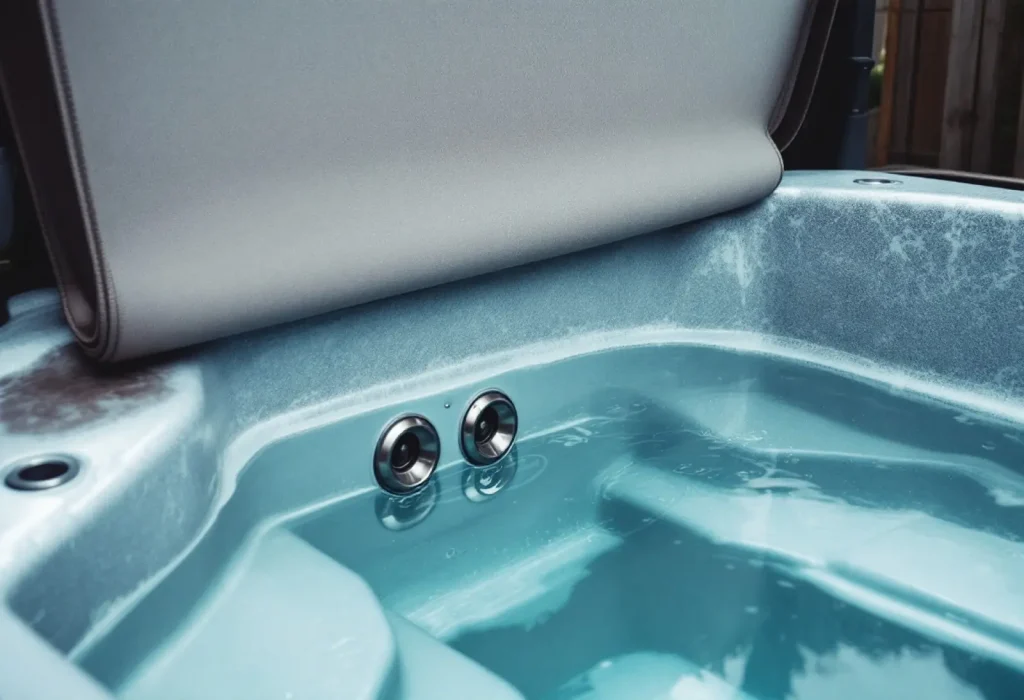
The short answer
Mold in hot tub water is almost always biofilm living in the filter, pipes and jets, so a drain alone will not clear it. Run a line flush through the plumbing before draining, scrub the shell, clean or replace the filter, refill, then hold free chlorine at 3 to 10 ppm or bromine at 4 to 8 ppm, the CDC ranges.
Where in the hot tub does the mold actually grow?
Not mainly on the shell you can see. In a 1988 field study, Price and Ahearn of Georgia State University (Journal of Clinical Microbiology, 1988) recovered Pseudomonas aeruginosa from seven commercial and two residential whirlpools and traced the bacteria in the water back to the biofilm in the filter and piping, plus the garden hoses used to fill the tubs. The slime coating those surfaces keeps feeding organisms back into clean water.
The laboratory numbers point at the filter. Goeres and colleagues at Montana State University's Center for Biofilm Engineering (2007) built a model hot tub and, with no sanitizer added, measured mean densities of 5.3 log10 colony forming units per square centimetre on test coupons and 6.6 log10 on the filter, about 20 times more bacteria per square centimetre on the filter than on the coupon surfaces, by our arithmetic from those two logs.
CDC's Legionella control toolkit for hot tubs names sediment and biofilm, temperature, water age and disinfectant residual as the factors that drive growth, and notes that hot tub water sits in the 77 to 113 F band where Legionella grows best. Its drain procedure ends with an instruction to flush the entire system with fresh water, which is the CDC’s way of saying the pipes hold what the basin does not.
Is the white or pink slime in a hot tub mold or bacteria?
Trade guides call floating white flakes white water mold, and Hot Spring Spas describes mold and mildew taking the form of floating white slime that establishes itself in the filters, jets or plumbing. No CDC page or peer reviewed study we found names a single organism behind that slime; the 1988 Georgia State and 2007 Montana State work both describe mixed bacterial biofilm. Treat the name as a description of where it sits, not a lab identification.
Pink or orange film at the waterline or on the pillows is a separate case usually tied to the bacterium Serratia marcescens, and the identification details are on our pink mold page. A fuzzy white growth on the wooden cabinet, rather than in the water, is a true mold on a building material, which our white mold guide covers.
Out of scope. Health effects of hot tub bacteria and mold are outside this page; CDC's hot tub rash page and CDC's hot tub user page are the starting points from the CDC.
What chlorine and bromine levels stop hot tub biofilm: 3 to 10 ppm or less?
CDC's Legionella control toolkit for hot tubs lists free chlorine at 3 to 10 ppm, bromine at 4 to 8 ppm and pH at 7.2 to 7.8, and says the measures follow ASHRAE Guideline 12 and the CDC’s 2018 Model Aquatic Health Code. Those are written for public tubs, but they are the only federal numbers for a hot tub, and the residential ranges in maker manuals fall inside them.
The sources disagree on pH and on how often to test, so the table keeps each figure with its own source instead of blending them. The public tub rule of two tests a day and the home maker rule of 2 to 3 tests a week differ by a factor of about five to seven; a residential tub used daily by several people sits closer to the public case.
| Parameter | Target | How often to check | Source |
|---|---|---|---|
| Free chlorine | 3 to 10 ppm | At least twice per day (public tubs) | CDC toolkit, from the 2018 MAHC |
| Free chlorine, user check | At least 3 ppm; above 10 ppm, tell the owner | Before each soak, test strip | CDC hot tub rash page |
| Bromine | 4 to 8 ppm | At least twice per day (public tubs) | CDC toolkit and rash page |
| pH | 7.2 to 7.8 | With each sanitizer test | CDC toolkit |
| pH, CDC user pages | 7.0 to 7.8 | With each sanitizer test | CDC rash and user pages |
| pH, one maker | 7.2 to 7.6 | 2 to 3 times per week (home tubs) | Jacuzzi cleaning guide |
| Water temperature | No higher than 104 F | Each use | CDC toolkit |
| Scrub water during a drain | Free chlorine at least 5 ppm | Every drain | CDC toolkit |
| Sanitizer before draining onto plants | Below 0.5 ppm | Before opening the drain | Bullfrog Spas |
Chlorine and bromine are not interchangeable at the same number. In the Montana State model tub, Goeres and colleagues at Montana State University's Center for Biofilm Engineering (2007) found that chlorine produced a greater log reduction than the same concentration of bromine in every case, and the log reduction rose with chlorine concentration for bacteria in the water, on the coupons and on the filter. That is one reason the CDC floor for bromine, 4 ppm, sits above the chlorine floor of 3 ppm.
Why does mold come back in a hot tub after draining and refilling?
Price and Ahearn of Georgia State University (Journal of Clinical Microbiology, 1988) tested exactly that. Superchlorination, or a full drain, clean, disinfect and refill, markedly cut bacteria in the water, but the populations were rapidly reestablished once sanitizer dropped below the levels then recommended, 3.0 ppm chlorine or 6.0 ppm bromine. The authors concluded that daily monitoring and adjustment, regardless of bather load, was essential.
The order matters: a flush product reaches the pipes only while the tub is full and the jets can circulate it, which is why Jacuzzi puts it before the drain. Each of the six maker and agency steps below comes from the linked source:
- Before draining, add a line flush or spa flush product to the full tub to help remove biofilm, per Jacuzzi's drain guide, and run the jets on high for 15 to 20 minutes, per Jacuzzi's cleaning guide. Follow the product label for dose and time.
- Let sanitizer fall below 0.5 ppm before draining onto a lawn or plants, as Bullfrog Spas' drain and refill instructions advise; that drain runs at about 5 to 10 gallons per minute.
- Turn power off at the breaker before draining. Jacuzzi says to restore power only after the tub is refilled.
- Scrub the shell. CDC's Legionella control toolkit for hot tubs calls for scrubbing all surfaces with water at a free chlorine level of at least 5 ppm every time the tub is drained; Bullfrog also has owners remove removable jet packs and brush the manifold behind them.
- Clean or replace the filter before the new water goes in, as the next section explains.
- Refill through the filter well. Jacuzzi says filling typically takes 30 to 90 minutes, then bring sanitizer and pH into the table’s ranges before anyone uses the tub.
Step one is the one the 1988 Georgia State result argues for: biofilm left in the filter and piping reseeded the new water as soon as sanitizer fell below 3.0 ppm chlorine.
How often should you drain a hot tub: the CDC formula for 300 to 500 gallons
CDC's Legionella control toolkit for hot tubs gives a formula: water replacement frequency in days equals the spa volume in gallons divided by 3, divided by the average number of users per day. Maker guidance is a flat calendar instead: Jacuzzi's drain guide says every 3 to 4 months, or at least three times a year, and Bullfrog Spas' drain and refill instructions say about every 3 to 4 months.
| Tub volume (example) | 1 user per day | 2 users per day | 3 users per day | 4 users per day |
|---|---|---|---|---|
| 300 gallons | 100 days | 50 days | 33 days | 25 days |
| 400 gallons | 133 days | 67 days | 44 days | 33 days |
| 500 gallons | 167 days | 83 days | 56 days | 42 days |
The two methods agree only for light use. A 400 gallon tub used by one person a day comes out at 133 days, about four months; the same tub with four daily users comes out at 33 days, so a household of four daily users on a three month calendar drains about one third as often as the CDC formula implies.
Is a slimy hot tub filter worth cleaning, or is 12 months the limit?
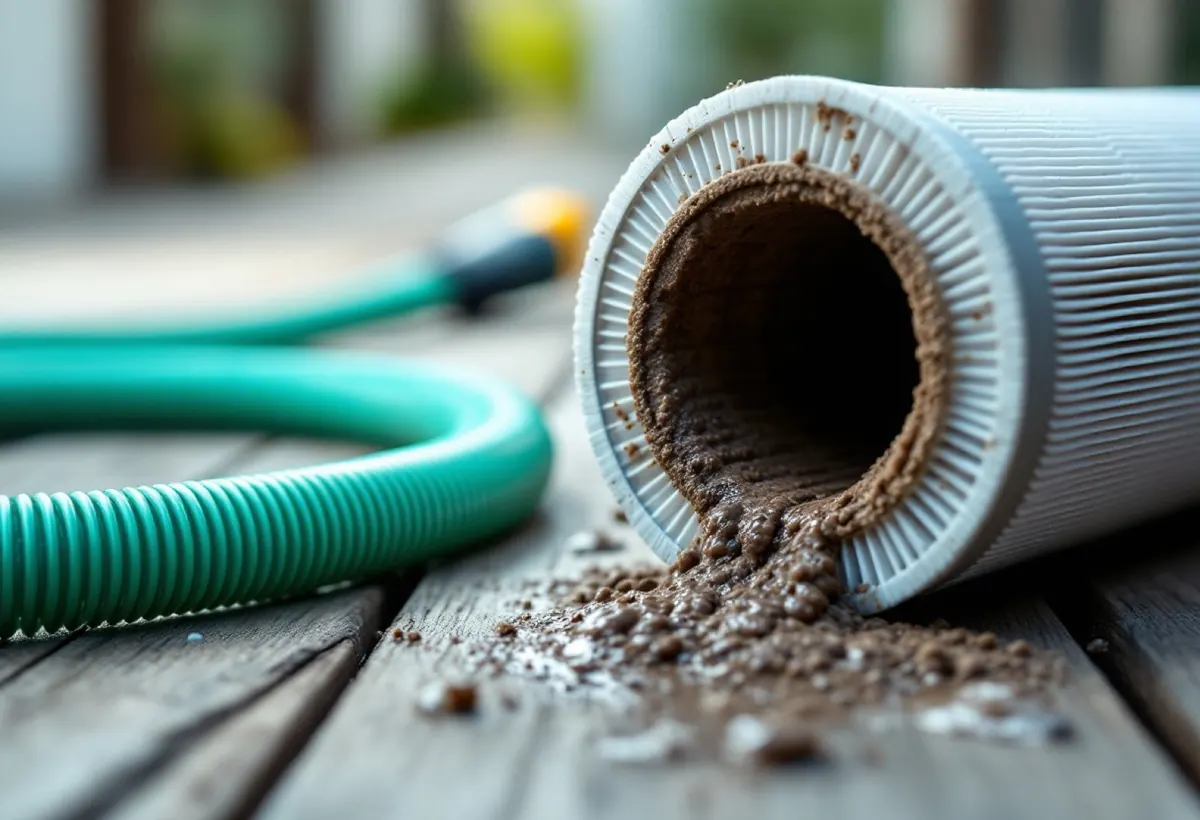
Jacuzzi's cleaning guide tells owners to rinse filters weekly with a hose, deep clean them monthly by soaking in filter cleaner for 15 to 30 minutes, and replace them every 12 to 18 months or when cleaning no longer restores flow. The same maker’s drain guide says to replace filters more than 1 to 2 years old and to soak overnight or for several hours, so even one maker publishes two different numbers.
The biofilm data supports the shorter end. The filter carried 6.6 log10 cells per square centimetre in the untreated Montana State model, the highest surface density measured, and the CDC toolkit asks operators to clean and service filters on every drain and to keep water moving across the filter 24 hours a day. A cartridge with slime deep in the pleats after a soak has used up its cleaning cycles.
How do you remove mold from a hot tub cover, and when is the foam core lost?
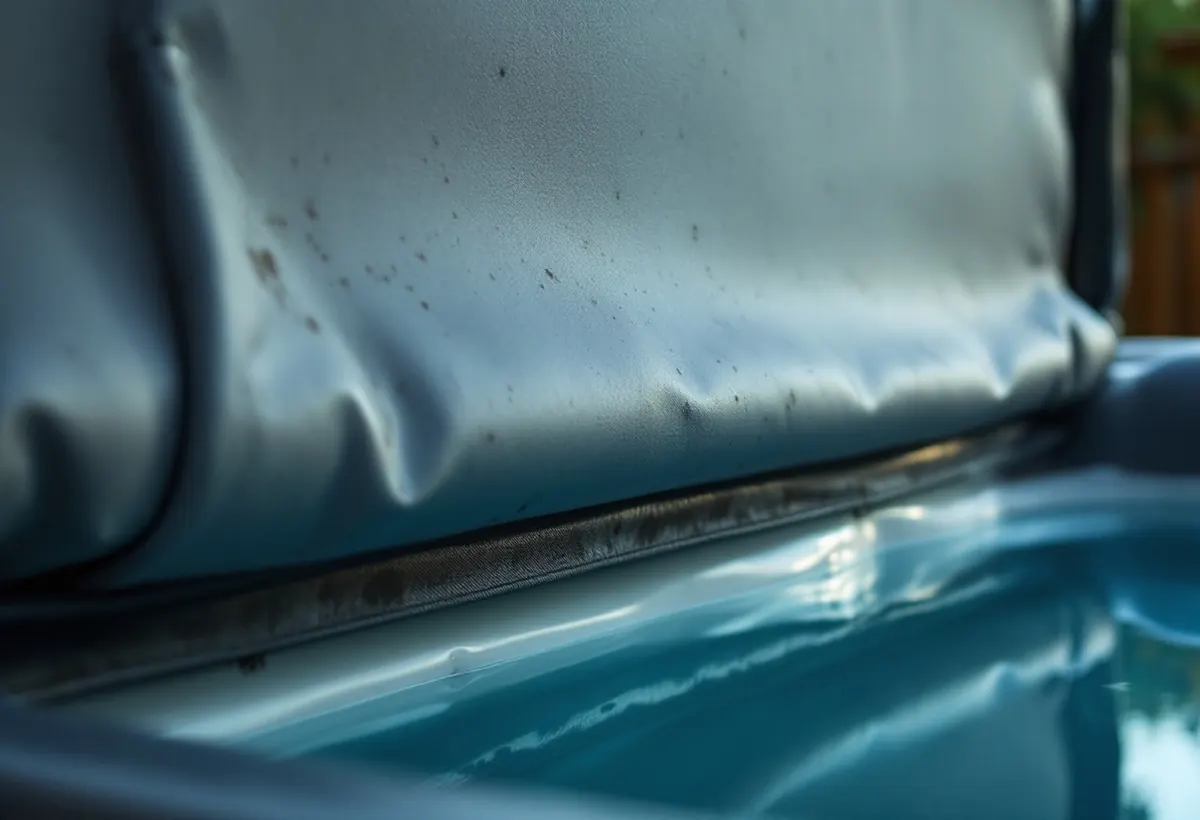
Jacuzzi's drain guide says to wash the underside of the cover with a mild cleaner to remove mildew or film during a drain, and according to Jacuzzi's cleaning guide a diluted bleach solution of no more than 10% bleach may be used for stubborn mold or mildew, with extreme caution. Rinse it off before the cover goes back over the water, and check the maker’s cover warranty terms on bleach first.
Mildew that returns within weeks is a sign the inside is wet. Hot Spring Spas explain that water which permeates the vapor barrier soaks the foam core, which then becomes a breeding ground for mold. Cleaning the vinyl skin cannot reach a wet core, so a torn vapor barrier on a cover that keeps growing mildew is the question to put to the cover maker or dealer: patch, or replace.
Chemical timing matters too. Bullfrog Spas' drain and refill instructions tell owners to keep the cover open at least 30 minutes after shocking, and to winterize the tub if it will sit unused for 6 weeks or longer rather than leave water standing under a closed lid.
Is there mold under the hot tub? Checking the cabinet and floor after a leak
If water is pooling inside the cabinet, the framing and the deck or slab under the tub are wet building materials, and the household rules apply. EPA's A Brief Guide to Mold, Moisture and Your Home says water damaged materials should be dried within 24 to 48 hours to prevent mold growth, that hard surfaces can be scrubbed with detergent and water, and that porous materials may have to be thrown away. It sets about 10 square feet as the size a homeowner can usually clean alone.
Turn the power off at the breaker before opening the cabinet on a wet floor; a hot tub combines water and line voltage, and repairs to its wiring or controls are an electrician’s work. Cleanup of the framing is covered on our page about mold on wood. Where the tub sits indoors, the room humidity target in EPA’s brief guide, below 60% and ideally 30 to 50%, also applies.
Two related cases follow the same water logic. Whether an acrylic shell, PVC pipe or vinyl pillow feeds mold itself is rated by the ASTM G21 test, explained on our page asking whether mold can grow on plastic. A humidifier tank is the household appliance closest to a hot tub, with maker cleaning steps on our humidifier mold page.
Questions people actually ask
What kills mold in a hot tub?
Sanitizer kept in range plus a plumbing flush. CDC’s hot tub toolkit sets free chlorine at 3 to 10 ppm or bromine at 4 to 8 ppm, and has operators scrub surfaces at 5 ppm free chlorine on each drain. A line flush product run through the jets before draining, as Jacuzzi’s drain guide advises, reaches the biofilm in the pipes that a shell scrub misses.
Can I shock the hot tub instead of draining it?
Shocking helps but does not reset the system. In the 1988 Georgia State whirlpool study, superchlorination markedly reduced bacteria in the water, yet the populations rapidly returned once chlorine fell below 3.0 ppm, fed by biofilm in the filter and piping. Shock when the water is cloudy, then drain on the CDC formula or the maker’s 3 to 4 month calendar.
Can I clean a hot tub with household bleach or vinegar?
Not as the main cleaner, according to Jacuzzi’s cleaning guide, which says never to use household bleach or vinegar as primary cleaning agents and to avoid abrasive pads on acrylic. The same guide, according to its text, allows a solution of no more than 10% bleach for stubborn mildew on the cover. Bullfrog lists mild diluted dish soap for a dry shell.
How long should the cover stay off after shocking a hot tub?
At least 30 minutes, according to Bullfrog Spas’ drain and refill instructions, which also tell owners to treat spa pillows with a non petroleum protectant about once a month. Wipe the underside at every water change, as Jacuzzi’s drain guide advises, and check that the vapor barrier around the foam has no tears.
How do you remove mould stains from an inflatable hot tub?
Drain it fully first, because the stain is usually biofilm fed by the water rather than the PVC. EPA’s brief guide says hard, non porous surfaces can be scrubbed with detergent and water and dried completely, and Jacuzzi warns against abrasive materials on spa surfaces. Check the inflatable maker’s manual for approved cleaners, then refill and hold chlorine at 3 to 10 ppm.
Sources
- CDC's Legionella control toolkit for hot tubs: Controlling Legionella in Hot Tubs, US Centers for Disease Control and Prevention, last updated 3 January 2025, citing ASHRAE Guideline 12 and the 2018 Model Aquatic Health Code. Retrieved 21 November 2026.
- CDC's hot tub rash page: Preventing Hot Tub Rash, Healthy Swimming, CDC, dated 30 May 2025. Retrieved 21 November 2026.
- CDC's hot tub user page: About Protecting Yourself from Legionella in Hot Tubs, Healthy Swimming, CDC, dated 28 May 2025. Retrieved 21 November 2026.
- Price and Ahearn of Georgia State University (Journal of Clinical Microbiology, 1988): D. Price and D. G. Ahearn, Incidence and persistence of Pseudomonas aeruginosa in whirlpools, Journal of Clinical Microbiology 26(9):1650 to 1654, September 1988. Retrieved 21 November 2026.
- Goeres and colleagues at Montana State University's Center for Biofilm Engineering (2007): D. M. Goeres, L. R. Loetterle and M. A. Hamilton, A laboratory hot tub model for disinfectant efficacy evaluation, Journal of Microbiological Methods 68(1):184 to 192, January 2007. Retrieved 21 November 2026.
- Jacuzzi's drain guide: How to Drain a Spa, Jacuzzi Inc. (Canada). Retrieved 21 November 2026.
- Jacuzzi's cleaning guide: How to Clean a Hot Tub, Jacuzzi Inc. (Canada). Retrieved 21 November 2026.
- Bullfrog Spas' drain and refill instructions: Draining, Cleaning, and Refilling your Bullfrog Spa, Bullfrog Spas, 8 August 2023. Retrieved 21 November 2026.
- Hot Spring Spas: How to Get Rid of Algae, Mold, and Mildew in Your Hot Tub, Hot Spring Spas blog. Retrieved 21 November 2026.
- EPA's A Brief Guide to Mold, Moisture and Your Home, US Environmental Protection Agency, last updated 18 February 2026. Retrieved 21 November 2026.
- How this page was built is described in our methodology, and more mold pages are on the mold hub.
CDC toolkit ranges are written for public hot tubs; a residential tub’s manual sets the ranges its warranty assumes. When the two differ, ask the maker or dealer which pH and sanitizer range the shell, heater and cover warranty require, and which flush products are approved for the plumbing.