The short answer
Mold on grout usually scrubs off, but whether it returns depends on the grout. Cement grout is porous: according to maker data sheets, ANSI A118.6 grout absorbs under 10% water and A118.7 grout under 5%, so growth lodges in the pores, while one epoxy reports 0% by ASTM C413. Scrub with detergent and water, dry the joint, and regrout when dark stains survive cleaning.
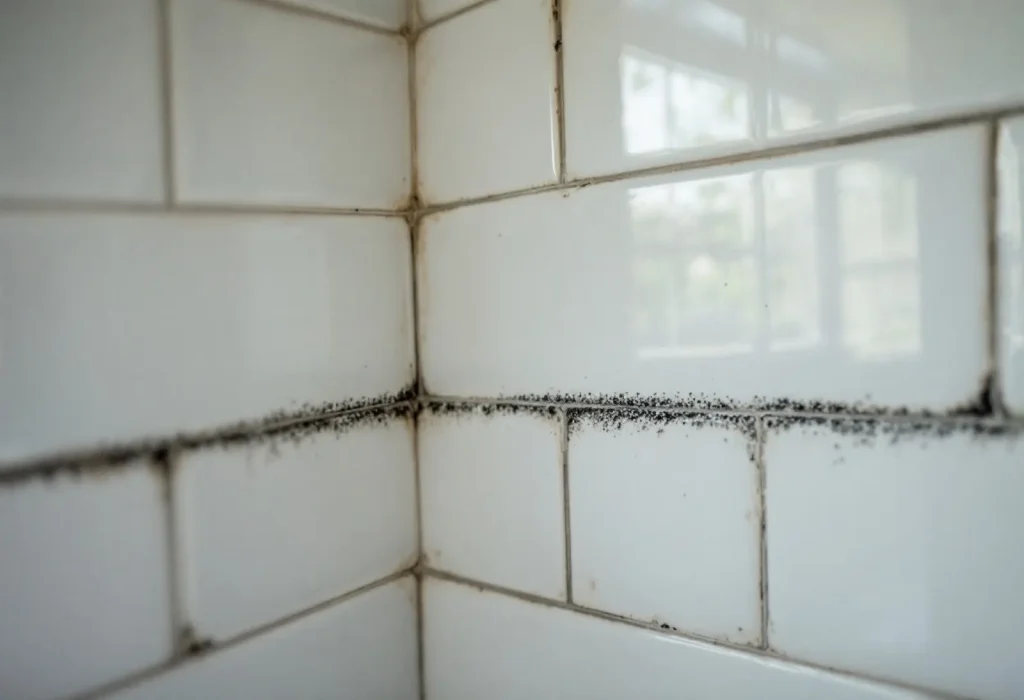
Is the dark line live mold in the grout or a stain left in the pores?
Both look alike, and the CDC's mold basics page says you do not need to know the type of mold to clean it up. What matters for grout is depth. The LATICRETE's tile and grout care page describes the joint between tiles as usually very porous and cement based, while the glazed tile beside it is impervious or highly resistant to staining. So the tile wipes clean and the 1/8 inch line beside it stays grey.
The EPA's homeowner mold guide explains the rest: mold can grow on or fill in the empty spaces and crevices of porous materials, so it may be difficult or impossible to remove completely. A film that lifts under a nylon brush and detergent was sitting on the surface. A shadow that returns within weeks after a full scrub and a full dry is growing back from the pores, and a uniform grey that never changes after cleaning is more likely a set stain in the cement.
Three look-alikes need a different page. A pink or orange slime on grout near the drain is covered on our pink mold page. Black growth in the bead where the wall meets the tub is in the sealant, not the grout: the Custom Building Products Polyblend Plus data sheet and Custom Building Products Fusion Pro data sheet both say grout is not for changes of plane, which get silicone or caulk, so that bead is cut out and replaced rather than cleaned. Dark lines that spread outward from one joint with loose or hollow tiles can mean water behind the tile, covered on our water behind tile page.
Which grout is it: cement (ANSI A118.6 or A118.7), premixed or epoxy (A118.3)?
Grout is sold to an American National Standards Institute (ANSI) specification, and the specification sets how much water the cured joint may soak up. A standard A118.6 sanded grout absorbs under 10% water, according to the SikaTile 800 Sanded Grout data sheet. The Custom Building Products Polyblend Plus data sheet prints the A118.7 requirement as under 5% at 28 days, and the LATICRETE PERMACOLOR Grout data sheet reports 3.25% for its A118.7 grout. Epoxy sits at the far end: 0% by ASTM C413 against a limit of under 1%, per the Custom Building Products CEG IG data sheet.
If the original bag or pail is in the garage, the maker and the ANSI number on it settle the question. Premixed single component grouts sit between the two: the Fusion Pro sheet says it meets many of the performance characteristics of ANSI A118.7 and A118.3, and LATICRETE says SPECTRALOCK 1 meets specific A118.3 tests without epoxy resins. Both makers say those grouts never need sealing.
| Grout type | Standard | Water absorption as published | Routine cleaner per maker | Sealer | Source |
|---|---|---|---|---|---|
| Standard sanded cement | ANSI A118.6 | Under 10% (A118.6 section 4.4), SikaTile 800 | Neutral pH cleaner, clean water rinse; acid cleaning not recommended | Optional penetrating sealer | SikaTile 800 Sanded Grout data sheet |
| High performance cement | ANSI A118.7 | Under 5% at 28 days (A118.7 section 3.4), Polyblend Plus; 3.25% at 28 days, PERMACOLOR | Neutral pH cleaner; LATICRETE: no acid on colored joints | Optional; LATICRETE waits 48 hours first | Custom Building Products Polyblend Plus data sheet; LATICRETE PERMACOLOR Grout data sheet |
| Premixed single component | No own standard; meets many A118.7 and A118.3 traits (Fusion Pro), specific A118.3 tests (SPECTRALOCK 1) | No absorption figure printed | Neutral cleaner; no high pressure cleaning; no solvent sealers | Never needs sealing, per both makers | Custom Building Products Fusion Pro data sheet; LATICRETE SPECTRALOCK 1 data sheet |
| 100% solids epoxy | ANSI A118.3 | % by ASTM C413 (limit under 1%), CEG IG; 0.032 g after 240 minutes (ISO 13007-4), SPECTRALOCK PRO | Neutral pH cleaner after 3 days of cure; SPECTRALOCK PRO: no acids for 7 days, no steam cleaning regimens | No sealer required | Custom Building Products CEG IG data sheet; LATICRETE SPECTRALOCK PRO Premium data sheet; SikaTile 825 Epoxy Grout data sheet |
LATICRETE builds antimicrobial protection into PERMACOLOR, yet the LATICRETE PERMACOLOR Grout data sheet adds a footnote asking for a regular cleaning regimen so organic material that collects on the grout surface is removed. An antimicrobial grout still grows a film on soap residue if the residue stays.
Where does mold sit in a cement joint, and what does a sealer change?
A cement joint has three zones that matter for mold: a surface film of soap and skin residue, a sealed top layer if the grout was ever sealed, and the open pore structure below it. The film is food and water; the pores hold moisture after the shower stops. The drawing below is drawn from the LATICRETE's tile and grout care page and the absorption figures in the data sheets.
A penetrating sealer fills the top of the joint. The Aqua Mix Sealer's Choice Gold PFAS Free data sheet describes it as stain protection for porous grout lasting up to 10 years under routine wear, needing grout at least 48 hours old and 24 hours of dry time after application. The sheet makes no mold claim, and it says the sealer will not prevent etching from acids or caustic chemicals. LATICRETE asks for 48 hours before sealing PERMACOLOR and 72 hours for PERMACOLOR Select, per the LATICRETE PERMACOLOR Select data sheet.
Why does a 1 inch mosaic floor grow more mold than 12 inch tile?
Because it is mostly joint. With 1/8 inch joints, our calculation puts 21% of a 1 inch mosaic surface in grout, against 2.1% for 12 inch tile, about 1 times as much porous area per the formula under the table. Each square foot of mosaic carries 21.3 feet of grout line to scrub, against 2 feet for 12 inch tile.
| Tile, 1/8 inch joints | Share of the surface that is grout | Grout line per square foot |
|---|---|---|
| 1 inch mosaic | 21% | 21.3 ft |
| 2 inch square | 11.4% | 11.3 ft |
| 4 inch square | 6% | 5.8 ft |
| 6 inch square | 4% | 3.9 ft |
| 12 inch square | 2.1% | 2 ft |
Shower floors are where that matters most, since they hold water longest. The whole shower, from the curtain to the ceiling, is covered on our mold in shower page; on the floor itself, the joint count is the reason a regrout in epoxy (0% absorption by ASTM C413, per the CEG IG sheet) changes more than a regrout in the same cement grout.
Bleach, vinegar or acid: which cleaner each grout type tolerates
Start where the agencies start. The EPA's mold cleanup page says to scrub mold off hard surfaces with detergent and water and dry completely, and the CDC's mold basics page allows household products, soap and water, or a bleach solution of no more than 1 cup of laundry bleach per gallon of water. Both say never to mix bleach with ammonia or other cleaners, because the mix gives off toxic gas.
Cement grout: neutral pH routinely, bleach rarely, no acid
MAPEI's grout bleach FAQ says grout should withstand occasional diluted bleach, puts 1 cup per gallon as usually sufficient, and warns that regular use can discolor and weaken grout over time; test a hidden joint first. The dilution and contact time are set out on our bleach to water ratio page, and why bleach whitens a stain without reaching into pores is on does bleach kill mold.
Acid is the bigger risk to cement. The LATICRETE's tile and grout care page lists vinegar among acids that will most likely etch grout, and tells owners of sealed grout to avoid acidic or alkaline cleaners, bleach, abrasives and ammoniated cleaners. LATICRETE’s LATICRETE PERMACOLOR Grout data sheet says not to use acid on colored joints, and the SikaTile 800 Sanded Grout data sheet says cleaning with acid is not recommended. Why vinegar is a weak mold treatment anyway is on our does vinegar kill mold page.
Epoxy and premixed grout: neutral cleaner, and patience after install
The SikaTile 825 Epoxy Grout data sheet asks for 3 days of cure before regular cleaning with a neutral pH cleaner. The LATICRETE SPECTRALOCK PRO Premium data sheet says maximum stain protection takes 7 days at 70 °F, warns against acids during that period, and rules out aggressive regimens such as steam cleaning. The Custom Building Products Fusion Pro data sheet rules out high pressure cleaning and solvent based sealers. Once cured, CEG IG is sold for resistance to organic and inorganic acids, per its data sheet.
How do you clean mold off cement grout without fading the color?
The steps below follow EPA, CDC and the grout makers’ sheets. EPA’s threshold for a job you can usually handle yourself is under about 10 square feet of growth, roughly 3 by 3 feet, per the EPA's mold cleanup page; a whole shower floor of mosaic is usually well under that, a moldy wall cavity behind it is not.
- Run the bathroom fan or open the window, as the EPA's homeowner mold guide advises, and wear gloves; EPA names natural rubber, neoprene, nitrile, polyurethane or PVC gloves when bleach is in use.
- Scrub the joints with a nylon brush and detergent in warm water. Work along each joint line.
- Rinse with clean water and wipe the tile dry; the Sika and Custom sheets both pair a neutral pH cleaner with a clean water rinse.
- If shadows remain on white or light grout, test diluted bleach (no more than 1 cup per gallon, per CDC) on one hidden joint first, as MAPEI advises. Skip it on colored grout, where MAPEI warns of discoloring.
- Let the joint dry fully. If you want to seal cement grout, wait the 48 to 72 hours LATICRETE names, then keep the sealer dry for 24 hours per the Aqua Mix sheet.
EPA says it is not enough to kill mold; it must also be removed, which is why the residue is scrubbed and rinsed rather than only sprayed. Health effects are outside this page; the CDC mold pages cover them. More cleaning guides sit on the mold hub.
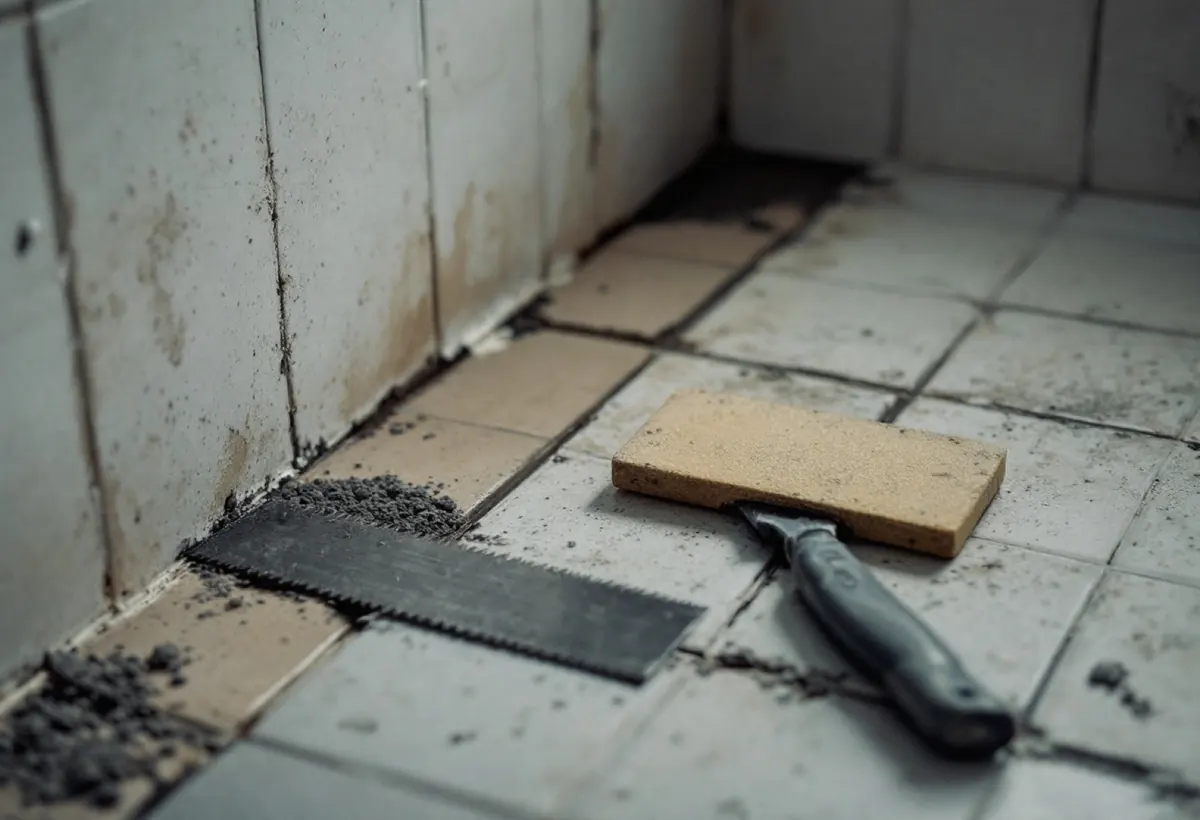
When does moldy grout have to come out, and how deep?
Regrouting is the fix when dark shadows return after repeated full cleanings and dry spells, when the joint is cracked or sandy, or when the grout is a standard cement product in a mosaic shower floor that never dries. The LATICRETE SPECTRALOCK PRO Premium data sheet lists re-grouting among its uses and says the grout never needs sealing, which is the case for moving a wet floor from cement to epoxy.
Depth is the part guides online skip. The SikaTile 800 Sanded Grout data sheet and SikaTile 825 Epoxy Grout data sheet both tell installers to clear the joint so that 2/3 of the tile depth is left available for grouting. Applied to a regrout as our calculation: a 3/8 inch tile needs about 0.25 inch of open joint, and a 5/16 inch wall tile about 0.21 inch. Skimming a thin new layer over old moldy cement leaves the pores below it in place.
Cut with a hand grout saw or an oscillating tool and stop above the thinset. LATICRETE’s sheets note that grout is not a replacement for a waterproofing membrane; in a shower that membrane sits behind or under the tile and is not something to cut into. Ask the grout maker’s technical line which grout suits the joint width you have: Polyblend Plus is printed for 1/8 to 1/2 inch joints and Fusion Pro for 1/16 to 1/2 inch.
How long before you can shower on new grout: 2 days or 10?
Epoxy wins on absorption and loses on patience. According to the maker sheets retrieved for this page, they put a cement grout shower back in use after 24 to 48 hours (SikaTile 800) or a minimum of 48 hours (PERMACOLOR), the premixed Fusion Pro after 7 days at 70 °F and 50% relative humidity, and SikaTile 825 epoxy after 10 days. Steam showers wait 14 days on both the Sika cement sheet and PERMACOLOR.
Lower temperature and higher humidity slow those times, per the Fusion Pro sheet, so a bathroom below its printed 70 °F runs longer.
What keeps mold off grout: humidity under 50 to 60 percent and a dry joint
Moisture control is the only lasting fix. The EPA's homeowner mold guide says to keep indoor humidity below 60% relative humidity, ideally between 30 and 50%, to run the bathroom fan or open a window when showering, and to dry wet areas within 24 to 48 hours. The CDC's mold basics page reports a line of no higher than 50% all day and asks for exhaust fans that vent outside the home.
For the grout itself: keep a neutral pH cleaner as the routine product, as every maker sheet above asks; reseal cement grout when water stops beading, inside the up to 10 years Aqua Mix claims; and recaulk changes of plane when the silicone bead darkens, since that bead is not grout. Why mold returns after a cleaning that looked complete is the subject of our mold in bathroom page.
Questions people actually ask
What is the black stuff on my shower grout?
Usually a mix of mold growth and soap residue sitting in and on porous cement grout. The CDC says you do not need to identify the mold type to clean it. If a nylon brush with detergent lifts it, it was surface film; if it returns within weeks after a full dry, growth is in the pores of a grout that, per the Sika A118.6 sheet, can absorb up to 10% water.
Can you get mold off of grout?
Off the surface, yes. EPA says to scrub mold off hard surfaces with detergent and water and dry completely. Cement grout is porous, and EPA notes mold can fill crevices of porous materials, so deep staining may stay. Diluted bleach at no more than 1 cup per gallon, per CDC, can whiten white grout; MAPEI warns repeated use discolors and weakens it.
Does white mold on grout look different from efflorescence?
They can look alike. EPA notes molds come in many colors, white included, and shows white mold beside black. Custom Building Products lists better resistance to efflorescence on Polyblend Plus and no efflorescence on Fusion Pro, treating it as a known cement grout issue that is not growth. Fuzzy growth that returns within weeks of a detergent scrub points to mold rather than mineral.
Can I grout over old moldy grout?
Not as a fix. Sika’s grout data sheets ask for 2/3 of the tile depth to be open for new grout, which on a 3/8 inch tile works out to about 1/4 inch by our calculation. A thin cap over moldy cement leaves the pores below in place. Rake out the old joint to that depth first.
Does grout sealer stop mold?
Not by itself. The Aqua Mix Sealer’s Choice Gold sheet claims stain protection for up to 10 years and makes no mold claim. Sealer is sold to keep stains out of the top of a cement joint; mold still grows on residue left on the surface, which is why LATICRETE asks for regular cleaning even on its antimicrobial PERMACOLOR grout.
Out of scope: health effects of mold exposure. For those, see the CDC and EPA mold pages listed below; this page covers the grout joint and how to clean, seal or replace it.
Sources
- SikaTile 800 Sanded Grout data sheet, Sika USA: water absorption under 10% (ANSI A118.6 section 4.4), 2/3 tile depth for grouting, acid cleaning not recommended, shower and steam shower waits. Retrieved 20 November 2026.
- SikaTile 825 Epoxy Grout data sheet, Sika USA: no sealer required, 3 day cure before regular cleaning, 10 day residential shower wait. Retrieved 20 November 2026.
- Custom Building Products Polyblend Plus data sheet, Custom Building Products: ANSI A118.7 section 3.4 water absorption under 5% at 28 days, joint widths, caulk at changes of plane, neutral pH maintenance. Retrieved 20 November 2026.
- LATICRETE PERMACOLOR Grout data sheet (DS-250), LATICRETE International: 3.25% water absorption at 28 days, no acid on colored joints, 48 hour shower and sealing waits, antimicrobial footnote. Retrieved 20 November 2026.
- LATICRETE PERMACOLOR Select data sheet (DS-116), LATICRETE International: 72 hour wait before sealing. Retrieved 20 November 2026.
- Custom Building Products Fusion Pro data sheet (TDS-242), Custom Building Products: never needs sealing, 7 day wait before shower exposure, cleaning limits. Retrieved 20 November 2026.
- LATICRETE SPECTRALOCK 1 data sheet, LATICRETE International: premixed grout meeting specific ANSI A118.3 tests without epoxy resins. Retrieved 20 November 2026.
- LATICRETE SPECTRALOCK PRO Premium data sheet, LATICRETE International: ISO 13007-4 water absorption, re-grouting use, 7 day stain protection, steam cleaning limit. Retrieved 20 November 2026.
- Custom Building Products CEG IG data sheet, Custom Building Products: ASTM C413 absorption 0% against under 1%, acid resistance. Retrieved 20 November 2026.
- Aqua Mix Sealer's Choice Gold PFAS Free data sheet, Custom Building Products: up to 10 years, 48 hour grout age, 24 hour dry time, no protection from acid etching. Retrieved 20 November 2026.
- MAPEI's grout bleach FAQ, MAPEI: occasional diluted bleach, 1 cup per gallon, regular use discolors and weakens grout. Retrieved 20 November 2026.
- LATICRETE's tile and grout care page, LATICRETE International: cement grout joints usually very porous; vinegar and other acids etch grout. Retrieved 20 November 2026.
- EPA's mold cleanup page and EPA's homeowner mold guide, United States Environmental Protection Agency: detergent and water, 10 square feet, humidity targets, 24 to 48 hour drying, gloves, bleach and ammonia warning. Retrieved 20 November 2026.
- CDC's mold basics page, CDC: bleach no more than 1 cup per gallon, humidity no higher than 50%. Retrieved 20 November 2026.
- Grout area shares, grout line per square foot and 2/3 joint depths are arithmetic on the figures above, computed when this page was built. Our methodology sets out the standing rules.
Grout formulas and data sheets are revised. Confirm the current sheet, cleaner compatibility and cure time for the exact product with its maker’s technical services line before cleaning, sealing or regrouting.