The short answer
How to tell if water damage is old or new: separate signs that need time to form from signs that only prove water is present today. Soft drywall and a high meter reading show current wetness. Mold means wetness outlasted EPA’s 24 to 48 hour drying window, wood rot needs moisture above about 30% per the USDA Forest Products Laboratory, and stacked rings count repeated wettings.
No published test dates a leak to the day. What the sources do give is a set of thresholds: a drying window from EPA, moisture levels for wood decay from the USDA Forest Products Laboratory Wood Handbook, chapter 14, a one year line for masonry salts from the Brick Industry Association Technical Note 23A, and a 14 day line that some insurance policies draw. The matrix below ties each visible sign to the one threshold that applies to it, and names the sign when no threshold exists.
Which signs point to old water damage, and which only prove it is wet today?
Of the 10 signs below, 4 (a single wet patch, colour, soft gypsum and a raw meter number) say almost nothing about age on their own. The other 6 carry real information, and only 3 of them, mold, rot and efflorescence, come with a threshold printed by a named source.
| Sign | What it suggests | What it cannot tell you | Test that confirms it | Clock from a source |
|---|---|---|---|---|
| Dark patch, no ring, wet to the touch | Water is present now | How long it has been there | Meter reading beside a dry reference of the same material | No clock. A reading needs a dry standard to mean anything (Insurance Journal) |
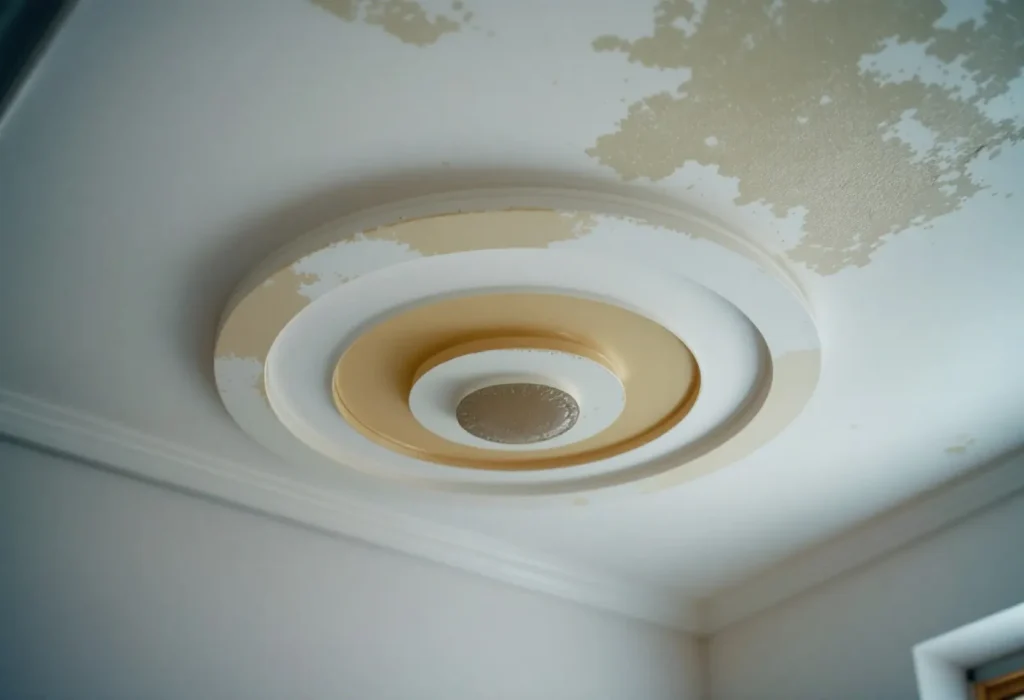
| One tan ring around a dry centre | At least one wet and dry cycle has finished | When that cycle happened | Meter on the ring and on the centre: dry ring, dry centre means history | Ring forms as the edge evaporates (Deegan and colleagues in Nature (1997)); no time scale for building materials |
| Several nested rings, different shades | Repeated wetting from one source | Elapsed time: the rings count events, not weeks | Note whether a new ring appears after rain or after an appliance runs | No published clock |
| Stain colour: yellow, tan, brown | What the water carried and left at the edge | Age | Trace the stain uphill to the source | No published clock |
| Soft or crumbling drywall | Gypsum is wet now or was soaked | Age: strength drops as soon as gypsum is wetted | Press test plus a meter reading on the gypsum scale | Wetting cuts bending strength 70 to 80% (Insurance Journal, citing Ranachowski 2020) |
| Visible mold growth | Wetness lasted past the drying window | Whether the water was a leak or humid air | Look for a liquid path; compare indoor humidity with EPA’s 60% ceiling | Dried within 24 to 48 hours, in most cases mold will not grow (EPA) |
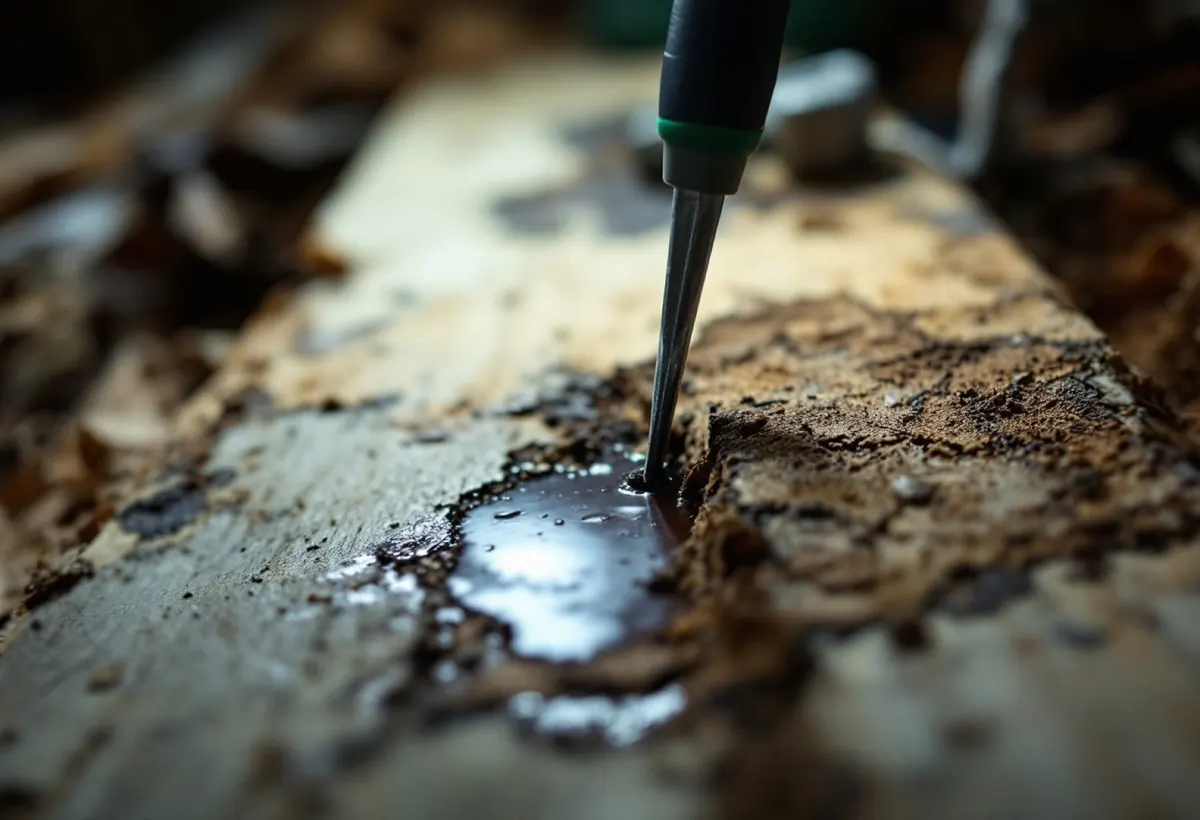
| Brown, cube checked, or bleached and spongy wood | Long or repeated wetting above fiber saturation | Days or months: decay speed swings with temperature | Probe the wood; read moisture content in percent | Serious decay only above 30% moisture content (Wood Handbook) |
| Black stain in oak around nails | Iron reacting with wood tannins while damp | Age | Oxalic acid lightens it; it returns if the iron stays | Iron stain mechanism per the Wood Handbook; no clock |
| Rust on screw heads, nails or corner bead | Metal stayed damp long enough to corrode | Leak versus condensation | Check whether rust bleeds through the paint film | No clock; NJM HO-3 lists rust and corrosion as a separate exclusion |
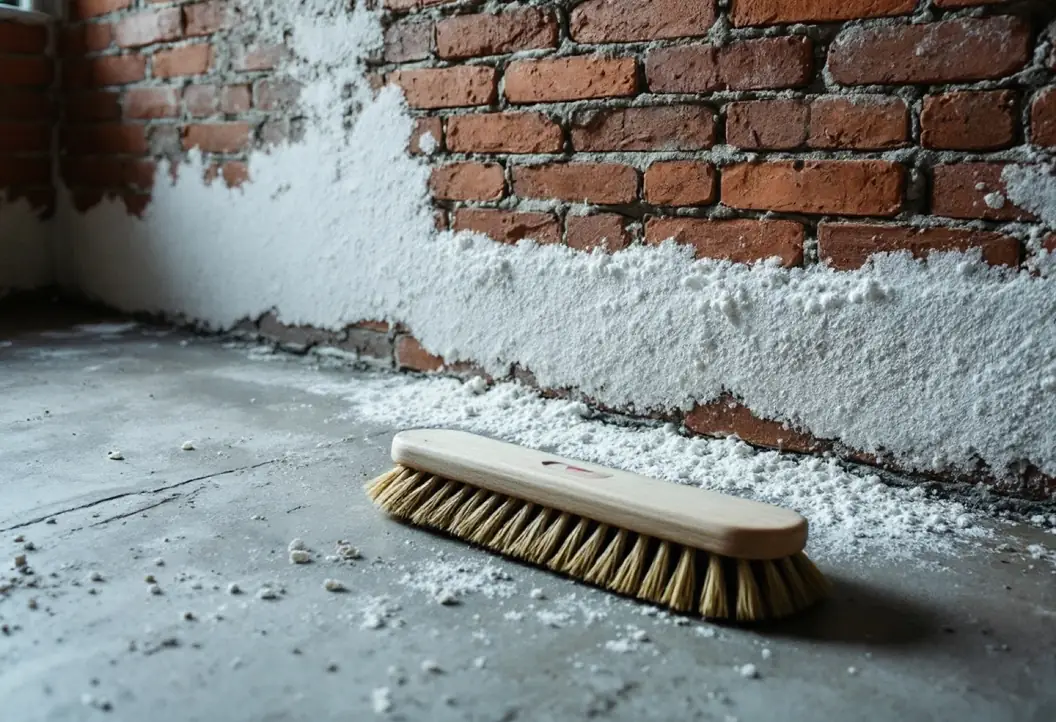
| White powder on brick, block or concrete | Water carried salts through the masonry and evaporated | One event versus an ongoing leak | Brush it off dry and watch for return after rain | More than 1 year after construction points to water penetration or poor drainage (BIA Technical Note 23A) |
Do more rings on a ceiling stain mean the leak is older?
Not by themselves. A ring forms where a wet area stops spreading and dries from its edge. Physicists Robert Deegan, Sidney Nagel and colleagues showed why, in a paper in Nature volume 389 (1997): the edge of a drying drop stays pinned, liquid evaporating there is replaced from the interior, and that outward flow can carry virtually all the dispersed material to the perimeter. That is the darker tan line around a pale centre on drywall or plaster.
Each ring therefore marks one completed wet and dry cycle, which is evidence of repetition, not of calendar time. Three rings can come from three storms in one week or three over 3 years. A common rule of thumb says more rings mean older damage; the mechanism in the Nature paper supports a narrower reading: more rings mean more events, and the outermost ring is the oldest edge. The ceiling version of this evidence, including where stains first appear, is covered in the guide to early signs of water damage on a ceiling.
A single dark patch with no ring is the reverse case: the edge has not dried yet, so water is either still arriving or arrived within the last day or two. Confirm with a meter before assuming either, because Insurance Journal notes that pinless meters read joists, truss plates, wiring and foil backing up to about an inch into a ceiling.
Can a moisture meter reading show how old water damage is?
A meter shows how wet a material is now, compared with a dry reference, and nothing about when it got wet. The IICRC S500 standard, as quoted by R&R Magazine, defines the dry standard as a reasonable approximation of a material’s moisture before the water intrusion. The engineers writing in the Insurance Journal guide for adjusters (2 November 2026) cite the same standard: a high reading means nothing until it is compared with that dry standard.
The gap between wet and dry can be large. Per the Insurance Journal piece, sound gypsum board sits at about 0.3% moisture at 50% relative humidity, intact board in humid unconditioned spaces stays under 1.0%, and a 40% reading is roughly 100 times baseline and means free water. A reading that matches the dry reference in the same room says the event, whatever its age, is over.
Two readings answer more than one. A wet reading at the centre of a ring with a dry reading at the ring itself says the area has been rewetted inside an older footprint. The same Insurance Journal article warns that relative scales are not percent moisture by weight and that wood mode on gypsum gives false highs. Meter types and scales are compared in our guide to moisture meters for water damage.
How long before mold, rot and salt deposits show up after a leak?
Three of the signs in the matrix have a published threshold. EPA's brief guide to mold and moisture says that if wet materials are dried within 24 to 48 hours after a leak, in most cases mold will not grow, so visible growth means wetness outlasted that window, either once or repeatedly. The timing in detail is set out in how long it takes for mold to grow after water damage.
Wood rot is gated by moisture, not by days. According to the USDA Forest Products Laboratory Wood Handbook, chapter 14, serious decay occurs only when wood moisture content is above the fiber saturation point, averaging 30%, and that air dried wood at 20% or less has a reasonable margin of safety. Water vapour in humid air alone will not wet wood enough for decay, though it permits some mold. Rot therefore means liquid water reached the wood: a leak, condensation or ground contact.
Temperature changes the speed, which is why rot cannot be turned into a day count. Per the Wood Handbook, most decay fungi grow best at 77 F, decay is relatively slow below 50 F and above 95 F, and it essentially ceases at 35 F or 100 F. A winter leak into an unheated crawl space and a summer leak inside a warm wall can produce very different damage over the same weeks.
Visible rot is also an old and serious sign. The Wood Handbook reports toughness losses of 6% to more than 50% by the time 1% of the wood’s weight is lost, and at 10% weight loss decay is detectable only under a microscope. Its conclusion: wood with decay you can see has been greatly reduced in all strength values, so do not stand on or load a rotted joist or subfloor while judging it.
Brown cubes, bleached wood or black rings: what do wood stains say about age?
The Wood Handbook separates two main decay types. Brown rot removes cellulose, turns wood browner and cracks it across the grain into cube shaped pieces; white rot can leave wood bleached and spongy while it keeps its shape. Per the Handbook, both need moisture above 30%, so either one on a floor joist or sill plate points to wetting that was long or repeated.
The Handbook also calls the term dry rot incorrect: wood must have available moisture for decay, although it may become dry later. A dry, crumbly joist today can be an old event that has stopped; per the same Handbook, decay will not progress in wood kept air dry at 20% or less. A meter reading on the rotted piece separates an old, stopped problem from an active one.
Black stains on oak flooring around nails are often iron stain, which the USDA Wood Handbook describes as iron reacting with tannins in the wood. Oxalic acid removes it, but it returns unless the iron source is removed. It needs moisture to form but says nothing about how long ago. Cleaning methods for these marks are in water stains on wood.
What does white powder on basement brick or concrete say about the timeline?
White crystal deposits on masonry are usually efflorescence. The Brick Industry Association Technical Note 23A (June 2019) explains the mechanism: water containing dissolved salts is brought to the surface, the water evaporates and the salts stay behind. It requires salts, a source of water in contact with them long enough to dissolve them, and a pore path to the surface.
The same note gives the only age line on this page tied to the building itself. Efflorescence on brickwork less than 1 year old is called new building bloom and is attributed to normal drying after construction. When it appears more than 1 year after construction, BIA says it can generally be attributed to excessive water penetration or poor drainage, and it is often worst in winter. Brushing the deposit off dry and watching whether it returns after the next rain tells an ongoing source from a past one.
Where the water comes from outside, the trade sites own the repair: roof leaks at The Roofing Brief and supply lines at The Plumbing Brief.
Why does a 14 day line in some homeowners policies make the age of a leak matter?
Some property policies exclude damage from water that leaks over a period of time. The Florida policy in Hicks v. American Integrity Insurance Co. of Florida, No. 5D17-1282 (Fla. 5th DCA, opinion filed 23 February 2018) excluded loss caused by constant or repeated seepage or leakage of water over a period of 14 or more days. The NJM New Jersey HO-3 (03/18) uses different words: seepage or leakage over a period of weeks, months or years, unless it is unknown to all insureds and hidden within walls, ceilings or floors.
In Hicks, a refrigerator supply line leaked while the owner was away and was discharging almost one thousand gallons a day by 25 October 2012. The insurer’s expert put the leak at 5 weeks or more and the claim was denied. The court held that the 14 day wording does not unambiguously exclude losses from the first 13 days, and that the insurer carries the burden of proving which loss happened after the thirteenth day. The owner’s forensic contractor had priced the first 13 days at $40,926.77, per the opinion.
That ruling binds one Florida appellate district and one policy wording; it does not say what any other policy pays. It shows why rings, rot and meter logs end up in claim files. Questions worth putting to the adjuster in writing: which exclusion and which time period is being applied, what evidence dates the leak, and whether damage before that date is treated separately. The state insurance department can explain how these clauses are read where you live. Coverage basics are in does homeowners insurance cover water damage.
What should be recorded before the area is dried or torn out?
Drying erases most of the evidence in the matrix. The engineers in the Insurance Journal article say a control value should be taken and documented in each area, and that moisture logs without the meter model, mode and scale are not scientifically interpretable. Five items cover what the matrix needs:
- Photos of every ring and stain edge, with a tape measure in frame, before any paint, cutting or drying.
- A meter reading at the stain centre, at each ring and at a dry reference of the same material in the same room, with meter model, mode and scale written down.
- Moisture content in percent on any rotted wood, against the 20% and 30% lines per the USDA Wood Handbook.
- Indoor relative humidity, compared with EPA’s advice to stay below 60% and ideally 30 to 50%.
- The likely source and its history: the last storm date, the last appliance service, the date the stain was first noticed.
For contractors, the order matters: readings and photos first, then removal. A drying log that starts at hour 0 with a dry standard per IICRC S500 gives an adjuster a defensible baseline and keeps an old, stopped stain from being billed or disputed as a new event. A formal assessment of the whole property follows the steps in water damage inspection, and the full water hub is at Water damage.
Questions people actually ask
Can old water damage become active again?
Yes. According to the USDA Wood Handbook, decay already present will not progress while wood is kept air dry, at 20% moisture content or less, but it restarts when liquid water returns. An old dry stain that reads wet on a meter after rain is a past event with a current source, and needs the source fixed before any repair.
Does old water damage always mean there is mold?
No. EPA says materials dried within 24 to 48 hours usually grow no mold, so a single quickly dried event can leave a ring with no growth. The Wood Handbook adds that humid air alone can support some mold on wood without any leak. EPA treats growth over about 10 square feet as a job for its larger remediation guidance.
Is dry rot a sign of old water damage?
Usually it signals long or repeated wetting, but the name misleads. The USDA Wood Handbook calls dry rot an incorrect term: brown rot fungi need moisture, though the wood may dry out later. Some species form water conducting strands that carry water from soil into buildings, which can make a rotted joist look far from any visible leak.
Can an inspector or expert date a leak exactly?
No published method gives a date. In the 2018 Florida Hicks case, the insurer’s expert said the leak ran five weeks or more, while the owner’s forensic contractor priced only the first 13 days. Ask any inspector which signs they relied on, the meter model and scale used, and what dry reference they compared against.
Do yellow or brown stains mean the leak is old?
Colour reflects what the water carried, not time. The 1997 Nature study by Deegan and colleagues showed that drying edges collect almost all dispersed material, so a ring darkens with dirt, wood extractives or rust in the water. A bright fresh stain and a faded one can share a date; meter readings and ring count say more.
Sources
- EPA's brief guide to mold and moisture, United States Environmental Protection Agency, A Brief Guide to Mold, Moisture and Your Home, last updated 18 February 2026. Retrieved 11 November 2026.
- USDA Forest Products Laboratory Wood Handbook, chapter 14: Arango, Lebow and Glaeser, Biodeterioration of Wood, Wood Handbook, General Technical Report FPL-GTR-282 (2021), USDA Forest Service. Retrieved 11 November 2026.
- Deegan and colleagues in Nature (1997): Deegan, Bakajin, Dupont, Huber, Nagel and Witten, Capillary flow as the cause of ring stains from dried liquid drops, Nature 389, 827 to 829, October 1997. Abstract retrieved 11 November 2026.
- Brick Industry Association Technical Note 23A, Efflorescence: Causes and Prevention, Brick Industry Association, June 2019. Retrieved 11 November 2026.
- Insurance Journal guide for adjusters (2 November 2026): George Miles and Steven Syrcle, When the Meter Says Wet but the Ceiling Is Dry, Insurance Journal. Retrieved 11 November 2026.
- R&R Magazine: Josh Woolen, What is Acceptable Dry?, Restoration and Remediation Magazine, June 2021, quoting IICRC S500 definitions. Retrieved 11 November 2026.
- Hicks v. American Integrity Insurance Co. of Florida, No. 5D17-1282, District Court of Appeal of Florida, Fifth District, opinion filed 23 February 2018 (court PDF, copy hosted by propertyinsurancecoveragelaw.com). Retrieved 11 November 2026.
- NJM New Jersey HO-3 (03/18), New Jersey Manufacturers Insurance Company homeowners policy jacket, Section I perils and exclusions. Retrieved 11 November 2026.
- Our methodology sets out the standing rules.
This page describes physical signs and published policy wording. It does not say what any policy pays; read your own policy, ask the insurer which clause applies, and contact your state insurance department with questions. Mold health questions are out of scope here; see EPA and CDC guidance.