The short answer
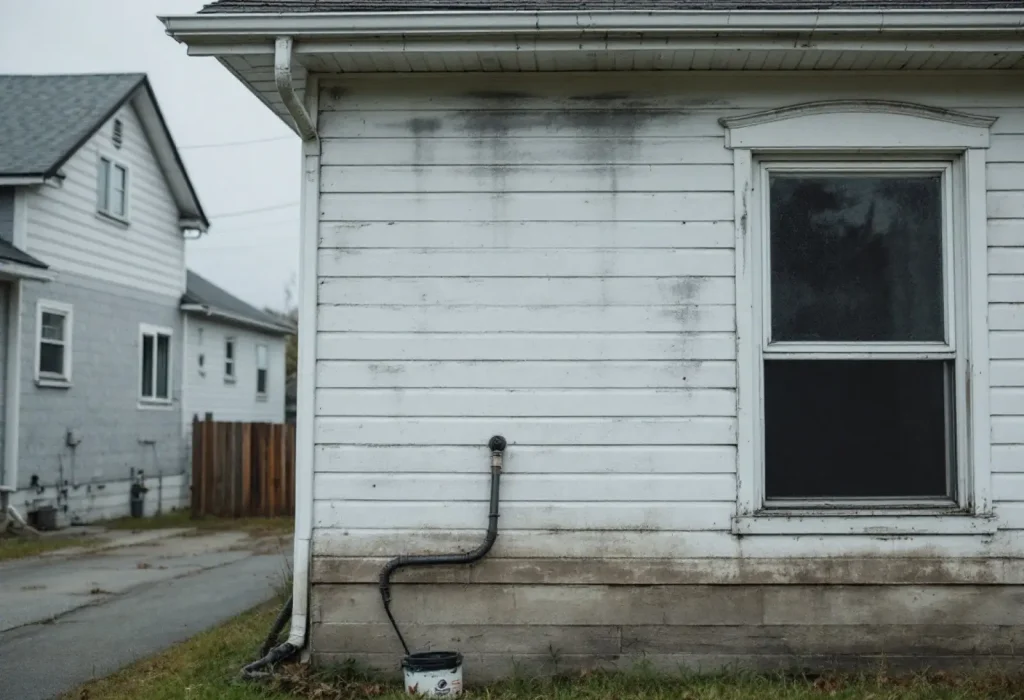
Smoke damage from neighbor fire is claimed on your own policy first: the ISO HO 3 form lists smoke as a named peril, meaning sudden and accidental damage from smoke, so your insurer pays under your terms, minus your deductible. The neighbor’s liability coverage pays only damages the neighbor is legally liable for, which your insurer can chase later through subrogation.
On this page
Why does your own HO 3 pay before the neighbor’s policy does?
Because the two policies answer different questions. In the ISO HO 00 03 05 11 form hosted by the Maine Bureau of Insurance, peril 7 under Coverage C reads: “This peril means sudden and accidental damage from smoke, including the emission or puffback of smoke, soot, fumes or vapors from a boiler, furnace or related equipment.” Nothing in that wording asks where the fire started. A neighbor’s kitchen fire that pushes soot through your soffit vents meets it the same way your own furnace would.
The only carve out written into peril 7 is smoke “from agricultural smudging or industrial operations”. A house fire next door is neither, so the trigger in the form is the event itself, not who caused it.
The neighbor’s policy works on fault. Coverage E in the same HO 00 03 05 11 form pays “the damages for which an ‘insured’ is legally liable” for property damage caused by an occurrence. A fire with no negligence behind it, such as a sudden electrical failure the owner could not have foreseen, may leave the neighbor with no legal liability and their insurer with nothing to pay you. That gap is why a first party claim on your own policy is the route that does not wait for anyone to prove fault.
California makes the order explicit for insurers it regulates. California Code of Regulations, title 10, section 2695.7 subsection (e) says no insurer shall delay or deny settlement of a first party claim “on the basis that responsibility for payment should be assumed by others”, except where policy provisions, statutes or regulations provide otherwise. If an adjuster tells you to go to the neighbor’s carrier first, ask which policy provision or regulation they are relying on, in writing.
Who responds first in five living situations?
The table below is the original element of this page. Each policy row comes from the HO 00 03 05 11 conditions; the condo row applies Florida Statutes section 718.111(11) and Florida Statutes section 627.70132; it is a map of where to start, not a statement of what any one policy pays. HO 4 and HO 6 forms carry their own named peril lists, so renters and condo owners should find the word Smoke in the Perils Insured Against section of their own form before filing.
| Where you live | Responds first | May pay later | Document to request | Clock to watch |
|---|---|---|---|---|
| Detached house next door burns | Your HO 3 (smoke peril 7; Coverage A for the structure) | Neighbor’s Coverage E, only if they were legally liable; your insurer pursues it by subrogation | Incident report from the responding fire department; your insurer’s subrogation decision letter | Prompt notice; proof of loss within 60 days after the insurer asks |
| Shared wall townhouse | Your HO 3 for your side of the wall and your contents | Neighbor’s Coverage E if negligent; any HOA policy only for what the governing documents assign to it | Fire report; the HOA declaration’s insurance section | Prompt notice; 2 years to sue your own insurer under the HO 3 |
| Condo unit, fire in another unit | Association master policy for the building elements it must insure; your HO 6 for contents and unit finishes | Neighbor unit owner’s liability coverage if negligent | Fire report; master policy declarations from the association | Florida: notice within 1 year; loss assessment claims within 90 days of the assessment vote, 3 years at most |
| Apartment renter, fire in another unit | Your HO 4 for your belongings; the landlord’s policy for the building | Tenant who caused it, through their liability coverage, if negligent | Fire report; landlord’s written notice on habitability | Prompt notice; Civil Authority stay up to 2 weeks if access is barred |
| Wildfire smoke, no single neighbor | Your own policy; there is usually no one party to subrogate against | Rarely anyone | Agency incident name and dates | Same policy clocks; see the wildfire page |
Wildfire smoke sits in the last row only because readers ask about it in the same breath; the coverage questions for regional smoke events are covered on the wildfire smoke damage page.
Renters have a split that owners do not: the landlord insures the walls, you insure what is inside them, and the tenant who started the fire is a liability question for their own policy. The renter side is laid out in detail on the renters insurance fire damage page.
When does the neighbor’s insurer owe you anything, and who chases it?
Under the HO 00 03 05 11 Subrogation condition, your insurer “may require an assignment of rights of recovery for a loss to the extent that payment is made by us”, and you must sign the papers and cooperate. In practice that means once your own carrier pays, the right to sue the neighbor for that same money belongs to your carrier, not to you. Your deductible and anything your policy did not pay stay yours to pursue.
California sets three rules on that hand off in 10 CCR 2695.7. Subsection (p) requires the insurer to tell you in writing whether it intends to pursue subrogation, and if it will not, to say that any recovery is your responsibility. Subsection (q) requires every subrogation demand to include your deductible and requires recoveries to be shared with you “on a proportionate basis”. It also bars deducting legal expenses from your deductible share unless an outside attorney or collection agency was retained.
A labelled calculation shows what proportionate sharing means. Applying the sharing rule per the regulation, if an insurer recovers 60% of a demand that included a $1,000 deductible, your share of the deductible back is 60% of $1,000, or $600. The figures are illustrative arithmetic, not a typical outcome.
You can also waive this right without meaning to. The HO 3 lets an insured “waive in writing before a loss all rights of recovery against any person”. A townhouse party wall agreement or an HOA document that waives claims between owners can be that writing, so send it to your adjuster with the first notice instead of letting it surface later.
How long does each clock run after the fire, in days?
Several timers start on different triggers, and confusing them is how claims stall. The HO 00 03 05 11 form sets four: prompt notice with no day count, a sworn proof of loss within 60 days after the insurer asks for it, payment 60 days after proof of loss once you reach agreement or a final judgment is entered, among the listed triggers, and a 2 year limit to sue your own insurer, counted from the date of loss.
State law can shorten or extend these. Florida Statutes section 627.70132 bars any property claim unless notice was given within 1 year after the date of loss, and a supplemental claim within 18 months. In California, 10 CCR 2695.7 subsection (b) requires the insurer to accept or deny within 40 calendar days of receiving proof of claim, and subsection (c)(1) requires written status every 30 days if it needs longer. Subsection (f) requires written notice of a time limit at least 60 days before the insurer relies on it.
Fire in another condo unit: does the master policy or your HO 6 pay for your unit?
Both, for different parts, and Florida writes the line into law. Florida Statutes section 718.111(11) paragraph (f) requires association policies issued or renewed on or after 1 January 2009 to give primary coverage for the condominium property as originally installed, and to exclude personal property inside the unit plus “floor, wall, and ceiling coverings, electrical fixtures, appliances, water heaters, water filters, built-in cabinets and countertops, and window treatments”. Those excluded items are the unit owner’s to insure.
So when smoke from the unit below stains your drywall and ruins your carpet, the drywall sits with the association’s carrier and the carpet, cabinets and contents sit with your HO 6. Paragraph (j) of the same subsection makes association deductibles a common expense, with exceptions that put unreimbursed costs on a unit owner in listed cases, including intentional conduct.
Florida’s notice statute also covers the assessment that often follows. Under Florida Statutes section 627.70132 subsection (4), a loss assessment claim must reach your insurer within 1 year of the loss or within 90 days of the board’s vote to levy the assessment, whichever is later, and never more than 3 years after the loss. Outside Florida, ask the association manager for the master policy declarations and the insurance article of the declaration; the split there decides which adjuster sees which wall.
Can you claim hotel costs if the fire department closes your building but your unit is not burned?
The HO 00 03 05 11 form answers this one directly. Its Civil Authority clause says that if a civil authority prohibits you from using the residence premises “as a result of direct damage to neighboring premises by a Peril Insured Against”, the policy covers Additional Living Expense and Fair Rental Value “for no more than 2 weeks”. A neighbor’s fire is the textbook case.
Two weeks is the cap for being shut out. If smoke damaged your own home enough to make it unfit to live in, read the Additional Living Expense clause that sits just above Civil Authority in Coverage D, which is not tied to the 2 week cap. Keep receipts from night 1: the HO 3 proof of loss lists “receipts for additional living expenses incurred” as a required attachment. The limits and common disputes are on the loss of use coverage page.
How do you get the fire report now that NFIRS has retired?
The federal reporting system many guides still name is gone. The U.S. Fire Administration NFIRS page gives 31 January 2026 as the final date for the National Fire Incident Reporting System and says it has retired, with reporting moving to a successor system USFA calls NERIS. In its last full year, according to USFA, 20,945 departments had submitted 26,771,008 incidents for 2025 as of 5 January 2026, as listed on that page.
None of that changes where your copy comes from: the department that responded keeps its own incident record. Ask that department for the incident report, giving the street address, the date and approximate time, and the incident number if a crew left one, and ask whether the request must be filed under your state public records law and when the cause section will be final.
The report matters for two reasons on this kind of loss. It fixes the date of loss that starts the HO 3 two year suit clock, and its cause and origin entries are what your insurer reads when deciding whether subrogation against the neighbor is worth pursuing, the decision 10 CCR 2695.7(p) requires California insurers to disclose in writing.
What does the HO 3 make you document before cleanup starts?
The Duties After Loss condition in HO 00 03 05 11 lists the work, and coverage can be refused where skipping a duty is prejudicial to the insurer. For a neighbor fire the ones that matter are:
- Duty 1: prompt notice to the insurer or agent, by phone and in writing, with the date of the neighbor’s fire.
- Duty 4: protect the property from further damage, make reasonable and necessary repairs, and keep an accurate record of repair expenses. Closing smoke stained vents and bagging soiled textiles fits here; tearing out drywall before an adjuster sees it does not.
- Duty 6: an inventory of damaged personal property showing quantity, description, actual cash value and amount of loss, with bills and receipts attached.
- Duty 7: show the damaged property as often as reasonably required, so photograph soot on window screens, exterior siding facing the fire, HVAC return grilles and closet contents before anything is wiped.
- Duty 8: a signed, sworn proof of loss within 60 days after the insurer requests it.
The HO 3 also gives the insurer an option to repair instead of paying, if it gives written notice within 30 days of your sworn proof of loss. How to fill that form in is on the proof of loss page. Residue types, dry sponge against wet cleaning, and when drywall is replaced rather than cleaned are on the smoke damage repair page.
The full smoke claim sequence, from boundary disputes to pack out and cleanable against replace calls, is on the smoke damage insurance claim page.
Questions people actually ask
Can I sue my neighbor for fire damage?
You can bring a claim if the fire came from the neighbor’s negligence, and their HO 3 Coverage E pays only damages they are legally liable for. If your own insurer pays first, the HO 3 subrogation condition lets it take over that right for the amount it paid, so your own suit is usually limited to the deductible and uninsured items. Ask a lawyer licensed in your state for the property damage filing deadline.
How do I get rid of the smoke smell from my neighbor’s fire?
Odor is part of the smoke loss, so log it before treating it: the HO 3 requires reasonable repairs plus an accurate record of repair expenses under Duty 4. Ask your adjuster in writing whether thermal fogging or hydroxyl treatment is approved before booking it. Methods are compared on the smoke smell removal page.
What can I do about smoke from my neighbour’s chimney?
That is usually not an insurance claim. The HO 3 smoke peril covers sudden and accidental damage, and a chimney that smokes every evening is neither sudden nor a single event. Complaints about recurring chimney or wood stove smoke go to your local air quality district or the city code enforcement office; keep dated photos and times.
Does my insurer have to tell me if it will go after the neighbor?
In California, yes. 10 CCR 2695.7(p) requires written notice of whether the insurer will pursue subrogation, and if it declines, a statement that any recovery is your responsibility. Elsewhere, ask the adjuster in writing for the subrogation decision and whether your deductible is in the demand, then ask your state insurance department whether a similar rule applies.
Sources
- ISO HO 00 03 05 11 form hosted by the Maine Bureau of Insurance, Homeowners 3 Special Form HO 00 03 05 11, copyright Insurance Services Office, Inc., 2010: Coverage C peril 7 Smoke, Coverage D Civil Authority, Section I Conditions C, D, H, I and J, Section II Coverage E, Sections I and II Condition F Subrogation. Retrieved 16 November 2026.
- Florida Statutes section 627.70132, Notice of property insurance claim, The Florida Legislature, history through ch. 2024-139. Retrieved 16 November 2026.
- Florida Statutes section 718.111(11), Condominiums, insurance subsection, paragraphs (f), (g) and (j), The Florida Legislature. Retrieved 16 November 2026.
- California Code of Regulations, title 10, section 2695.7, Standards for prompt, fair and equitable settlements, subsections (b), (c)(1), (e), (f), (p) and (q), via Cornell Legal Information Institute. Retrieved 16 November 2026.
- U.S. Fire Administration NFIRS page, National Fire Incident Reporting System, U.S. Fire Administration, FEMA; participation data as of 5 January 2026, page last reviewed 27 August 2026. Retrieved 16 November 2026.
- Day counts in the chart convert the cited years and months at 365 days a year and 30.44 days a month; the deductible example is labelled illustrative arithmetic. Our methodology sets out the standing rules, and the fire and smoke hub lists related pages.
This page describes standard policy language and state rules; it does not say what any reader’s policy pays. Read your own declarations and form, call your state insurance department for the deadlines that apply to you, and ask a licensed agent, public adjuster or attorney about your specific claim.