The short answer
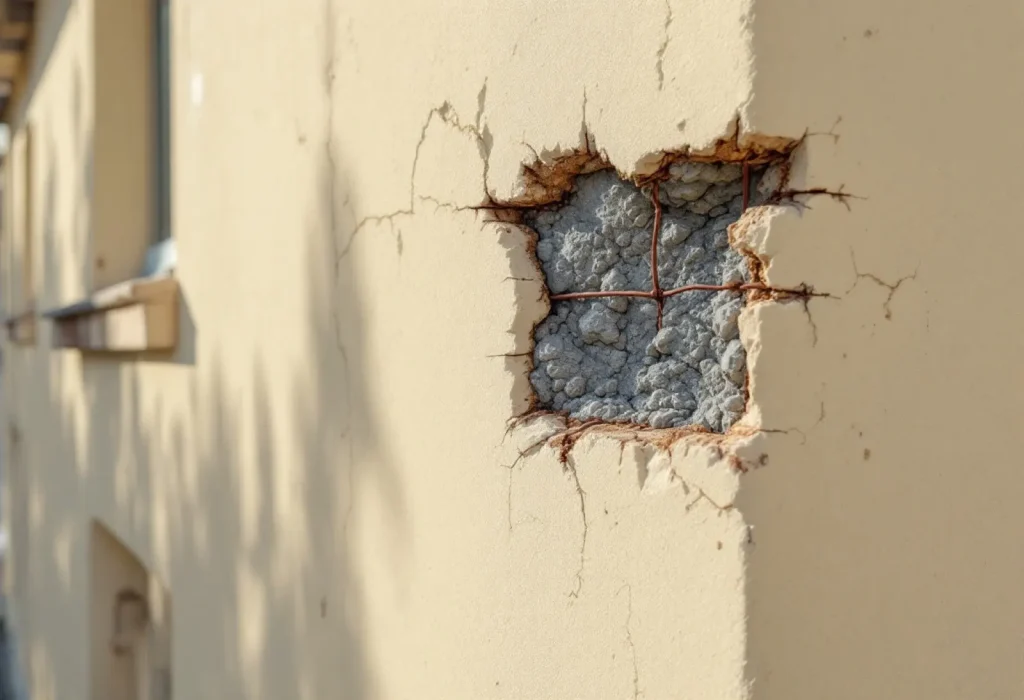
Yes, stucco asbestos is possible, but federal rules do not presume it in exterior cement stucco. OSHA’s 18 June 1999 interpretation says stucco is not surfacing material, so the pre-1981 presumed asbestos rule in 29 CFR 1926.1101 does not attach. Sprayed or troweled acoustic ceiling texture is surfacing material and is presumed. Under both EPA and OSHA definitions, only a lab result above 1% asbestos settles either.
Does OSHA presume pre-1981 exterior stucco contains asbestos?
No. Under 29 CFR 1926.1101, presumed asbestos containing material (PACM) means thermal system insulation and surfacing material found in buildings constructed no later than 1980. The same section defines surfacing material as material that is sprayed, troweled on or otherwise applied to surfaces, and names acoustical plaster on ceilings and fireproofing on structural members as examples.
Read literally, troweled exterior stucco looks like it fits. OSHA answered that point directly in its OSHA interpretation of 18 June 1999, titled Clarification of surfacing material under the asbestos standard, written to the Department of the Navy. The letter states that stucco is not surfacing material as OSHA intends to define the term, because any fibres are too tightly bound for the material to belong in the high risk category that the PACM presumption targets. It put paint, floor leveling compound and resilient tile mastic in the same group.
The same 1999 letter adds that OSHA understood stucco does not normally contain asbestos, and that any asbestos present would likely be at low concentrations. That is OSHA’s stated understanding, not a survey result, and no federal prevalence count for asbestos in stucco turned up in the EPA, OSHA or CPSC material read for this page.
What it changes in practice: an employer working on pre-1981 exterior stucco has no automatic PACM duty for that wall under 29 CFR 1926.1101(k)(1), but OSHA’s letter is explicit that stucco with more than 1% asbestos is still asbestos containing material, and taking it off is Class II work. A sprayed acoustic ceiling in the same 1975 house is PACM until an accredited inspector or an industrial hygienist holding the CIH credential samples it and a lab shows otherwise.
Which kinds of stucco count as surfacing material, and from which years?
The word stucco covers at least three different things in a house, and the federal rules split them. National Park Service Preservation Brief 22 dates the exterior material: before the mid to late 1800s stucco was mostly hydrated lime, sand and water with straw or animal hair as a binder; portland cement was first made in the United States in 1871, and after about 1900 most stucco was portland cement with some lime. The brief notes there are no precise cut-off dates, because plasterers varied by region.
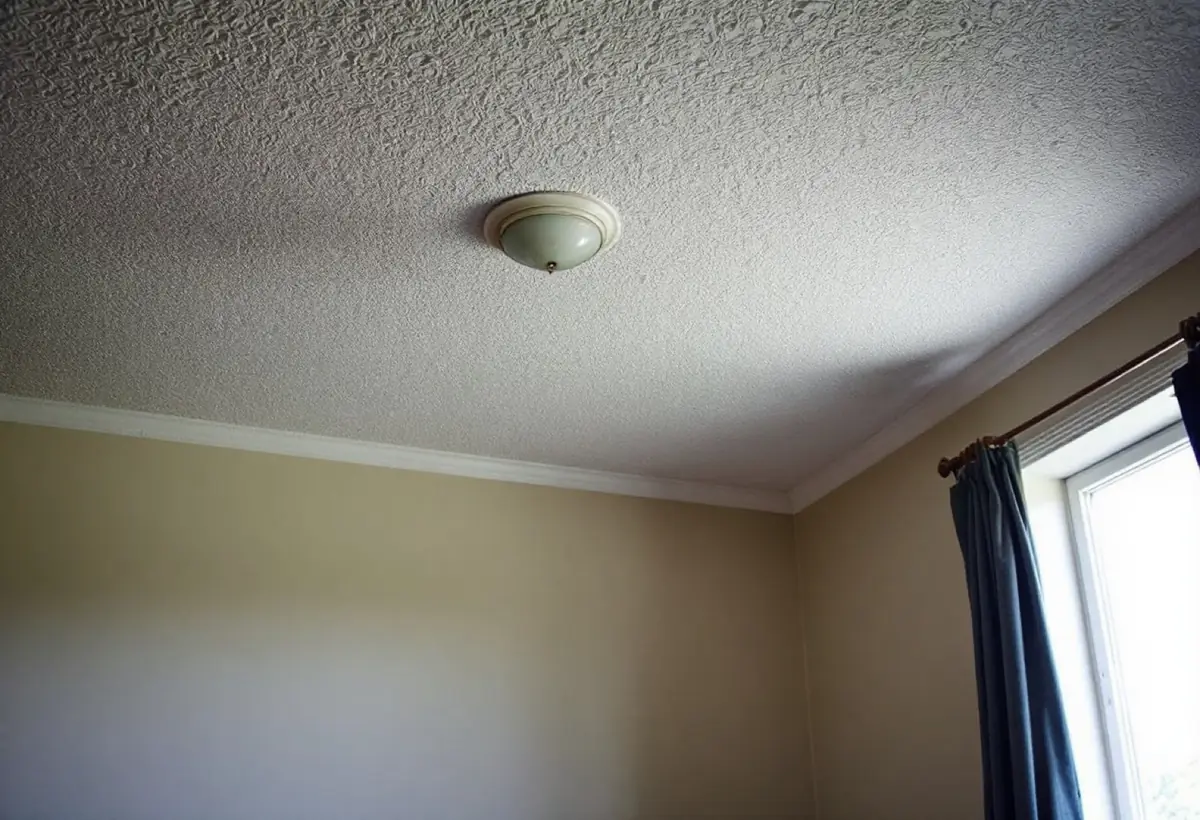
The interior ceiling called a stucco ceiling is a different product. EPA's asbestos regulatory history records that EPA banned spray-applied surfacing asbestos for fireproofing and insulating in 1973 and for all remaining purposes in 1978, both under the NESHAP at 40 CFR Part 61 Subpart M. EPA’s summary names spray-applied material; it does not list a matching federal ban for troweled wall stucco.
| Material | Era evidence | OSHA category | Work class if ACM |
|---|---|---|---|
| Lime stucco (lime, sand, straw or animal hair) | Usual before the mid to late 1800s (NPS Brief 22) | Not surfacing material (OSHA 1999 letter on stucco) | Class II removal if over 1% |
| Portland cement stucco on masonry or lath | US portland cement from 1871; most stucco after about 1900 (NPS) | Not surfacing material (OSHA 1999 letter) | Class II removal if over 1% |
| Sprayed acoustic or decorative ceiling texture | Spray applied surfacing banned by EPA in 1973 (fireproofing, insulating) and 1978 (all other purposes) | Surfacing material; PACM if the building dates to 1980 or earlier | Class I removal; Class III for drilling or patching |
| Troweled acoustical plaster on ceilings | Named in the 1926.1101 and 763.83 definitions | Surfacing material; PACM to 1980 | Class I removal; Class III repair |
| Textured paint on walls or ceilings | Listed by EPA as a place asbestos may be found | Not surfacing material (OSHA 1999 letter on paint) | Class II removal if over 1% |
| Consumer patching compound | Banned by CPSC if made after 16 January 1978; all banned after 11 June 1978 | Not addressed in the 1999 letter | Ask the inspector to classify it in writing |
Two consequences follow from the table. A 1960s house can hold a presumed-asbestos ceiling and a non-presumed exterior wall at the same time, so one survey usually has to sample both. And a later re-stucco or patch is its own homogeneous area under 40 CFR 763.83, which defines that as material uniform in colour and texture. The ceiling side is covered in more depth at popcorn ceiling asbestos, and lime and gypsum wall plaster at asbestos in plaster.
How many samples does a 1,260 sq ft stucco wall need under EPA’s 40 CFR 763.86?
For surfacing material, EPA’s rule at 40 CFR 763.86(a) sets the minimum bulk samples per homogeneous area that is not simply assumed to be asbestos: at least 3 for 1,000 sq ft or less, at least 5 for more than 1,000 up to 5,000 sq ft, and at least 7 above 5,000 sq ft, collected in a statistically random way across the area. The rule was written for schools under AHERA, but OSHA borrows it: 29 CFR 1926.1101(k)(5)(ii)(B) says tests that rebut PACM must use bulk samples collected in the manner described in 40 CFR 763.86.
| Area of one homogeneous area | EPA minimum samples | Paragraph |
|---|---|---|
| 1,000 sq ft or less | 3 | 763.86(a)(1) |
| More than 1,000, up to 5,000 sq ft | 5 | 763.86(a)(2) |
| More than 5,000 sq ft | 7 | 763.86(a)(3) |
Turning square feet into a sample count is where most guides online stop short, so the table below runs the arithmetic on typical stucco surfaces. Wall areas are gross: perimeter times wall height, with no deduction for windows, which can only move a wall down a band, never up. Each row assumes one uniform finish; a re-stuccoed side or a patch of a different texture adds a separate homogeneous area with its own minimum under 40 CFR 763.83.
| Surface | How the area is computed | Area (sq ft) | EPA band minimum |
|---|---|---|---|
| One storey house, 40 by 30 ft footprint | 140 ft perimeter x 9 ft walls | 1,260 | 5 |
| Two storey house, same footprint | 140 ft perimeter x 18 ft walls | 2,520 | 5 |
| Small commercial box, 60 by 100 ft, 20 ft walls | 320 ft perimeter x 20 ft | 6,400 | 7 |
| Textured ceiling, one 12 by 14 ft bedroom | 12 ft x 14 ft | 168 | 3 |
| Same ceiling texture through a 1,500 sq ft single level | floor area of the ceilings that share the texture | 1,500 | 5 |
| Garage wall patch, 6 by 8 ft | 6 ft x 8 ft | 48 | 3 |
The ceiling rows matter most. Because a sprayed texture is OSHA PACM in a building from 1980 or earlier, an employer who wants to treat a 1,500 sq ft run of matching ceiling as non-asbestos needs at least 5 samples under the 763.86 method, analysed by a lab in a programme such as NIST’s NVLAP or the AIHA round robin, both named in 1926.1101(k)(5). The asbestos survey page sets out how inspectors divide a building into homogeneous areas.
Why does one positive sample out of seven decide the whole wall?
Because the rule is written that way. Under EPA’s rule at 40 CFR 763.87(c), a homogeneous area is treated as not containing asbestos only if every required sample shows 1% or less, and it is treated as asbestos containing material if at least one sample shows more than 1%. Samples may not be composited, and the analysis method is polarized light microscopy (PLM) under Appendix E to Subpart E of 40 CFR Part 763.
That asymmetry is why an inspector can stop early. EPA’s paragraph 763.86(a) itself carves out the 763.87(c)(2) exception, so a first sample above 1% can end sampling of that area, while a clean result has to be repeated across the full 3, 5 or 7 before the area is cleared. Low readings get a second look under EPA’s NESHAP at 40 CFR 61.141: when a non point count PLM result is below 10%, the NESHAP friable definition calls for verifying the content by point counting. With OSHA’s 1999 letter describing stucco asbestos as likely low in concentration, a trace PLM result on stucco is the case where asking the lab for a point count is worth the extra line item; lab pricing for that is on the asbestos testing cost page.
Can you drill, patch or re-stucco over it without a test?
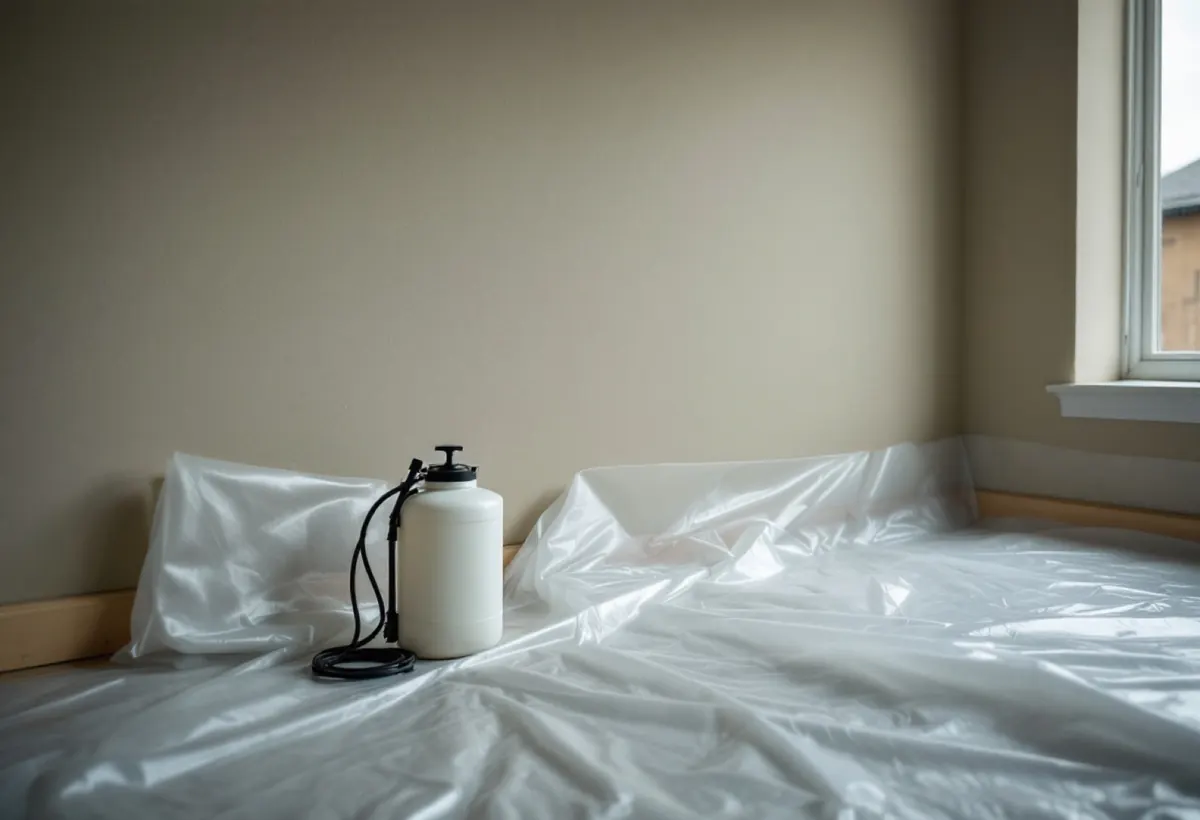
Exposure limits in 29 CFR 1926.1101 are 0.1 f/cc as an 8 hour time-weighted average and 1.0 f/cc over 30 minutes, and the standard sorts every task into a class before any air sample is taken. For a sprayed ceiling in a 1980 or older building, drilling, sanding or breaking into the texture is Class III work, and paragraph (g)(9)(iii) requires impermeable drop cloths plus a mini enclosure, glove bag or another isolation method whenever surfacing material is drilled, cut, abraded, sanded, chipped, broken or sawed.
Exterior stucco takes a different route. Since it is not PACM, the duty starts with knowing what it is: a sample result over 1% makes removal Class II under OSHA’s 1999 letter. Re-stuccoing over sound old stucco without cutting or grinding it does not remove anything, which is why a scratch coat over intact stucco and a tear-off for a window land in different rows of the table below.
| Task | OSHA class | Controls named in 29 CFR 1926.1101 |
|---|---|---|
| Drill holes in a pre-1981 sprayed ceiling for a light | Class III (surfacing PACM) | Wet methods; impermeable drop cloths; mini enclosure or glove bag, 1926.1101(g)(9)(iii) |
| Patch a crack in a sprayed or troweled acoustic ceiling | Class III | Wet methods; local exhaust ventilation where feasible, (g)(9)(i) and (ii) |
| Cut out exterior stucco for a new window, tested over 1% | Class II | Competent person supervision, (g)(7)(i); no dry sweeping and no unvented abrasive disc saws, (g)(3) |
| Strip a full stucco elevation, tested over 1% | Class II | Respirator if not removed substantially intact or not wet, (h)(1)(ii) and (iii) |
| Strip a pre-1981 sprayed ceiling, not tested | Class I (PACM) | Full Class I controls under (g)(4); the 1999 letter does not apply to ceiling texture |
If water is getting behind the stucco and the repair is really about rot, flashing and drainage, the moisture side is handled at stucco remediation. The asbestos question still comes first there, because opening a wall to dry it is the same cut that 1926.1101(g)(3) and (g)(7) govern.
Does tearing stucco off a house trigger an EPA NESHAP notice?
Usually not for a house, often yes for anything bigger. 40 CFR 61.141 defines a facility to exclude residential buildings with 4 or fewer dwelling units, so the federal asbestos NESHAP does not reach a typical single-family re-stucco. A five-unit apartment building, a shop or a school is a facility, and 40 CFR 61.145(a) requires the owner or operator to thoroughly inspect the affected part before a demolition or renovation starts, including Category I and Category II nonfriable material.
Hard cement stucco that cannot be crumbled by hand when dry is Category II nonfriable ACM under EPA’s 40 CFR 61.141 if it holds more than 1% asbestos. It becomes regulated asbestos containing material (RACM) when it has a high probability of being crumbled, pulverized or reduced to powder by the forces of the demolition or renovation. Once RACM reaches 160 sq ft on facility components, 260 linear ft on pipes or 35 cubic ft off components, 61.145 requires written notice at least 10 working days before stripping or removal begins. The calculation table above shows why a commercial stucco elevation passes 160 sq ft almost immediately.
Local air agencies can be stricter than the federal floor. According to the Puget Sound Clean Air Agency in Washington, an owner-occupant may survey a single-family house before a remodel, an AHERA building inspector is required for rentals, condominiums and demolitions, and a $25 filing fee applies to a single-family notification before friable asbestos is removed. The agency exempts less than 10 linear ft of pipe or 48 sq ft of surface per calendar year, and nonfriable material, from that notice. Ask your state or local air agency which of its rules treat stucco as nonfriable, and whether an owner survey is allowed where you live. The way friability shifts during removal is set out at friable asbestos.
For contractors: what to have in writing before a stucco tear-off
Under 29 CFR 1926.1101(k)(1), building owners and employers share the job of identifying installed asbestos material, and OSHA’s 1999 letter removes only the presumption for stucco, not the duty to know. A short file that answers OSHA, the NESHAP and a local air agency at once:
- Homogeneous areas mapped by colour and texture under 40 CFR 763.83, with original stucco, re-stucco and patches split.
- Sample counts per area at or above the 763.86(a) bands of 3, 5 or 7, and the PLM report for each, with point counting where a result came back under 10%.
- A note on whether any ceiling or soffit finish is sprayed or troweled acoustic texture, which stays PACM to 1980.
- The OSHA class for each task and, for Class II removal not kept substantially intact, the respirator programme under 1926.1101(h).
- For a facility of 5 or more units, the 61.145 inspection record and the 10 working day notice if RACM passes 160 sq ft.
Siding that looks like stucco is a separate material. Cement asbestos board shingles are covered at asbestos siding, and OSHA lists siding shingles by name as Class II removal work in 1926.1101(b).
Questions people actually ask
How common is asbestos in stucco?
No federal agency publishes a prevalence rate. OSHA’s 18 June 1999 interpretation states its understanding that stucco does not normally contain asbestos and that any present would likely be in low concentrations. That is why OSHA does not presume it, and why a lab result, ideally with PLM point counting when the reading is under 10%, is the only way to know for one wall.
Is it okay to live in a house with asbestos stucco?
EPA’s homeowner guidance, last updated 25 June 2026, says material in good condition that will not be disturbed should be left alone, and that a house does not need testing if materials are undamaged and no remodel is planned. Testing becomes worthwhile before drilling, cutting, sanding or removing the stucco or a sprayed ceiling.
Can I test my stucco with a home asbestos kit?
EPA recommends against taking samples yourself, because sampling done incorrectly can release fibres. Some agencies, such as the Puget Sound Clean Air Agency, allow an owner-occupant to survey a single-family house before a remodel. If you use a lab, ask whether it takes part in NIST’s NVLAP programme, the standard OSHA names in 29 CFR 1926.1101(k)(5).
How should stucco dust be cleaned up after asbestos stucco is removed?
Never dry sweep: 29 CFR 1926.1101(g)(3) bans dry sweeping, shoveling and other dry clean-up of asbestos debris on jobs it covers, and (g)(1) calls for HEPA vacuums and wet methods. EPA’s homeowner guidance adds misting the material with a wetting agent and sealing the work area with plastic sheeting with heating and air conditioning off.
Is a stucco ceiling the same as a popcorn ceiling?
For federal purposes they fall in one group if sprayed or troweled on for acoustic or decorative effect: both meet the surfacing material definition in 29 CFR 1926.1101(b), and both are PACM in buildings built in 1980 or earlier. EPA banned all remaining spray-applied surfacing asbestos uses in 1978.
Out of scope: this page covers classification, sampling and work rules, not health effects. EPA’s asbestos pages and the CDC’s Agency for Toxic Substances and Disease Registry (ATSDR) cover exposure and health questions.
Sources
- OSHA interpretation of 18 June 1999, Occupational Safety and Health Administration, Clarification of surfacing material under the asbestos standard, letter to the Department of the Navy. Retrieved 12 November 2026.
- 29 CFR 1926.1101, OSHA asbestos standard for construction: definitions in (b), PELs in (c), work practices in (g), respirators in (h), owner duties and PACM rebuttal in (k), via the Legal Information Institute. Retrieved 12 November 2026.
- 40 CFR 763.83, 40 CFR 763.86(a) and 40 CFR 763.87(c), EPA AHERA definitions, sampling and analysis rules (52 FR 41846, 30 October 1987), via the Legal Information Institute. Retrieved 12 November 2026.
- 40 CFR 61.141 and 40 CFR 61.145, EPA asbestos NESHAP definitions and demolition and renovation standard, via the Legal Information Institute. Retrieved 12 November 2026.
- 16 CFR 1304.4, Consumer Product Safety Commission ban on consumer patching compounds containing respirable free-form asbestos. Retrieved 12 November 2026.
- EPA's asbestos regulatory history, United States Environmental Protection Agency, 1973, 1978, 1989 and 2024 actions. Retrieved 12 November 2026.
- EPA homeowner guidance, United States Environmental Protection Agency, last updated 25 June 2026. Retrieved 12 November 2026.
- EPA's list of where asbestos may be found, United States Environmental Protection Agency. Retrieved 12 November 2026.
- National Park Service Preservation Brief 22, The Preservation and Repair of Historic Stucco, National Park Service, Technical Preservation Services. Retrieved 12 November 2026.
- Puget Sound Clean Air Agency, Homeowner Renovation requirements, Puget Sound Clean Air Agency, Washington. Retrieved 12 November 2026.
- Area and sample-count examples are arithmetic on stated dimensions, computed when this page was built and mapped to the 40 CFR 763.86(a) bands. Our methodology sets out the standing rules, and more standards pages sit in the standards hub.
Federal rules set a floor; state and local air agencies and state asbestos programmes can add survey, licensing and notice duties. Ask your state asbestos programme whether exterior stucco needs a survey before your project and who may take the samples.