
The short answer
Tear gas cleanup means removing a fine solid residue (CS, CN or pepper spray) that barely dissolves in water and settles on every surface. Work top floor down with the HVAC off, HEPA vacuum first, wash hard surfaces with an alkaline detergent, bag clothing, and plan to discard carpet, pad and upholstery. Never use bleach: NIOSH lists strong oxidizers as incompatible with CS.
Which agent was used: CS, CN or OC pepper spray?
The word tear gas covers several chemicals, and the CDC riot control agent fact sheet names CN, CS, CR, CA and PS among them. In homes the residue is almost always one of three: CS from police grenades, CN from older devices, or OC from pepper spray. None of them is a gas at room temperature. The NIOSH Pocket Guide describes both CS and CN as crystalline solids, which is why the job is residue removal, not airing out.
The table below sets the three side by side from the NIOSH Pocket Guide entry for CS, the NIOSH Pocket Guide entry for CN, the PubChem HSDB record for CS, the PubChem HSDB record for CN and the PubChem record for capsaicin. No ranking cleanup page publishes this comparison, and the differences change the cleaning method.
| Agent | Chemical | Form at room temperature | Water solubility | Vapor pressure | Breakdown and persistence | NIOSH incompatibilities | Cleanup the sources describe |
|---|---|---|---|---|---|---|---|
| CS (named in the distributor article as the most common police agent) | o-chlorobenzylidene malononitrile, CAS 2698-41-1 | White crystalline solid, pepper-like odor | 0.1 to 0.5 g per 100 mL at 20 °C (slightly soluble) | 3.4 × 10⁻⁵ mm Hg at 20 °C | Hydrolyses with a 14.5 minute half life at 25 °C once dissolved, but dissolves very slowly; settled powder active up to 5 days, 45 days with a silicone water repellent | Strong oxidizers | HSDB: alkaline hydrolysis to o-chlorobenzaldehyde. Distributor article: alkaline detergent plus sodium bisulfite or metabisulfite |
| CN (NIOSH lists Mace® as a trade name) | alpha-chloroacetophenone, CAS 532-27-4 | Colorless to gray crystalline solid, sharp odor | NIOSH: insoluble. ICSC via PubChem: 1.64 g per 100 mL at 25 °C | 5.4 × 10⁻³ mm Hg at 20 °C | Hydrolyses very slowly; volatilises from moist surfaces | Water, steam, strong oxidizers; slowly corrodes metals | HSDB spill text: sweep into sealed plastic containers, moisten only to stop dusting |
| OC (pepper spray) | capsaicin, CAS 404-86-4, from oleoresin capsicum | White crystalline solid when pure; sprays carry it in a liquid | Practically insoluble in cold water; freely soluble in alcohol | 1.3 × 10⁻⁸ mm Hg at 25 °C (estimated) | No hydrolysis or surface half life published in HSDB; rated immobile in soil (estimated Koc 12,000) | None listed by NIOSH (no Pocket Guide entry) | No agent specific surface method published; it dissolves in alcohol, not water |
Three readings matter for cleanup. CS is 159 times less volatile than CN, computed from the HSDB vapor pressures, so CS stays put as dust while CN can keep giving off vapor. Capsaicin is about another 2,600 times less volatile than CS per the HSDB estimate, so pepper spray residue is a film that does not evaporate. And CN is the only one of the three where NIOSH lists water and steam as incompatible.
Why does CS residue last days when it breaks down in 14.5 minutes in water?
The PubChem HSDB record for CS gives a hydrolysis half life of 14.5 minutes at 25 °C and 281.7 minutes (about 4.7 hours) at 0 °C, measured in seawater. That sounds fast. The same record adds the catch: actual degradation may be much slower because the rate at which CS dissolves in water can be very slow. Undissolved crystals sitting in carpet pile or on a ledge are not hydrolysing at all.
The field figures in the same HSDB record show what that means in practice. Settled CS dust can remain active for up to 5 days, and when it is formulated with a silicone water repellent, for up to 45 days. In a Norwegian forest test, more than 10% of CS applied to snow was still there after 28 days, per the HSDB record.
The 19 fold gap between the 0 °C and 25 °C half lives, computed from the HSDB values, is also why an unheated winter house holds residue longer than a warm one. The CMM cleanup plan tells crews to turn the thermostat down in cold climates but keep rooms warm enough that pipes do not freeze. Cold slows the breakdown, so a gassed house left unheated for weeks is not cleaning itself.
How long does tear gas stay in the air versus on surfaces?
Not long in the air, much longer on surfaces. The UK Health Security Agency CS incident guidance says decontamination of people should not be necessary after CS exposure because the agent is expected to disperse within minutes. The HSDB record explains where it goes: with a vapor pressure of 3.4 × 10⁻⁵ mm Hg at 20 °C, CS exists as both vapor and particles, and the particles are removed from air by wet and dry deposition. Deposition indoors means floors, ledges, fabrics and the inside of ductwork.
The estimated outdoor breakdown of CS vapor by hydroxyl radicals has a half life of 110 hours, about 4.6 days, per the PubChem HSDB record for CS. That is an outdoor atmospheric estimate, not an indoor clearance time, and no source opened for this page publishes an indoor air clearance figure for a gassed house. The practical point from the chart: running fans moves CS dust around rather than evaporating it, which is why the CMM cleanup plan shuts the HVAC off before anyone enters.
What order do crews clean a gassed house in, and why 15 by 15 feet?
The most detailed published sequence is the trauma cleanup plan published in CMM magazine, first posted in 2013 and updated in 2020 by a biohazard cleanup firm. It notes that police may use up to 100 canisters in one structure and that remediation takes 4 days to two weeks. Its order, condensed:
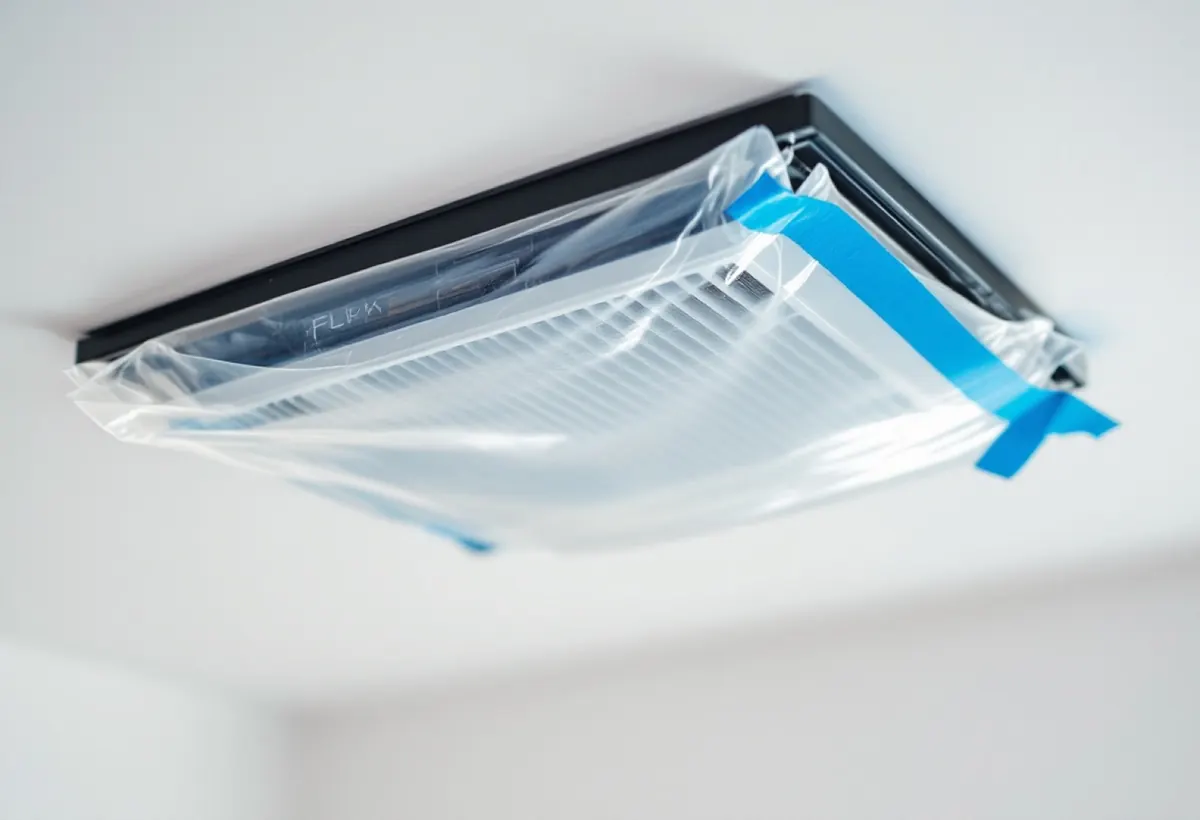
- Shut the HVAC off before entry and cover every supply and return vent so residue cannot recontaminate cleaned rooms.
- Start on the top floor, because the particles settle, and within each floor work from the rooms farthest from the exit toward it.
- Seal each room and hallway with plastic sheeting as you go, and split big rooms into halves or quadrants, ideally no larger than 15 feet by 15 feet.
- Use one exit only, so nobody walks back through a finished area.
- Spray a cleaning agent before disturbing residue so particles do not lift into the air.
- Remove carpet, pad, cloth furniture, drapes and electronics; take out both layers of drywall and the insulation wherever a canister punctured a wall.
- Seal exposed wood studs with a wood sealant.
- Have a qualified HVAC company clean the ducts before the system is turned back on.
The small sections and single exit exist for one reason: CS is a dust with a vapor pressure of 3.4 × 10⁻⁵ mm Hg, per the HSDB record, so the main way it spreads during cleanup is on boots, tools and air currents. That is the same containment logic used on a biohazard cleanup job.
Room by room: what gets washed, sealed or thrown out?
This decision table pulls together the instructions from the trauma cleanup plan published in CMM magazine, the restoration supply distributor's tear gas article (dated 7 December 2022) and the CDC riot control agent fact sheet, with the HSDB chemistry that explains each one. Where two sources disagree, both are shown rather than blended.
| Material | What the source says to do | Source | Why, from the chemistry |
|---|---|---|---|
| Hard nonporous surfaces: counters, tile, glass, sealed floors | HEPA vacuum first, then an alkaline detergent with surfactant, then flush with water; add about 0.5 oz of sodium metabisulfite per gallon for CS stains | Distributor article | HSDB: alkaline hydrolysis is the documented CS breakdown route; the detergent supplies the base, the water the hydrolysis |
| Carpet, pad, upholstered furniture, drapes | CMM plan: remove and dispose. Distributor article: prespray, solvent booster at 1 to 2 oz per gallon, extraction | CMM plan; distributor article | The sources disagree; CS dissolves slowly (HSDB) and fibres hold crystals, which favours removal where CS was heavy |
| Drywall a canister punctured | Remove both layers of drywall and the insulation | CMM plan | CMM: porous materials cannot be cleaned completely of tear gas |
| Exposed wood studs and framing | Seal with a wood sealant | CMM plan | CMM: prevents off gassing from the wood |
| HVAC system and ducts | Off before entry, vents covered, ducts cleaned by an HVAC company before restart | CMM plan | CMM: residue is redistributed when the system restarts |
| Air during the work | HEPA air scrubber during cleanup and for several hours afterward | Distributor article | HSDB: CS exists as both vapor and particles in air |
| Clothing worn during exposure | Place in a plastic bag, seal it, put that bag inside a second bag | CDC | Keeps residue from transferring to other fabrics |
| Electronics | Remove and dispose | CMM plan | CMM lists electronics with the porous items to discard |
The distributor article also says to move contents outdoors and clean them on a downdraft table or soak them in an alkaline solution, and it warns that bisulfite smells strongly, can lighten colors, and needs good ventilation beyond spot use. The HEPA machine it describes is explained on our air scrubber page. Duct cleaning prices are covered on our air duct cleaning cost page.
Is bleach or steam safe on tear gas residue?
Skip bleach. The NIOSH Pocket Guide entry for CS lists one incompatibility for CS: strong oxidizers. Household bleach is sodium hypochlorite, an oxidizer, and no source opened for this page tested bleach on CS residue or recommends it. The Trauma Services page in the current results says bleach can reactivate tear gas but cites nothing, so treat the NIOSH incompatibility listing as the reason, not that claim.
Steam depends on the agent. Some cleanup guides tell readers to steam clean carpets and upholstery without naming an agent, but the NIOSH Pocket Guide entry for CN lists water and steam as incompatible with CN and notes it slowly corrodes metals. For CS, water is part of the documented breakdown route, since CS hydrolyses once dissolved per the HSDB record. If the agent is unknown, ask the police department which product was deployed before choosing a wet method.
The chemical neutralisers in the HSDB spill text for CS are not household products: a 5% solution of sodium hydroxide in 50/50 ethyl alcohol and water, or a 10% solution in isopropyl alcohol and water left for 20 minutes before flushing, per the PubChem HSDB record for CS. Those are caustic, flammable mixtures written for bulk spills of the pure agent by trained responders, and they explain why trade cleaners for this job are alkaline rather than acidic.
Which respirator does NIOSH list for CS residue work?
The NIOSH Pocket Guide entry for CS sets a ceiling exposure limit of 0.05 ppm (0.4 mg/m³) with a skin notation, and an IDLH of 2 mg/m³. Up to that 2 mg/m³ level it lists an air purifying, full facepiece respirator (gas mask) with a chin style, front or back mounted canister for the compound and an N100, R100 or P100 filter, at an assigned protection factor of 50, or supplied air options. A half mask is not on the CS list.
For CN the NIOSH Pocket Guide entry for CN sets a time weighted limit of 0.3 mg/m³ (0.05 ppm) and an IDLH of 15 mg/m³, and its lowest tier, up to 3 mg/m³, allows a half mask with organic vapor cartridges plus a particulate filter. Both NIOSH entries say to prevent skin and eye contact and to remove clothing when wet or contaminated, which is why trade guidance pairs the respirator with a disposable coverall such as the suits used on biohazard jobs.
Out of scope: health effects of tear gas are not covered here. The CDC riot control agent fact sheet describes them and says they usually last 15 to 30 minutes after a person is away from the source and cleaned off.
For contractors: the ceiling limit means any sampling has to capture peaks, not a shift average, and the NIOSH entry names measurement method P&CAM304. Write the agent, the respirator tier and the canister count from the police report into the scope before pricing, because the CN tier allows lighter respirators than the CS tier does.
Who pays when police gas a house? What Baker v. McKinney decided in 2023
The clearest public record is the Fifth Circuit opinion in Baker v. City of McKinney, filed 11 October 2023. On 25 July 2020 McKinney, Texas police used explosives and toxic gas grenades to end a standoff with an armed fugitive inside Vicki Baker’s house. The opinion quotes her filing: the gas that permeated the house required a HAZMAT remediation team, appliances and fabrics were irreparable, and floors, ceiling fans and plumbing had to be replaced.
A jury found damages of $44,555.76 for the home and $15,100.83 for personal property, $59,656.59 combined, according to the opinion. The Fifth Circuit reversed, holding that the Takings Clause does not require compensation when destroying property was objectively necessary in an active emergency. The opinion also records that the city denied her claim and that her insurer would not cover damage caused by the city’s police. That figure includes blast damage, so it is not a cleanup only price.
The ruling is about constitutional takings law and says nothing about any one insurance policy. Before work starts, ask the insurer in writing whether damage from law enforcement action falls under an exclusion, and ask the state insurance department how it reads that exclusion. A claim filed with the city should include the remediation contractor’s itemised scope. The same documentation habits apply on a crime scene cleanup.
Questions people actually ask
How much does it cost to clean up tear gas?
No published price list for tear gas cleanup could be confirmed for this page. The best public figures are court records: in Baker v. City of McKinney a jury found $44,555.76 in home damage and $15,100.83 in personal property, including blast damage, according to the opinion. The CMM cleanup plan puts the work at 4 days to two weeks, so get itemised written quotes.
How toxic is tear gas?
NIOSH sets an immediately dangerous level of 2 mg/m³ for CS and 15 mg/m³ for CN, and a CS ceiling limit of 0.05 ppm, per the NIOSH Pocket Guide. That makes CS about 7.5 times more potent than CN by that measure, computed here. For health effects, read the CDC riot control agent fact sheet.
What do you do with clothes exposed to tear gas?
The CDC fact sheet says to remove the clothing quickly, cutting it off rather than pulling it over the head, then put it in a plastic bag, seal or tie it, and place that bag inside a second plastic bag. The UKHSA CS guidance also says to seal contaminated clothing in plastic bags.
Does baking soda neutralize tear gas?
No source opened for this page tested baking soda on tear gas residue. The documented CS breakdown route is alkaline hydrolysis, and per the HSDB record the spill methods use 5% to 10% sodium hydroxide in an alcohol and water mix, a far stronger base than baking soda. Baking soda will not dissolve CS crystals, which barely dissolve in water at 0.1 to 0.5 g per 100 mL.
How do you clean pepper spray residue?
Pepper spray carries capsaicin, which the PubChem record lists as practically insoluble in cold water and freely soluble in alcohol, with an estimated vapor pressure of 1.3 × 10⁻⁸ mm Hg, so it will not evaporate. NIOSH has no Pocket Guide entry for capsaicin, so follow the maker’s cleanup directions.
Sources
- NIOSH Pocket Guide entry for CS, National Institute for Occupational Safety and Health, o-Chlorobenzylidene malononitrile, page last reviewed 30 October 2019. Retrieved 11 November 2026.
- NIOSH Pocket Guide entry for CN, National Institute for Occupational Safety and Health, alpha-Chloroacetophenone. Retrieved 11 November 2026.
- CDC riot control agent fact sheet, Centers for Disease Control and Prevention, Facts About Riot Control Agents, updated 10 June 2026. Retrieved 11 November 2026.
- PubChem HSDB record for CS, National Library of Medicine, 2-Chlorobenzalmalononitrile: environmental fate, solubility, vapor pressure, cleanup methods. Retrieved 11 November 2026.
- PubChem HSDB record for CN, National Library of Medicine, 2-Chloroacetophenone: environmental fate, solubility, vapor pressure, spillage disposal. Retrieved 11 November 2026.
- PubChem record for capsaicin, National Library of Medicine, Capsaicin: solubility, vapor pressure, environmental fate, uses. Retrieved 11 November 2026.
- UK Health Security Agency CS incident guidance, UK Health Security Agency, CS gas: incident management, updated 16 November 2022. Retrieved 11 November 2026.
- trauma cleanup plan published in CMM magazine, Cleaning and Maintenance Management, article contributed by a trauma cleanup firm, posted 16 May 2018, updated 2020. Retrieved 11 November 2026.
- restoration supply distributor's tear gas article, restoration supply distributor blog, How to Clean Up After Tear Gas, 7 December 2022. Retrieved 11 November 2026.
- Fifth Circuit opinion in Baker v. City of McKinney, United States Court of Appeals for the Fifth Circuit, Baker v. City of McKinney, No. 22-40644, filed 11 October 2023. Retrieved 11 November 2026.
- Ratios (volatility, hydrolysis temperature effect, IDLH comparison) and the combined Baker figure are arithmetic on the values above, computed when this page was built. Our methodology sets out the standing rules. More standards pages are in the standards hub.
Cleanup instructions here are summaries of published sources, not a site specific protocol. Confirm the agent with the deploying agency and follow the respirator selection in the NIOSH Pocket Guide.