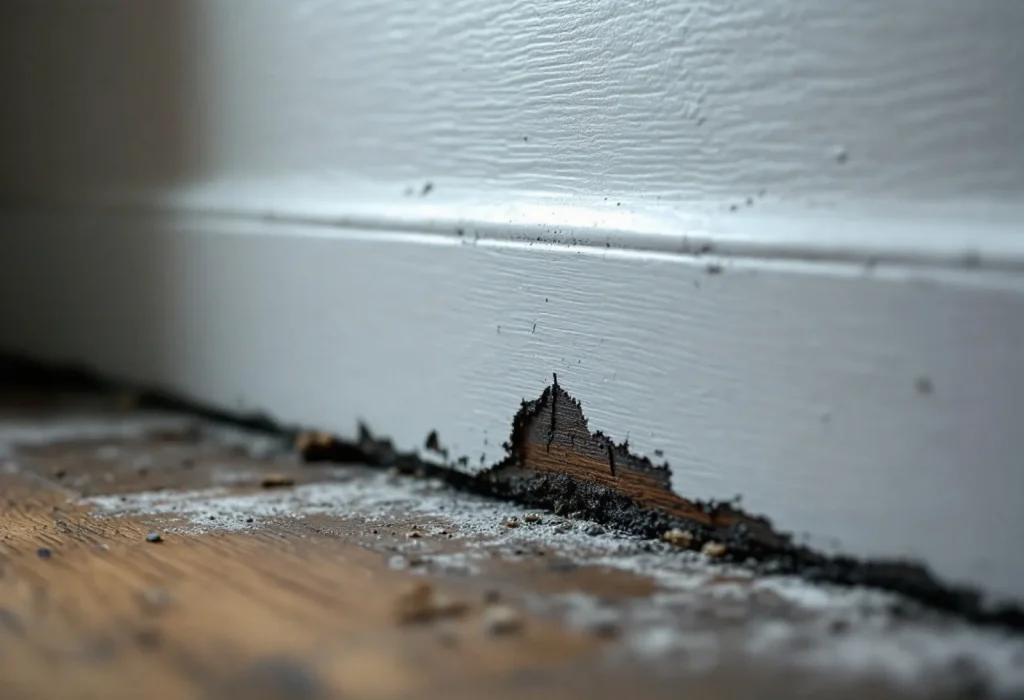
The short answer
Water damage to door frame parts calls for a decision by jamb material and moisture reading: replace swollen MDF, dry finger jointed pine and splice a soft foot, and use epoxy only below 17% moisture, the Abatron limit. The USDA Wood Handbook puts serious decay above about 30%, so dry the jamb, probe it, then choose.
What is your jamb made of, and what does that allow after a soak?
Chip the paint at the floor end of the jamb before choosing a repair, because the material decides the options. Jeanne Huber's Daily Herald column read a rotted French door jamb this way: peeled primer revealed short glued segments with interlocking finger joints. The door slab is a separate question, and hollow core swelling, peeled veneer and maker edge clauses sit on our page about bathroom door water damage.
| Jamb material | How to tell | What the record says | Response after a soak |
|---|---|---|---|
| MDF or fiberboard jamb | Even brown fiber at a chip, no grain and no joints | Urea formaldehyde bonded MDF: moisture breaks down the bond chemistry, and swelling can permanently damage fiber composites, per the Wood Handbook, chapter 11. | Replace the swollen leg or the unit. Do not wait for it to shrink back. |
| Finger jointed pine, primed | Zigzag glue lines between short segments, visible where paint has peeled | Pines not named elsewhere rate slightly or nonresistant to decay in Table 14-1 of the Wood Handbook, chapter 14. JELD-WEN warrants frames for 1 year and excludes decay outside AuraLast. | Dry to 20% or less, the Wood Handbook margin. Hard wood: refinish, including the end. Soft foot only: splice. Soft past the hinge: replace. |
| Solid softwood or white oak | Continuous grain from floor to head | White oak sits in the resistant group in Table 14-1; Therma-Tru's 2024 fiberglass warranty gives pre-finished oak jambs a lifetime term. | Worth saving. Consolidant and epoxy or a matched lap joint keep a stained jamb stainable. |
| Rot resistant pine (AuraLast and similar) | Paperwork or the maker’s mark; looks like primed pine | AuraLast frame parts are warranted against decay while the original consumer owns the home, not in soil contact, per the JELD-WEN limited warranty. | Read the warranty before cutting: JELD-WEN excludes alteration or modification of the product. |
| Composite foot or full composite | Plastic feel below a seam, or the whole leg; no grain | Endura's FrameSaver page says its composite bottom will not wick water or swell (a maker claim). Therma-Tru lists full composite jambs as lifetime items that need no finish. | Leave the composite alone. Fix the water path and probe the wood above the seam. |
| Labeled fire rated frame | A rating label on the door or frame | Changes outside NFPA 80’s list are field modifications needing listing lab approval, per Allegion's iDigHardware explainer. | No patch without written approval from the maker. Otherwise replace with a listed assembly. |
Floodwater changes the table. FEMA Technical Bulletin 2 (August 2008) rates standard solid wood finish and trim Class 3: it survives clean water but may not clean up after a flood. Decay resistant solid wood is Class 5 and preservative treated wood Class 4, so a jamb soaked by river or sewer water is a stronger replacement case than one soaked by a supply line.
Swollen, wet or rotted: which moisture reading sends you where?
Swelling and rot are different failures. Per the Wood Handbook, chapter 4, wood below about 30% moisture swells as it gains water and shrinks as it loses it, so a solid pine jamb can tighten on the door and then relax. Rot means fungi removed wood substance, and drying stops it without restoring it. A pin meter gives the number: our page on moisture meters for water damage covers how to read one.
| Reading | What the source says | What it means for the jamb |
|---|---|---|
| Below 17% | Abatron’s ceiling for LiquidWood, which warns that moisture diminishes penetration and adhesion (Abatron's LiquidWood instructions) | Epoxy, primer and paint can go on |
| 17% to 20% | Fully air dried wood usually sits at or below 20%, a reasonable margin against fungal damage (Wood Handbook, chapter 14) | Decay stops progressing; keep drying before epoxy |
| 20% to 30% | Below fiber saturation, yet wood still changes size as it gains and loses moisture (Wood Handbook, chapter 4) | Swelling is live here; no paint, no plane yet |
| Above about 30% | Fiber saturation: serious decay occurs only above it (Wood Handbook, chapter 14) | Find the water source first, then dry |
Then probe with an awl at the floor end and behind the weatherstrip. The Wood Handbook, chapter 14 describes brown rot as wood that darkens, cracks across the grain into cube-like pieces and crushes to powder, and white rot as bleached wood that keeps its shape and feels spongy. Hard fibers that resist the point mean swelling or staining, and the jamb keeps its options. Allow the job time: our water damage drying timeline sets out what slows it down.
Did the water come up from the floor or in through the sill?
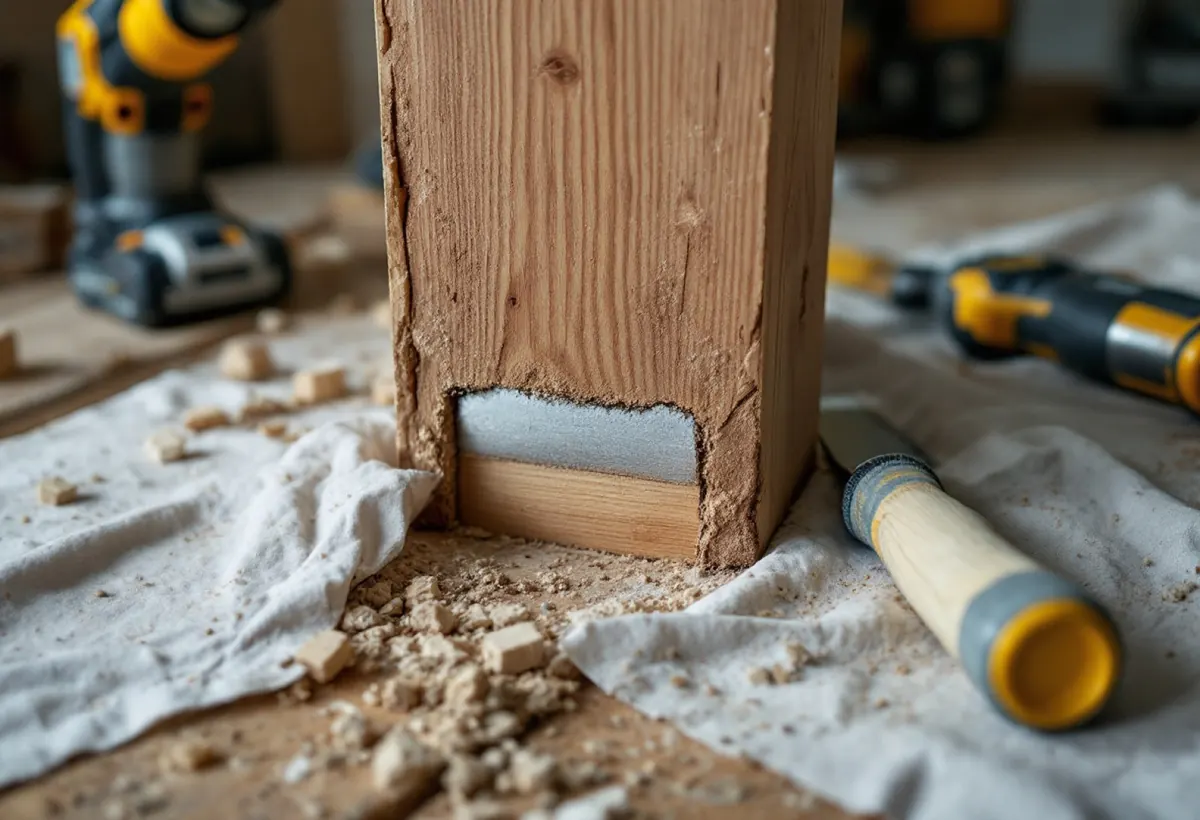
The Wood Handbook, chapter 4 says liquid absorption is most rapid along the grain, when end grain meets water, and a jamb leg stands on its end grain. So an interior flood from a washer or supply line should mark both legs at about the same height and leave the head dry. That pattern is our reasoning from the handbook rather than a published test, and it is quick to check with a meter on each leg.
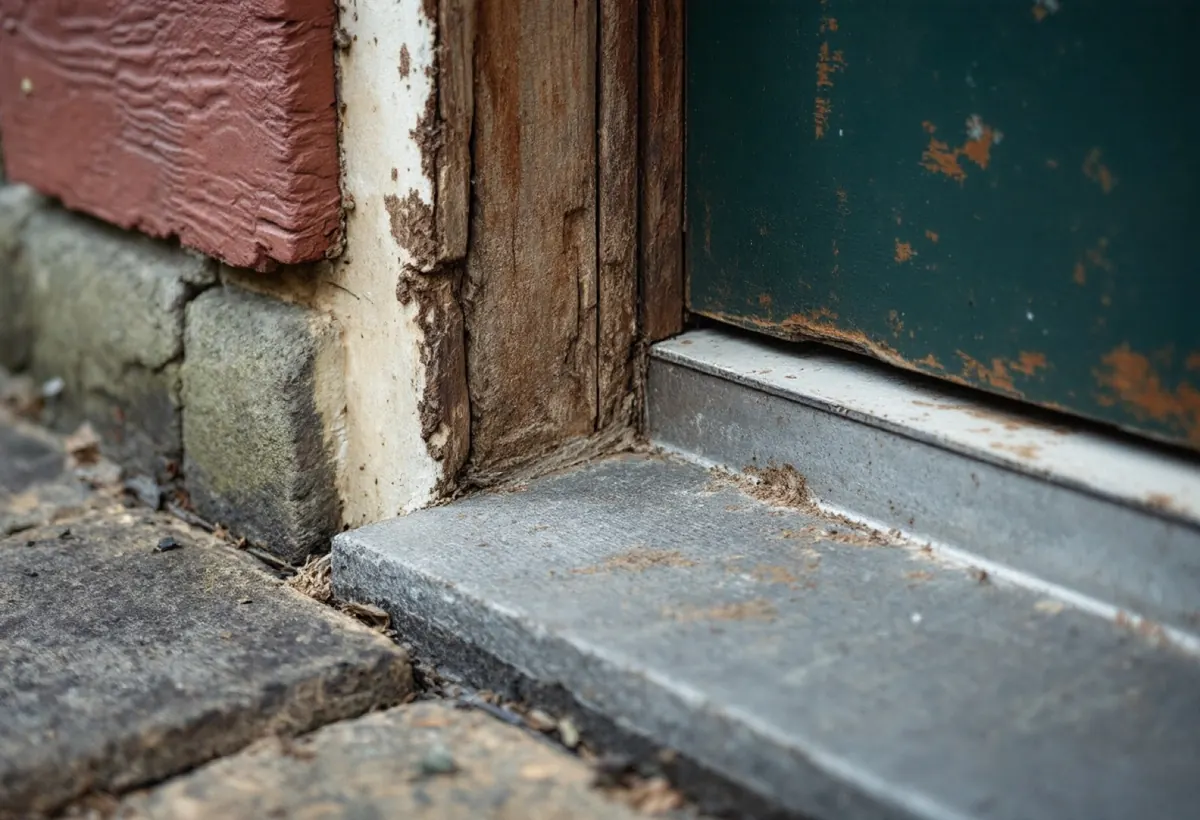
An exterior leak should favor the sill corner and worsen after rain. Therma-Tru's 2015 owner's manual lists the causes in its troubleshooting table: a broken seal where the sill meets the jamb, sealant breakdown between sill and subfloor, a humped sill and a damaged or painted weatherstrip. Its fix for the first is a bead of elastomeric and polyurethane sealant along the entire joint. Humid air alone is rarely the culprit: per the Wood Handbook, only rain, condensation or wet ground bring dried wood to the 30% fiber saturation point.
Warranty language follows the same split. Therma-Tru's 2024 fiberglass warranty excludes “moisture penetration resulting from improper caulking”, and the JELD-WEN limited warranty excludes water infiltration from improper installation or flaws in building design. A soft sill or spongy floor under the threshold moves the job past carpentry, so check the subfloor for water damage before pricing a jamb. The trim and drywall beside a wet jamb have their own entries in our water damage library.
Epoxy, jamb foot splice or full replacement: where is each line?
- Epoxy when rot is small or the shape is hard to copy. Jeanne Huber's Daily Herald column backs filling when rot is not extensive: brush on consolidant until saturated, apply WoodEpox while it is tacky, sand, prime, paint. The wood must read below 17%, per Abatron's LiquidWood instructions.
- Splice when the foot is gone but the leg is sound. The same column measures two kits: Boss-Rx is PVC, 8 inches tall with a lap joint (first cut at 6 3/4 inches), and KS Hardware is primed wood, 12 inches tall with a butt joint. A home-made patch from matching stock works the same way.
- Replace the leg or unit when rot passes the bottom hinge. JELD-WEN JII110 sets the low hinge 10 inches up from the slab bottom on new work, so on that layout a 8 inch splice stops 2 inches short while a 12 inch kit runs 2 inches past it and needs its screws rethought. That arithmetic is ours; measure your own hinge.
- Replace the unit when the sill, the trim and both legs are soft, or the door is labeled. Rated frames follow the garage section further down.
Contractors disagree on where splicing stops paying. One builder in a Fine Homebuilding forum thread says he stopped doing rot surgery after comparing costs, because on a typical entry door the gap was about the price of the door. Another in the thread found a double door’s jamb gone behind the weatherstrip for about 6 inches, which rules out filler because there is nothing left to bond to. Those are forum accounts rather than measurements, so treat them as the question to put to your own carpenter: what does the quote include for matching, weatherstrip and repaint?
Whatever survives needs its end sealed. JELD-WEN JCM004 says to finish wood frames the same way as the slab, and Therma-Tru's 2015 owner's manual gave bare wood frames the lesser of 2 weeks from installation or weather exposure to get primer and paint. Huber’s read of her reader’s jamb is the warning: pre-primed finger jointed stock that was never painted.
What do published prices say a jamb repair costs?
| Job | Published range | Source and date |
|---|---|---|
| Jamb repair or replacement | $180 to $300 | HomeAdvisor, updated 25 April 2025 |
| Doorframe repair (rot, warp, splits) | $350 to $850 | HomeAdvisor, updated 25 April 2025 |
| Frame replacement and pre-hung door with jamb | $150 to $250 | HomeAdvisor, same page; conflicts with the row above |
| Frame casing and stop, no rough framing | $220 to $370 | HomeAdvisor, updated 29 October 2025 |
| Install a door frame, starting range | $363 to $561 | Homewyse, May 2026 national average |
| Replace interior frame | $113 to $222 | CountBricks, undated |
| Replace exterior frame | $131 to $382 | CountBricks, undated |
The sources disagree by more than a factor of two on similar wording, and HomeAdvisor's door repair guide contradicts itself between the doorframe row and the pre-hung row. Comparing scope helps more than the midpoint. According to Homewyse, frame installation starts at $363, only $63 above the $300 top of HomeAdvisor’s jamb repair range (our subtraction), so a repair quote near that top deserves a replacement quote beside it. CountBricks sits lower and HomeAdvisor's interior door guide falls in the middle. According to HomeAdvisor, labor runs $30 to $120 per hour. We could not confirm current retail prices for the Boss-Rx or KS Hardware kits, so none are shown.
Does a 20-minute door to the garage change the repair?
Only if the opening relies on a label. IRC R302.5.1, read in the 2021 code as adopted in Virginia, requires garage to house openings to have solid wood doors at least 1-3/8 inches thick, solid or honeycomb core steel doors at least 1-3/8 inches thick, or 20-minute fire rated doors. It bars garage openings directly into sleeping rooms. A plain 1-3/8 inch solid wood door has no label to protect, so on our reading a jamb splice is ordinary carpentry under that sentence, subject to your local adoption.
A labeled assembly differs. We read NFPA 80 through Allegion's iDigHardware explainer and iDigHardware's 2026 inspection note because the standard itself sits behind NFPA’s paywall: changes not otherwise permitted are field modifications needing advance approval from the listing lab, normally through the manufacturer, and a frame altered without approval may need to be relabeled. Since the 2013 edition, an inspection follows maintenance work on the assembly. Masonite's interior door warranty says the same for slabs: no alteration to a rated door unless expressly authorized under standards such as NFPA 80.
Ask the building department two things before a saw comes out: does this opening need a label under the adopted R302.5.1, and will you accept a spliced jamb if the maker approves it in writing? Those answers decide between a carpenter and a listed replacement assembly.
Could an old door frame hide asbestos or lead paint?
The documented asbestos concern sits in the door rather than the jamb. WorkSafe Western Australia Bulletin 13, published December 2023, says fire doors were commonly made with a core of asbestos or compressed asbestos, that the core often looks white from the top, and that a door without an asbestos-free label should be assumed to contain it. None of the sources read for this page names a plain wood jamb as an asbestos material, but that is an absence in what we read and no clearance. If an older rated door or frame needs cutting, sample first and read our page on asbestos containing material.
Lead paint is the more likely old-jamb issue. Under 40 CFR 745.103, target housing means housing built before 1978, and 40 CFR 745.82 applies the renovation rule to paid work there. 40 CFR 745.83 exempts minor repair disturbing 6 square feet or less per room inside, or 20 square feet outside, but not demolition of painted surface areas. Contractors should ask whether cutting out a painted jamb foot counts as demolition before relying on that exemption. Our lead paint removal page covers the options.
Questions people actually ask
Will a swollen door frame go back to normal on its own?
Solid wood usually will, at least partly. The Wood Handbook says wood below about 30% moisture shrinks as it loses water, so a pine jamb can release the door as it dries. Fiber composites differ: the same handbook warns swelling can permanently damage their adhesive bonds, so a swollen MDF leg is a replacement item. Per the handbook’s air dry margin, recheck the fit once the reading falls under 20%.
Can you use Bondo or wood filler on a rotted door jamb?
Filler alone leaves soft wood underneath. The Daily Herald column of 15 July 2025 pairs a penetrating consolidant with a two part epoxy patch, and Abatron requires under 17% moisture. One builder on a Fine Homebuilding forum who used epoxy or Bondo patches now recommends replacement on entry doors, because the patch needed more work later. Where the wood is gone, cut it out.
Do I have to take the door off to repair a door jamb?
For a splice, yes. The Boss-Rx steps in the Daily Herald column start with tapping up the hinge pins and lifting the door out, then removing weatherstrip and prying off the exterior trim before a cut at 6 3/4 inches. The consolidant and epoxy route in the same column lists no door removal, only clean, dry wood.
Is mold on a door jamb the same as rot?
No. The JELD-WEN warranty states that superficial mold or mildew does not indicate wood decay, and the Wood Handbook says humid air can support some mold fungi without wetting wood enough for significant decay, which needs about 30% moisture. Probe the jamb with an awl to separate them, then follow our page on mold on wood for cleanup.
Does a door warranty cover a rotted jamb?
Often not. JELD-WEN’s 2019 warranty gives door frames 1 year and excludes decay outside AuraLast pine. Therma-Tru’s 2024 fiberglass warranty gives 2 years on standard jambs and brickmould, against lifetime for full composite or rot resistant primed jambs, and excludes reinstallation. Endura advertises a transferable lifetime warranty on FrameSaver. Ask the maker for the warranty dated to your unit’s purchase.
How do I stop a new jamb from rotting at the bottom?
Seal the end grain before the leg stands on the floor, since the Wood Handbook says water enters fastest there. JELD-WEN says wood frames get finished like the slab, on all surfaces. Then keep the path shut: Therma-Tru’s manual calls for sealant along the full sill and jamb joint, plus weatherstrip that the door meets evenly from top to bottom.
Sources
- USDA Forest Products Laboratory, Wood Handbook FPL-GTR-282, chapter 14: Biodeterioration of Wood (Internet Archive copy; the FPL server refused direct requests), retrieved 2 November 2026.
- USDA Forest Products Laboratory, Wood Handbook FPL-GTR-282, chapter 4: Moisture Relations (Internet Archive copy), retrieved 2 November 2026.
- USDA Forest Products Laboratory, Wood Handbook FPL-GTR-282, chapter 11: Wood-Based Composite Materials (Internet Archive copy), retrieved 2 November 2026.
- FEMA, Technical Bulletin 2: Flood Damage-Resistant Materials Requirements, August 2008, retrieved 2 November 2026.
- Abatron, LiquidWood and WoodEpox instructions, retrieved 2 November 2026.
- Jeanne Huber, Daily Herald, The wood around our French doors is rotting, 15 July 2025, retrieved 2 November 2026.
- Fine Homebuilding, Rotting door jambs, forum thread (anecdotal), retrieved 2 November 2026.
- JELD-WEN, Interior and Exterior Door Slab and System Limited Warranty, products made on or after 1 June 2019, retrieved 2 November 2026.
- JELD-WEN, Installation Instructions for Interior Door Slabs, JII110, 2018, retrieved 2 November 2026.
- JELD-WEN, Finishing and Refinishing Instructions, JCM004, retrieved 2 November 2026.
- Therma-Tru, Fiberglass Doors Warranty Information, purchases on or after 1 June 2024, retrieved 2 November 2026.
- Therma-Tru, 2015 Owner's Manual, retrieved 2 November 2026.
- Endura Products, FrameSaver door frame page (maker claims), retrieved 2 November 2026.
- Masonite, Interior Door Warranty, doors purchased after 15 May 2020, retrieved 2 November 2026.
- UpCodes, 2021 International Residential Code as adopted in Virginia, section R302.5.1, retrieved 2 November 2026.
- Allegion iDigHardware, Decoded: Alterations to Fire Door Assemblies, retrieved 2 November 2026.
- Allegion iDigHardware, FDAI inspection criteria 11, January 2026, retrieved 2 November 2026.
- WorkSafe Western Australia, Health and Safety Bulletin 13: Fire doors containing friable asbestos material, retrieved 2 November 2026.
- Legal Information Institute, 40 CFR 745.82, 40 CFR 745.83 and 40 CFR 745.103, retrieved 2 November 2026.
- HomeAdvisor, Door repair cost guide, updated 25 April 2025 (Internet Archive capture of 23 October 2025), retrieved 2 November 2026.
- HomeAdvisor, Interior door cost guide, updated 29 October 2025 (Internet Archive capture of 10 January 2026), retrieved 2 November 2026.
- Homewyse, Cost to Install Door Frame, May 2026, retrieved 2 November 2026.
- CountBricks, How much to replace a door frame (undated), retrieved 2 November 2026.
Warranty terms are quoted from the versions named above and change by purchase date; check the document for your unit. We read standards, regulations and published prices and did not inspect any door. How we check facts: our methodology.