The short answer
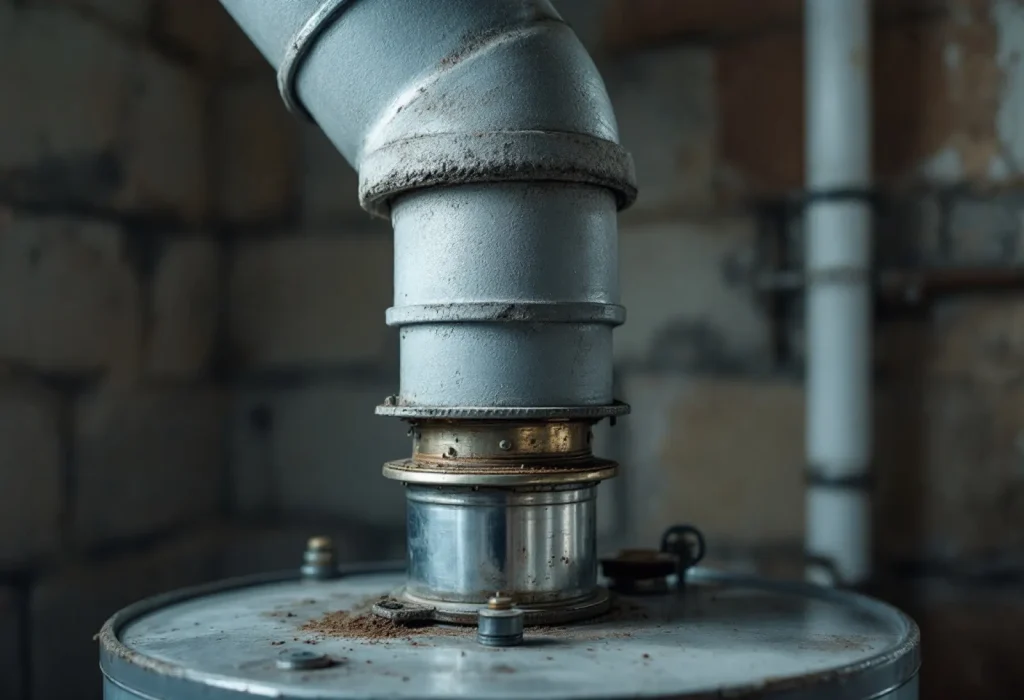
An asbestos flue pipe is a grey or off-white asbestos cement (transite) vent that carried exhaust from a gas furnace, boiler or water heater up through the attic, or lined a chimney. EPA’s 1985 building guidance lists asbestos cement pipe at 15 to 20 percent asbestos. Only a lab result confirms it, and intact pipe is Category II nonfriable under federal air rules.
Where does transite sit on a gas water heater or furnace vent? Four places on one run
Two government product lists name the parts. The Australia's Asbestos and Silica Safety and Eradication Agency product guide describes asbestos cement flue components for gas and briquette heaters, gas hot water systems, cookers and central heating units: straight pipes, bends, connectors, adapters, baffles and cowls, used before 1990. The Minnesota Department of Health product list lists chimney flue lining under cement asbestos board (Transite) products.
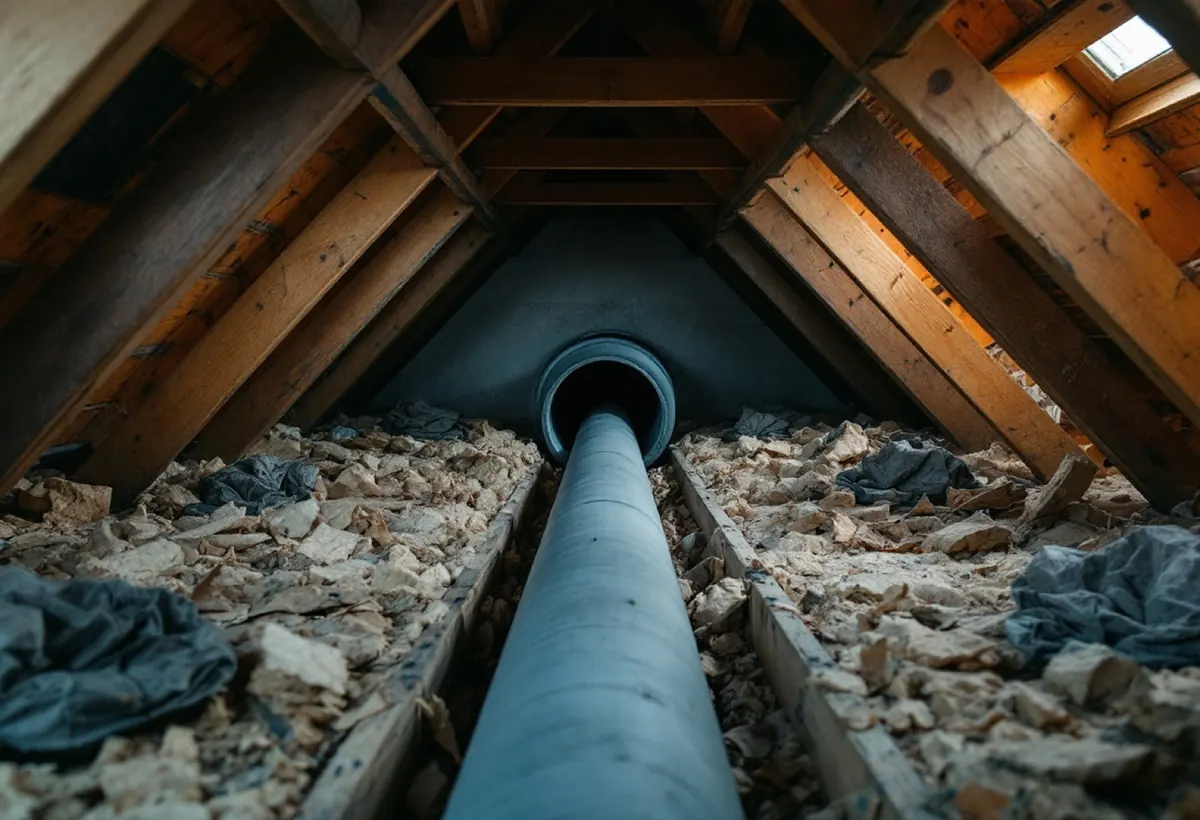
Point 2 is the one most buyers meet, a round grey pipe rising from a basement water heater through the living floors and out of the roof. The Australia's Asbestos and Silica Safety and Eradication Agency product guide adds two warnings that apply on any continent: asbestos cement parts may be hidden under steel or tin coverings, and asbestos dust or ash can build up inside the pipework, so the inside of the run is a second suspect surface.
Asbestos cement water mains, sewer laterals and drain lines are the same material in a different job, and their rules are covered on our asbestos cement pipe page. Vent sizing and replacement belong to the heating trade, which our sister site thehvacbrief.com covers.
How do you tell a transite flue from metal, clay or plastic? An identification table by look and era
EPA's homeowner asbestos page sets the limit on every visual check: generally, you cannot tell whether a material contains asbestos simply by looking at it unless it is labeled, and if in doubt you treat it as asbestos and leave it alone. The table below narrows what to sample; it never clears a pipe.
| Part | What it looks like | Era in the sources | What to do |
|---|---|---|---|
| Asbestos cement vent pipe | Matte grey or off-white, cement-like, rigid, thick wall; collar joints; may be painted | Pipe listed from 1935 (EPA 1985); AC flue parts before 1990 (ASSEA) | Suspect: sample |
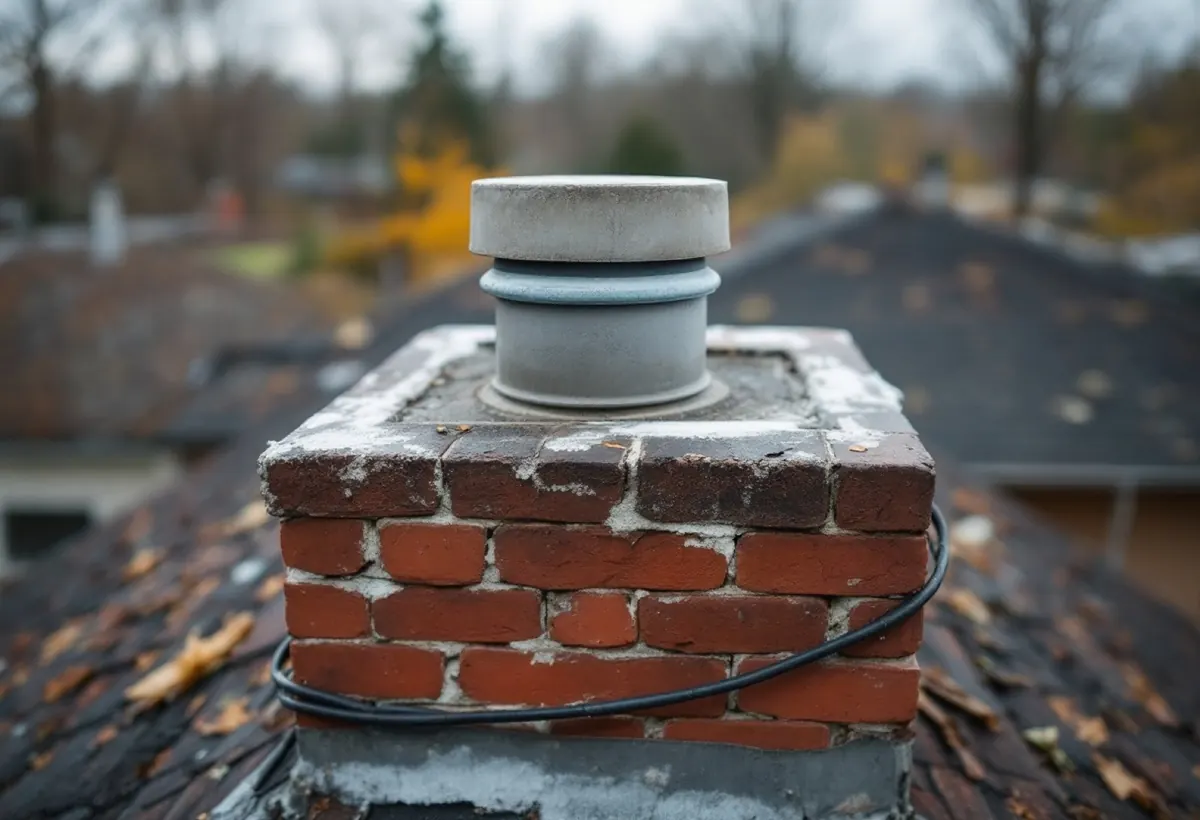
| Asbestos cement chimney liner | Round grey tube inside masonry, often visible at the crown or the cleanout | Listed by Minnesota Health under Transite products; not dated | Suspect: sample |
| Asbestos cement cap or cowl | Grey cement hood on top of the vent pipe | AC cowls listed by ASSEA, before 1990 | Suspect: sample |
| Cement pipe under a metal jacket | Steel or tin outer cover; cement edge visible at a cut or joint | ASSEA: AC parts may be hidden under coverings | Suspect: look at joints |
| Large plastic look pipe | Smooth, uniform, light; ASSEA says larger AC pipes may look like PVC | No date in sources read | Do not rule out by eye |
| Metal vent or connector | Shiny or galvanized sheet metal, seams and crimped ends | No date in sources read | Not cement; check joint seals |
| Clay tile chimney liner | Square or round fired clay sections, orange or buff | No date in sources read | Not cement; check mortar and gaskets |
Content explains why cement pipe was never a borderline case. Appendix A of EPA's 1985 Purple Book (EPA 560/5-85-024) prints asbestos cement pipe at 15 to 20 percent asbestos with a portland cement binder, and flat cement sheet at 40 to 50 percent. The federal line under 40 CFR 61.141 is more than 1 percent, so a positive flue result clears it many times over.
Stamps and brand marks come up in most discussions of transite vent, and no source read for this page documents a reliable marking that proves or rules out asbestos. The Australia's Asbestos and Silica Safety and Eradication Agency product guide names two Australian brands, Fibrolite and Durabestos, without describing marks. What a printed label on newer pipe does and does not prove is set out on our page about the manufactured without asbestos stamp.
Who takes the sample from a flue, and which lab result counts under the 1 percent rule?
The Minnesota Department of Health asbestos pamphlet (13 November 2023) says the only way to determine asbestos is to have samples of suspect materials collected and analyzed, that bulk samples follow the EPA protocol at 40 CFR 763.86, and that the lab must be accredited through NIST’s NVLAP or take part in the AIHA bulk analysis program. In Minnesota, inspections are done by an MDH certified asbestos inspector.
EPA's homeowner asbestos page recommends that a trained and accredited asbestos professional take samples, and says sampling done incorrectly can be more hazardous than leaving the material alone. A flue adds a reason: breaking a chip off a vent can open a crack in a pipe that carries combustion gas, so ask the inspector how the sample point will be sealed and whether the appliance should stay off until it is.
Under 40 CFR 61.141, every asbestos category in the federal air rule starts at more than 1 percent asbestos by polarized light microscopy using Appendix E to Subpart E of 40 CFR Part 763. Ask for separate result lines for the pipe wall, the joint sealant and any rope gasket, since each is a separate material. How to pick a lab and read the report is covered on our asbestos testing lab page.
Is an intact transite flue Category II nonfriable, and when does it become regulated?
Yes, while it stays whole. 40 CFR 61.141 defines Category II nonfriable ACM as any material other than Category I (packings, gaskets, resilient floor covering and asphalt roofing) that contains more than 1 percent asbestos and, when dry, cannot be crumbled, pulverized or reduced to powder by hand pressure. Sound cement pipe meets that description.
The status changes with the removal method. The same section defines regulated asbestos containing material (RACM) to include Category II nonfriable ACM that has a high probability of becoming, or has become, crumbled, pulverized or reduced to powder by the forces expected during demolition or renovation. A flue taken down in whole sections stays Category II; one broken out with a hammer is RACM, with the handling duties that follow.
For most houses the federal rule then steps aside. 40 CFR 61.141 excludes residential buildings having four or fewer dwelling units from the definition of a facility, and the notice duties in 40 CFR 61.145 start at 260 linear feet of RACM on pipes, 160 square feet on other components or 35 cubic feet, with notice at least 10 working days before work. Apartment buildings of five or more units, schools and commercial buildings are facilities.
Friability is a hand test on dry material, and a weathered flue cap or a liner eroded by years of exhaust can fail it even where the pipe below passes. Our guide to friable asbestos explains how inspectors make that call and why it moves a job between rule sets under 40 CFR 61.141.
Can a transite flue stay when the water heater or furnace is replaced?
As asbestos, intact pipe can stay. EPA's homeowner asbestos page says material in good condition that will not be disturbed should be left alone, and that for slightly damaged material the best course is sometimes to limit access and not touch it. If material is more than slightly damaged, or a change to the home might disturb it, EPA says repair or removal by a trained and accredited professional is needed.
As a vent, the question belongs to the gas code and the heating trade, not the asbestos rules. The Australia's Asbestos and Silica Safety and Eradication Agency product guide notes that such installations may be a fire hazard because the pipe structure can split from use, and that dust or ash can build up inside. Before a new appliance is connected to an old cement run, ask the installer and the local building department two things: whether the existing vent is approved for the new appliance, and how they will check its interior.
Abandoning the run in place, capped top and bottom, avoids cutting the cement at all. It is not automatically outside the rules: in Minnesota the regulated work is removal, encapsulation or enclosure above 10 linear feet, per MDH guidance for other contractors. Ask the state program whether sealing the openings counts as enclosure before anyone starts.
Sealing an asbestos surface is a recognized repair. EPA's homeowner asbestos page describes encapsulation as treating material with a sealant that binds the fibers or coats the surface, and says it should be done only by a professional trained to handle asbestos. Encapsulant on a pipe that carries hot exhaust needs a product rated for that temperature, so ask the contractor for the data sheet.
Who may take it out? Owner occupant rules in New York, Puget Sound and Minnesota compared
New York is the clearest. New York State Department of Labor publication P229 quotes Industrial Code Rule 56, Section 1.3(a): the asbestos abatement rules do not apply to owner-occupied single-family dwellings where the owner performs the work. All three conditions must hold. A house slated for demolition is not occupied, flippers and landlords are not owners, and hiring anyone ends the exemption. The department says there is no restriction on type or amount, and still recommends licensed contractors.
In the Puget Sound Clean Air Agency area of Washington, an owner who lives in a single-family house may survey and remove asbestos personally; renters and condo owners must hire a certified abatement contractor. Per the agency, friable removal needs a Single-Family Residence Notification and a $25 fee unless it is under 10 linear feet of pipe or 48 square feet a year, and the debris must go to an authorized facility within 10 days. Nonfriable material follows a separate method under the agency’s Regulation III, Section 4.05(c).
Minnesota draws the line by quantity. The Minnesota Department of Health asbestos pamphlet (13 November 2023) says that in a single family home or a building under five units, disturbing more than 6 square feet, 10 linear feet or 1 cubic foot of ACM is regulated, and MDH guidance for other contractors states that only an MDH licensed asbestos contractor may disturb those amounts; notice goes to MDH at least 5 calendar days ahead. The pamphlet does not state an owner exemption and sends removal questions to the MDH Asbestos and Lead Compliance Unit.
| Example flue run | Minnesota (MDH) | Puget Sound, WA (PSCAA) | New York owner occupant | Federal NESHAP |
|---|---|---|---|---|
| Connector only, appliance to chimney, 6 ft | At or under 10 ft: below MDH amount | No notice if friable; nonfriable has its own method | No amount limit for the owner | Not a facility; run is 2 percent of 260 ft |
| Basement heater to roof, one story house, 18 ft | Regulated: MDH licensed contractor | Notice and $25 fee if friable; nonfriable has its own method | No amount limit for the owner | Not a facility; run is 7 percent of 260 ft |
| Basement heater to roof, two story house, 30 ft | Regulated: MDH licensed contractor | Notice and $25 fee if friable; nonfriable has its own method | No amount limit for the owner | Not a facility; run is 12 percent of 260 ft |
Disposal is separate from removal everywhere. NYSDOL says it has no jurisdiction once asbestos enters the waste stream and points to the Department of Environmental Conservation and the landfill. Wrapping, labeling and landfill acceptance by state are on our asbestos disposal page. Elsewhere, ask your state asbestos program three things: whether an owner occupant exemption exists, what length triggers notice, and whether nonfriable cement pipe has its own method.
What does asbestos flue pipe removal cost? Three published sources, and only one prices a flue
The one flue specific estimate found, according to LatestCost, puts a straightforward single flue at $1,500 to $4,500 with an average near $2,800. It names no survey or bid data behind the figures, so treat it as a planning range. The two broader cost guides price wrapped pipe insulation, a different job.
| Source and date | What it prices | Published figure | Fit for a transite flue |
|---|---|---|---|
| LatestCost, 2026 guide | One transite flue, residential | $1,500 to $4,500; average near $2,800; hard access above $6,000 | Only flue specific source found; no data source named |
| LatestCost, 2026 guide | Per linear foot of flue | $50 to $300 or more | Runs under 10 ft may carry a $1,000 to $2,000 minimum |
| Bob Vila, updated 21 December 2023 | Whole asbestos project | $1,192 to $3,240; national average $2,201 | Not specific to flues |
| Bob Vila, updated 21 December 2023 | Pipe insulation wrap | $2 to $5 per linear foot; $5 to $15 per sq ft | Wrap on a pipe, not a cement pipe |
| Fixr, updated 18 August 2022 | Pipe (wrap insulation) | $10 to $15 per sq ft | Wrap on a pipe, not a cement pipe |
Per-foot wrap prices undercount a flue for a mechanical reason. A roof penetration or a chimney liner has to be reached from above, and 29 CFR 1926.1101 bars dry sweeping and compressed air cleanup on asbestos work, so setup and cleanup carry most of the bill on a short run. Ask each bidder to price containment, roof or chimney closure, disposal and any air test as separate lines, plus the new vent from the heating contractor.
Whole-house budgets, per square foot rates by material and what drives an abatement quote are compared on our asbestos removal cost page, which uses the same rule of naming every price source and its date.
For contractors: is a transite vent Class II work under 1926.1101, and which tools are banned?
29 CFR 1926.1101(b) defines Class II work as removal of ACM that is not thermal system insulation or surfacing material, naming wallboard, floor tile, roofing and siding shingles and construction mastics as examples. Thermal system insulation means ACM applied to pipes, boilers, breeching or ducts to prevent heat loss; a cement vent is the pipe itself, so Class II is the reading, and PACM covers only TSI and surfacing in buildings constructed no later than 1980.
The closest named practice is paragraph (g)(8)(iii) of 29 CFR 1926.1101, for cementitious siding, shingles and transite panels on building exteriors: no cutting, abrading or breaking unless less dusty methods cannot be used, amended water before removal, and wrapped or bagged pieces lowered by the end of the shift. Under paragraph (g)(3), high-speed abrasive disc saws without HEPA exhaust, compressed air cleaning and dry sweeping are banned outright.
Exposure limits are 0.1 fiber per cubic centimeter as an 8 hour time-weighted average and 1.0 f/cc over 30 minutes under 29 CFR 1926.1101(c). Indoor Class II work needs critical barriers or an equivalent isolation method unless the employer has a negative exposure assessment and removes the material substantially intact. Training under paragraph (k)(9)(iv)(A) for transite panel work is at least 8 hours with hands-on practice, repeated annually.
Homeowners comparing bids can use that rule as a check. Ask whether the crew lowers the flue in whole sections, how they seal the roof or chimney opening, and who holds the supervisor training that 29 CFR 1926.1101 requires of the competent person on Class II jobs. The step-by-step sequence for a hired removal is on our how to remove asbestos page.
Out of scope: health effects. This page reads regulations, agency product lists and published prices only; for health information see EPA's Learn About Asbestos page and CDC’s Agency for Toxic Substances and Disease Registry.
Questions people actually ask
How do I tell if my chimney has asbestos?
Look down the chimney crown or into the cleanout for a round grey cement tube inside the brick: the Minnesota Department of Health lists chimney flue lining among Transite products. A clay liner is fired tile in square or round sections. Only a lab sample settles it, so ask an inspector to sample the liner, the joint sealant and any cap separately under the 1 percent PLM rule.
Is the rope gasket on an old boiler flue asbestos?
It can be. Appendix A of EPA’s 1985 Purple Book lists asbestos cord, rope and yarn at 80 to 100 percent asbestos, in use from 1920. Under 40 CFR 61.141, gaskets and packings are Category I nonfriable material, a different category from the cement pipe itself. Ask for the rope to be sampled as its own layer.
Can I paint a transite flue to seal it?
EPA’s homeowner page calls sealing, or encapsulation, a repair that binds or coats asbestos material, and says it should be done only by a professional trained to handle asbestos. On a vent, the coating also has to tolerate exhaust heat. Ask for the product’s temperature rating and whether the vent still meets the gas code for the appliance it serves.
When did they stop making asbestos flue pipe?
No single date applies. EPA issued a rule on 12 July 1989 banning most asbestos products, and the Fifth Circuit overturned it in 1991; only flooring felt, rollboard and certain papers stayed banned, per EPA’s ban page. Australia’s asbestos agency dates asbestos cement flue parts there to before 1990. In the US, age alone never clears a pipe.
Do I need a permit to remove a 10 foot transite vent myself?
It turns on state law. New York’s Rule 56 exempts an owner doing the work in an owner-occupied single-family house. According to the Puget Sound Clean Air Agency, a $25 notification applies only to friable removal of 10 linear feet of pipe or more a year. Minnesota regulates more than 10 linear feet in a home and says only licensed contractors may disturb that amount.
Sources
- EPA's 1985 Purple Book (EPA 560/5-85-024), Guidance for Controlling Asbestos-Containing Materials in Buildings, U.S. EPA, June 1985, Appendix A. Retrieved 12 November 2026.
- EPA's homeowner asbestos page, Protect Your Family from Exposures to Asbestos, U.S. EPA. Retrieved 12 November 2026.
- EPA's ban and phase-out page, Asbestos Ban and Phase-Out Federal Register Notices, U.S. EPA. Retrieved 12 November 2026.
- 40 CFR 61.141, Definitions, National Emission Standard for Asbestos, Legal Information Institute, Cornell Law School. Retrieved 12 November 2026.
- 40 CFR 61.145, Standard for demolition and renovation, Legal Information Institute, Cornell Law School. Retrieved 12 November 2026.
- 29 CFR 1926.1101, OSHA asbestos standard for construction, Legal Information Institute, Cornell Law School. Retrieved 12 November 2026.
- Minnesota Department of Health product list, Asbestos-Containing Products, Minnesota Department of Health. Retrieved 12 November 2026.
- Minnesota Department of Health asbestos pamphlet (13 November 2023), Before you renovate or demolish, Minnesota Department of Health, dated 13 November 2023. Retrieved 12 November 2026.
- MDH guidance for other contractors, What Other Contractors Need to Know, Minnesota Department of Health. Retrieved 12 November 2026.
- Australia's Asbestos and Silica Safety and Eradication Agency product guide, Asbestos cement flue pipes, cowls and fittings, Asbestos and Silica Safety and Eradication Agency (Australia). Retrieved 12 November 2026.
- New York State Department of Labor publication P229, Asbestos Abatement Homeowner Exemption (P229, 1/26), New York State Department of Labor. Retrieved 12 November 2026.
- Puget Sound Clean Air Agency, Homeowner Renovation, Puget Sound Clean Air Agency. Retrieved 12 November 2026.
- LatestCost, Transite Flue Pipe Removal Cost: Typical Prices and What Changes the Quote 2026. Retrieved 12 November 2026.
- Bob Vila, How Much Does Asbestos Removal Cost?, updated 21 December 2023. Retrieved 12 November 2026.
- Fixr, Asbestos Removal Cost, updated 18 August 2022. Retrieved 12 November 2026.
- EPA's Learn About Asbestos page, Learn About Asbestos, U.S. EPA. Retrieved 12 November 2026.
Prices are quoted as each source printed them and are not averaged. Rules are read from the regulation or agency page, not from summaries; state programs change, so confirm with the agency before work. How we source and check figures: methodology. More rules and standards pages: standards.