The short answer
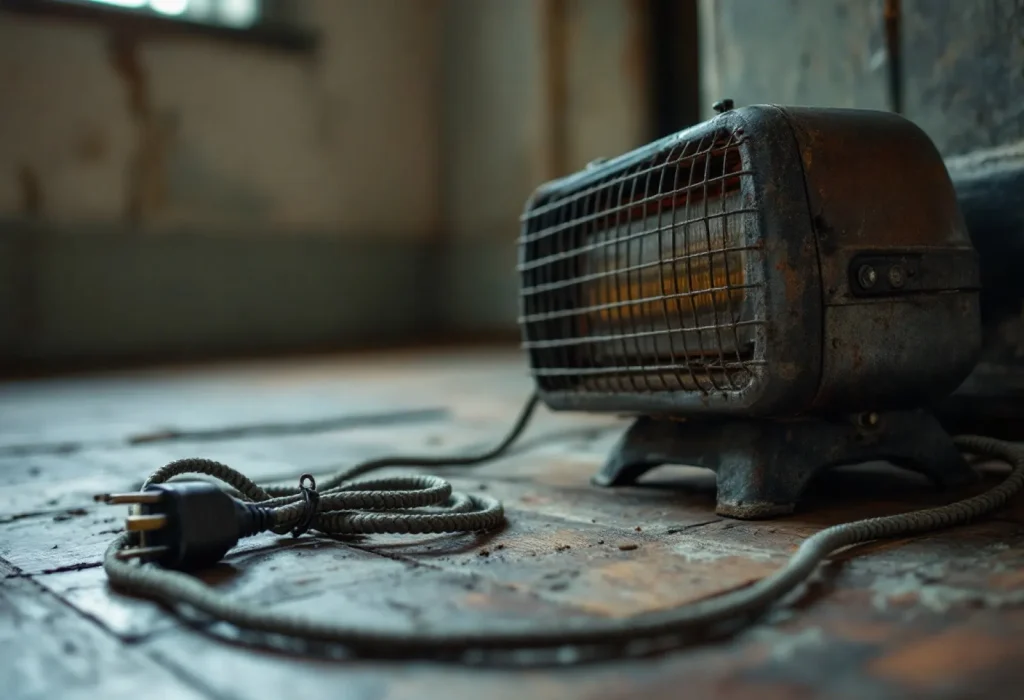
Asbestos wire insulation was real but specialised: the conductor table in US Army Field Manual 5-424 lists asbestos in Types A, AA, AI, AIA, AVA, AVB, AVL, AF, SA and TA, rated 90 to 200°C, plus heater and fixture cords. Ordinary rubber and cotton braid house wire is a different product, and only a lab result above 1 percent confirms asbestos.
Which old wire type letters mean asbestos? A decoder for A, AA, AI, AIA, AVA, AVB, AVL, AF, SA, TA and the heater cords
The decoder below is built from two tables in US Army Field Manual 5-424, Appendix B: Table B-2, Conductor insulation, and Table B-8, Flexible cords. Both follow the trade name and type letter format of the National Electrical Code. Together they name 10 conductor types and 13 cord types whose printed insulation or covering includes asbestos. Every asbestos conductor type in Table B-2 carries the letter A somewhere in its code, and no other type in that table does; in cords, asbestos also hides behind H for heater.
| Type | Insulation as printed | Rating | Use as printed | Source |
|---|---|---|---|---|
| A | Asbestos | 200°C | Dry locations only; in raceways only for loads to or within apparatus; limited to 300 V | FM 5-424 Table B-2 |
| AA | Asbestos | 200°C | Dry locations only; open wiring; in raceways only for loads to or within apparatus; limited to 300 V | FM 5-424 Table B-2 |
| AI | Asbestos | 125°C | Dry locations only; in raceways only for loads to or within apparatus; limited to 300 V | FM 5-424 Table B-2 |
| AIA | Asbestos | 125°C | Dry locations only; open wiring; in raceways only for loads to or within apparatus | FM 5-424 Table B-2 |
| AVA | Asbestos and varnished cambric | 110°C | Dry locations | FM 5-424 Table B-2 |
| AVL | Asbestos and varnished cambric | 110°C | Dry and wet locations | FM 5-424 Table B-2 |
| AVB | Asbestos and varnished cambric | 90°C | Dry locations | FM 5-424 Table B-2 |
| AF | Asbestos covered, heat resistant fixture wire | 150°C | Fixture wiring, limited to 300 V and dry indoor locations | FM 5-424 Table B-2 |
| SA | Silicone asbestos | 90°C | Dry locations; 125°C for special applications | FM 5-424 Table B-2 |
| TA | Thermoplastic and asbestos varnished cambric | 90°C | Switchboard wiring only | FM 5-424 Table B-2 |
| AFC, AFPO, AFPD | Impregnated asbestos; outer: Cotton or rayon braid, or saturated asbestos (AFPO, AFPD) | Not printed | Pendant, dry places | FM 5-424 Table B-8 |
| AFS, AFSJ | Impregnated asbestos; outer: Rubber | Not printed | Portable heaters, damp places | FM 5-424 Table B-8 |
| HC | Rubber and asbestos; outer: Cotton braid on each conductor | Not printed | Portable heaters, dry places | FM 5-424 Table B-8 |
| HPD, HS, HSJ, HSO, HSJO | Rubber with asbestos or all neoprene; outer: Cotton, rayon, rubber or oil resistant compound | Not printed | Portable heaters | FM 5-424 Table B-8 |
| AVPO, AVPD | Asbestos and varnished cambric; outer: Asbestos, flame retardant, moisture resistant | Not printed | Pendant or portable, damp places | FM 5-424 Table B-8 |
Three patterns stand out in the printed uses. Every asbestos building wire row is limited to dry locations except AVL, and Types A, AA and AI are capped at 300 V and allowed in raceways only for loads to or within apparatus. That points to wiring inside or next to hot equipment, not branch circuits run through walls. Of the cords in Table B-8, the AFS and HC families are listed for portable heaters.
Edition dates are the gap in this decoder. The copy of US Army Field Manual 5-424, Appendix B read for this page does not print which Code edition its tables reproduce, and no government or university source opened for this page dates when each asbestos type letter was dropped. Treat a type letter as a reason to sample, never as a date.
Why did heater and fixture wire use asbestos? A 200°C rating against 60°C for code rubber
Heat explains where asbestos went. In Table B-2 of US Army Field Manual 5-424, Appendix B, Types A and AA are rated 200°C, while Code rubber Type R and Thermoplastic Type T are rated 60°C, about 3.3 times lower. A wire feeding a heating element, a lamp socket or an oven terminal had to survive heat that would bake rubber.
EPA’s 1985 building guidance shows the raw material behind those ratings. Appendix A of EPA's 1985 Purple Book (EPA 560/5-85-024) lists asbestos textiles in use from 1920: tape and strip at 90 percent asbestos and cord, rope and yarn at 80 to 100 percent, with cotton or wool as the binder. Those are the same forms a wire maker would wrap or braid around a conductor, though EPA’s table does not tie them to wire.
What does asbestos wire insulation look like in cross section, and what can you not tell by eye?
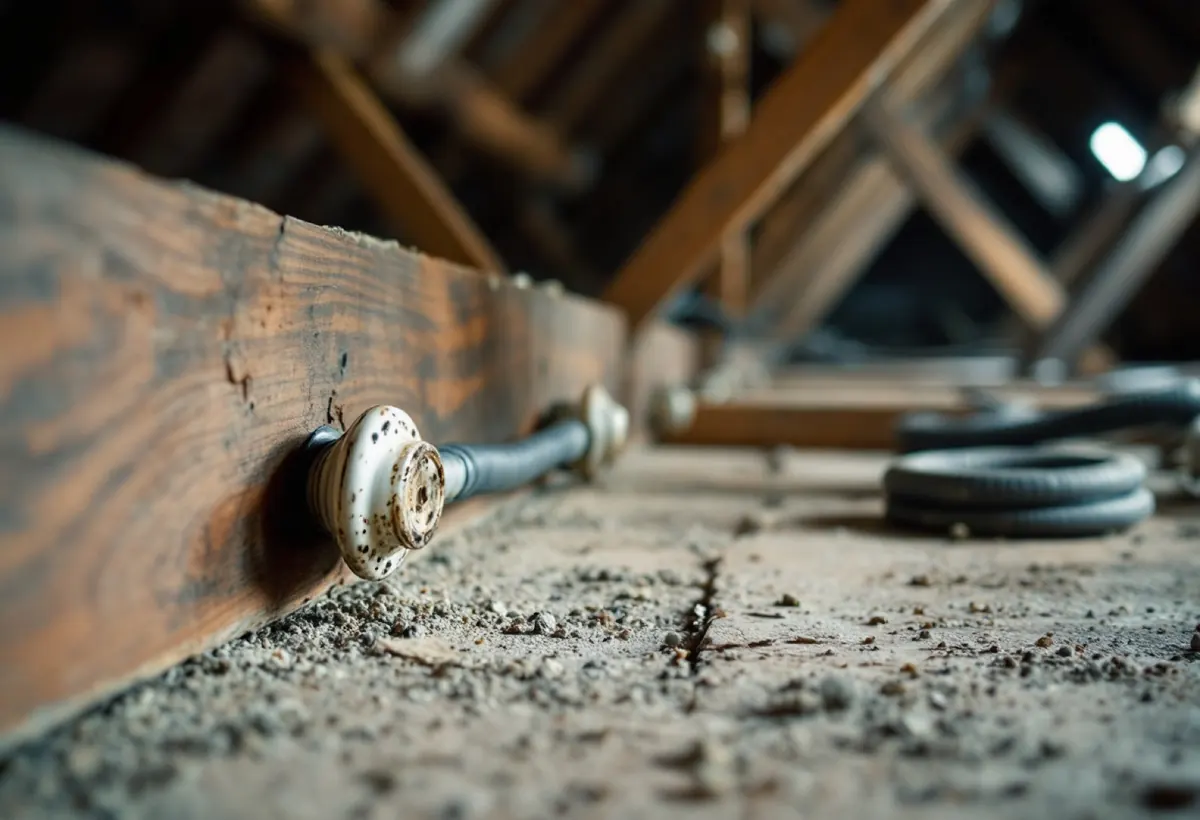
EPA's homeowner asbestos page sets the limit on every visual check: generally, you cannot tell whether a material contains asbestos simply by looking at it unless it is labeled, and if in doubt you treat it as asbestos and leave it alone. A fabric covering is the trap. The asbestos cords in Table B-8 of US Army Field Manual 5-424, Appendix B can carry cotton or rayon braids, so the outside may look like any cloth cord.
The useful clues are context, not texture. A cord on a portable heater, a pendant lamp or a hot appliance terminal sits in the uses printed for the AF, AFS, HC and AV cord families in US Army Field Manual 5-424, Appendix B. A single wire run on porcelain knobs through an attic is the opposite case, covered in the next section. Our photo guide to what asbestos looks like shows the wider set of building products where a visual check helps and where it stops.
Is cloth covered knob and tube or 1940s Romex asbestos? The documented build is rubber under a cotton braid
The construction history points away from asbestos. Per a 2006 Underwriters Laboratories history of residential wiring by David A. Dini, P.E., original residential wiring used gum rubber insulation cured with sulfur, so the copper had to be tinned, and a cotton braid or wrap was added outside the soft rubber for mechanical protection. Wire rated for outdoor use carried three braids saturated with a weatherproofing compound.
The same 2006 paper dates the other cloth you see in old houses. Where knob and tube wires entered boxes and fixtures, a water resistant cotton braid tubing called loom covered them. Nonmetallic sheathed cable was first described in the NEC in 1926, and its early conductors were wrapped in a cotton braid impregnated with varnish or a tar like substance; rayon was permitted around 1950 and a braid was still permitted until 1984.
None of that rules asbestos out. The Minnesota Department of Health product list names cloth wire insulation and insulating cloth among asbestos containing electrical products, alongside breakers, panel arc chutes and panel partitions, without dates or percentages. So the honest reading is this: house circuit wire was usually rubber and cotton, high heat wire was the documented asbestos use, and a braid you plan to cut still gets sampled first. More on the decades involved is on our page about houses with asbestos.
Does a lab count wire insulation as asbestos at 1 percent, and which layer goes in the bag?
Yes, the same line applies as for any building material. 29 CFR 1926.1101 defines asbestos containing material as any material containing more than 1 percent asbestos, and 40 CFR 61.141 sets every federal air rule category at more than 1 percent by polarized light microscopy, using Appendix E to Subpart E of 40 CFR Part 763. The definitions behind that threshold are explained on our page on asbestos containing material.
A wire has layers, and Table B-8 of US Army Field Manual 5-424, Appendix B shows why each one matters: an AVPO cord prints asbestos in both the insulation and the outer covering, while an HC cord prints rubber and asbestos under a cotton braid. Ask the inspector to submit the braid and the inner wrap as separate samples, or to state in writing that they were combined. Choosing a lab and reading its report is covered on our asbestos testing lab page.
EPA's homeowner asbestos page recommends that a trained and accredited asbestos professional take samples and says sampling done incorrectly can be more hazardous than leaving the material alone. On a wire there is a second reason: the conductor may be live. Ask for the circuit to be shut off and proven dead by an electrician before anyone cuts a sample, and ask how the cut will be sealed.
Which OSHA class is cutting out asbestos wire: Class II, III or IV under 29 CFR 1926.1101?
Wire insulation is not thermal system insulation. 29 CFR 1926.1101 defines TSI as ACM applied to pipes, fittings, boilers, breeching, tanks, ducts or other structural components to prevent heat loss or gain. Removing ACM that is neither TSI nor surfacing material is Class II work, the class that also covers wallboard, floor tile, shingles and mastics. Pipe and boiler lagging is the separate case on our thermal system insulation page.
| What the electrician does | Class in 1926.1101 | What the rule requires |
|---|---|---|
| Pulls out and replaces asbestos covered wire or cord | Class II: removal of ACM that is not TSI or surfacing | Respirators when not removed substantially intact, when not wet, or with no negative exposure assessment |
| Cuts back or splices an asbestos braid during repair | Class III: repair and maintenance where ACM is likely to be disturbed | Wet methods; local exhaust to the extent feasible; respirators with no negative exposure assessment |
| Works near intact wire without disturbing it | Class IV: contact without disturbance | Awareness training; wet methods, HEPA vacuums and prompt cleanup of debris |
Two numbers from 29 CFR 1926.1101 anchor the job. The permissible exposure limit is 0.1 fibers per cubic centimeter as an 8 hour time weighted average, and paragraph (h)(3) says employers must not select filtering facepiece respirators for asbestos; where a respirator is required for Class II or III work with no negative exposure assessment, the minimum is an air purifying half mask other than a filtering facepiece.
Can you live with intact asbestos covered wiring, and do federal air rules apply to a house?
As asbestos, intact material can stay. EPA's homeowner asbestos page says material in good condition that will not be disturbed should be left alone, and that it may release fibers when it is disturbed, damaged, removed improperly, repaired, cut, torn, sanded, sawed, drilled or scraped. A brittle braid that flakes when a cord is flexed is damaged material by that description.
Friability decides the federal category. Under 40 CFR 61.141, Category II nonfriable ACM is material above 1 percent that, when dry, cannot be crumbled, pulverized or reduced to powder by hand pressure; a crumbling braid fails that test. Our page on friable asbestos explains how inspectors make the call. The same section excludes residential buildings having four or fewer dwelling units from the definition of a facility, so the federal demolition and renovation notice does not reach most single family rewires.
As wiring, the question is electrical, and the age and condition of a circuit belong to a licensed electrician and the local building department under the NEC edition your state adopted. Per a 2006 Underwriters Laboratories history of residential wiring by David A. Dini, P.E., knob and tube has not been permitted for new installations since the mid 1970s and is still described in Article 394 of the 2005 NEC for existing installations.
What should you ask an electrician before old cloth or heater wire is cut? Five questions with the rule behind each
- Will you have the braid and inner wrap sampled before cutting, and by PLM under 40 CFR 763 Appendix E? The 1 percent line in 40 CFR 61.141 is set by that method.
- Which 29 CFR 1926.1101 class do you treat this as, and do you have a negative exposure assessment for it? The answer sets the respirator duty in paragraph (h).
- Will the wire come out substantially intact, or be cut in place? Class II removal not done intact triggers respirators.
- Will you work wet and HEPA vacuum the debris? Class IV and Class III duties in 1926.1101 both require wet methods.
- Where will removed cord and braid be bagged and disposed of? Ask for the hauler and landfill named in writing, because waste that tests above 1 percent is asbestos containing material under 29 CFR 1926.1101.
Out of scope: health effects. This page reads regulations, agency product lists and published wire tables only; for health information see EPA's Learn About Asbestos page and CDC’s Agency for Toxic Substances and Disease Registry.
Questions people actually ask
Was asbestos used in wire insulation?
Yes. Table B-2 of US Army Field Manual 5-424 prints asbestos in the trade names of conductor Types A, AA, AI, AIA, AVA, AVB, AVL, AF, SA and TA, rated 90 to 200°C, and Table B-8 prints impregnated asbestos in heater and fixture cords such as AFC, AFS and HC. These were high heat products, mostly limited to dry locations and to wiring within or to apparatus.
What does 1920s asbestos insulation look like?
In a 1920s house the fabric forms are the ones EPA dates to that decade. Appendix A of EPA’s 1985 Purple Book lists asbestos tape and strip at 90 percent and cord, rope and yarn at 80 to 100 percent, in use from 1920. They look like any woven tape or cord, so EPA says to treat doubtful material as asbestos and have it sampled.
Is there asbestos in an old electrical box or panel?
Possibly, and not only in the wire. The Minnesota Department of Health lists electrical panels, panel partitions, panel arc chutes and breakers among asbestos containing electrical products, next to cloth wire insulation. A panel board or arc chute needs its own sample under the 1 percent PLM rule in 40 CFR 61.141, taken with the power off.
Is varnished cambric wire always asbestos?
No. In FM 5-424 Table B-2 varnished cambric appears in three trade names: asbestos and varnished cambric (AVA, AVL, AVB), thermoplastic and asbestos varnished cambric (TA), and a Type V rated 85°C whose trade name cell is shared with TA in the copy read. Cambric is a cloth; whether asbestos sits with it depends on the type, and a lab settles it.
Can I cut old cloth wire myself to send a sample?
EPA advises against it: its homeowner page says a trained and accredited professional should take samples and that sampling done incorrectly can be more hazardous than leaving material alone. A wire adds shock risk, so the circuit should be switched off and proven dead by an electrician first, and the cut sealed afterward under 29 CFR 1926.1101 wet methods.
Sources
- US Army Field Manual 5-424, Appendix B, Theater of Operations Electrical Systems, Appendix B Electric Data, Table B-2 Conductor insulation and Table B-8 Flexible cords, Headquarters, Department of the Army. Retrieved 16 November 2026.
- Minnesota Department of Health product list, Common Asbestos-Containing Products, Minnesota Department of Health. Retrieved 16 November 2026.
- EPA's 1985 Purple Book (EPA 560/5-85-024), Guidance for Controlling Asbestos-Containing Materials in Buildings, U.S. EPA, June 1985, Appendix A. Retrieved 16 November 2026.
- EPA's homeowner asbestos page, Protect Your Family from Exposures to Asbestos, U.S. EPA, last updated 25 June 2026. Retrieved 16 November 2026.
- EPA's Learn About Asbestos page, Learn About Asbestos, U.S. EPA, last updated 13 July 2026. Retrieved 16 November 2026.
- 40 CFR 61.141, Definitions, National Emission Standard for Asbestos, Legal Information Institute, Cornell Law School. Retrieved 16 November 2026.
- 29 CFR 1926.1101, Asbestos, OSHA construction standard, Legal Information Institute, Cornell Law School. Retrieved 16 November 2026.
- a 2006 Underwriters Laboratories history of residential wiring by David A. Dini, P.E.: Some History of Residential Wiring Practices in the U.S., Underwriters Laboratories Inc., 2006. Retrieved 16 November 2026.
Type letters, ratings and uses are quoted as the Army tables print them; edition dates for each type were not found in a primary source and are not given. Rules are read from the regulation text, not summaries. How we source and check figures: methodology. More rules and standards pages: standards.