The short answer
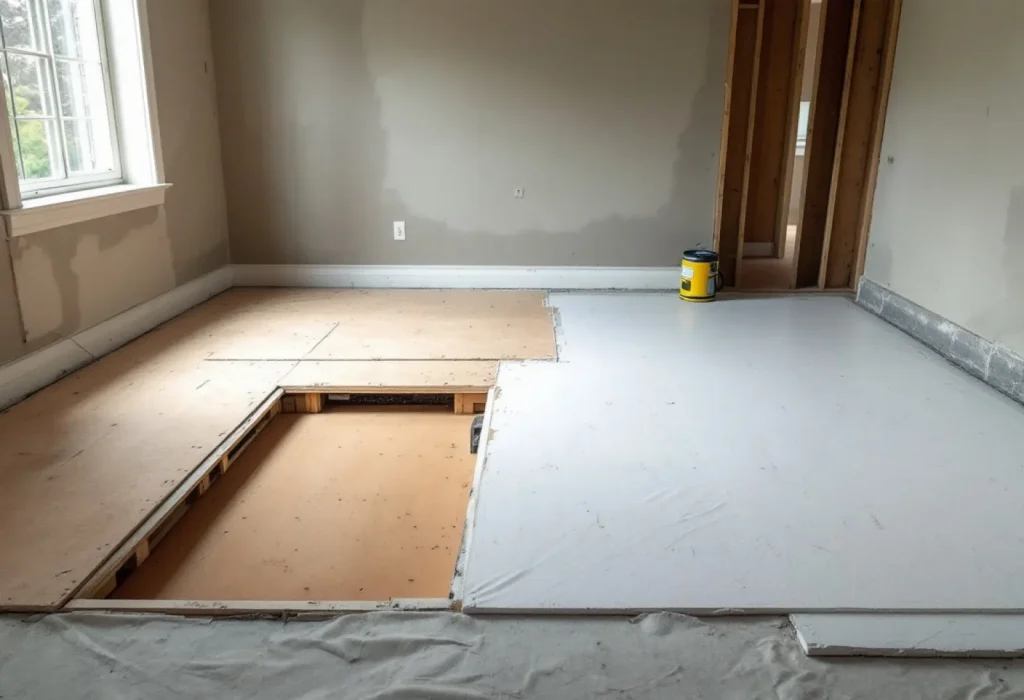
Decomposition smell removal works only when the fluid soaked materials come out: carpet and pad, stained subfloor and the lower drywall go as regulated waste, and the wood left behind is cleaned, disinfected and sealed. Ozone, sprays and odor powders treat the air while the source stays in the floor, so the smell returns. The federal rule for the workers is 29 CFR 1910.1030.
On this page
Why does the smell stay after the body has been removed?
Because the source was never only the body. During an unattended death, fluid leaves the body and moves through whatever it rests on: carpet, then pad, then the plywood or OSB subfloor, then down the joists, sometimes as far as the ceiling of the room below. The 29 CFR 1910.1030 definition of regulated waste describes exactly these items: anything that would release blood or other potentially infectious materials “in a liquid or semi-liquid state if compressed”, and anything caked with dried material that can release it during handling.
The removal of the deceased by the medical examiner or funeral home takes away the largest source of odor and none of the absorbed one. Under the OSHA definition, a pad that releases fluid when stepped on is regulated waste by that fact alone. The ANSI/IICRC S540 standard for trauma and crime scene cleanup assumes the scene has already been released by law enforcement or a regulatory agency before cleanup starts, and it lists structural remediation as its own component, separate from contents.
Which compounds make the smell, and is it really cadaverine?
Guides online usually blame cadaverine and putrescine. The measurement record points elsewhere. In a 2024 study in the International Journal of Legal Medicine, researchers sampled the air inside the body bags of 9 complete human bodies, detected around 350 organic substances, and found that sulfur compounds, mainly dimethyl disulfide and dimethyl trisulfide, were the most important to how the odor was perceived. Putrescine and cadaverine were not detected; the authors note that both cannot be detected by classical GC-MS analysis.
The concentrations vary widely from body to body. Per the study, dimethyl disulfide ran from 289 to 378 micrograms per cubic metre in the stage 1 bags, 447 in one stage 2 body and 1,280 in another. The bodies were held at about 6 degrees Celsius until sampling, so a room at household temperature is not a like for like comparison. The panel also noted that substances present in small amounts were clearly perceptible because of their very low odour threshold.
An earlier laboratory study, a 2015 PLoS ONE study, tracked 6 human and 26 animal remains for 6 months and identified 452 volatile compounds, 77 of them sulfur containing, and did not detect putrescine or cadaverine either. A mixture of hundreds of compounds soaked into porous material is why no single neutralizer chemistry fixes it, and removal does.
Which materials can be cleaned, and which have to come out?
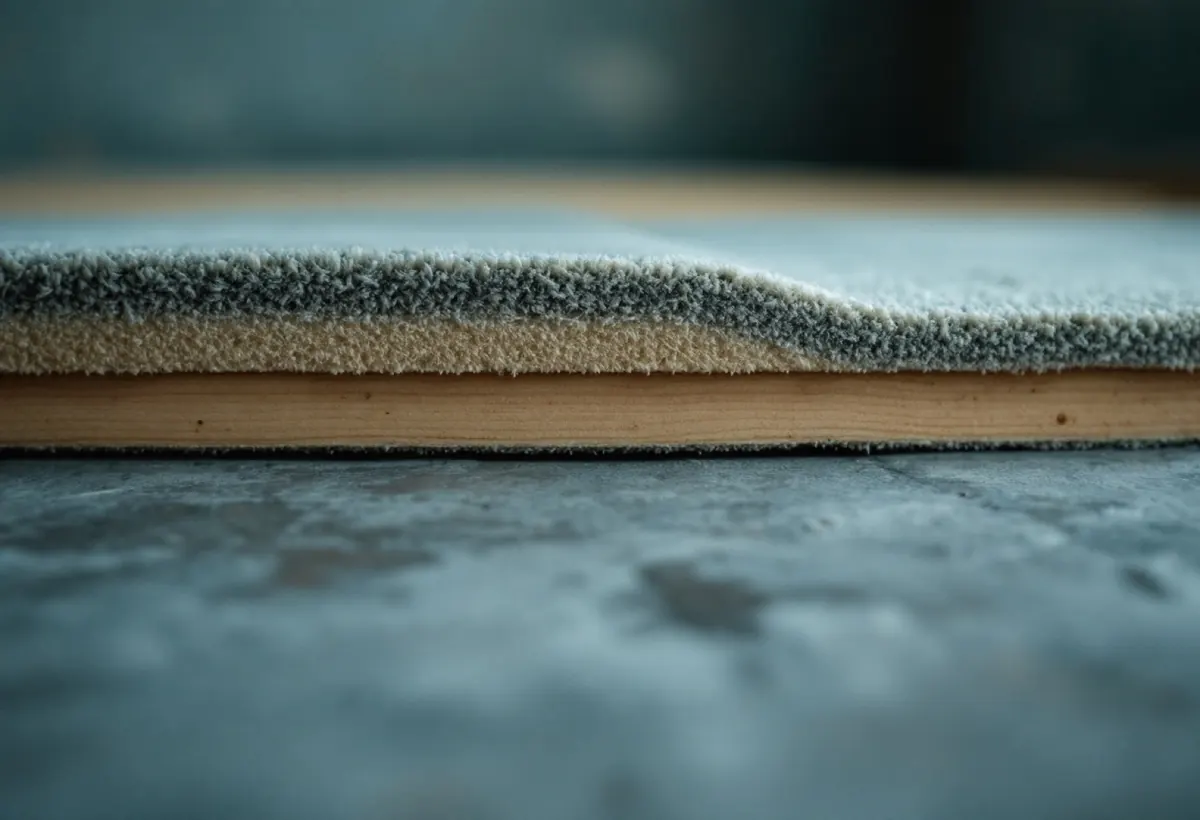
OSHA settled the carpet question in 1994. In the OSHA letter of 10 June 1994, the agency withdrew an earlier statement that plush carpet could be decontaminated and wrote that it had no evidence decontamination of plush carpets is possible. That one sentence is why carpet and pad from a decomposition scene are removed rather than shampooed, and the same logic carries to every soft, thick material in the table.
| Material | Absorbs fluid? | Clean or remove | Rule or source |
|---|---|---|---|
| Carpet and pad | Yes; pad spreads it sideways | Remove and bag | OSHA letter of 10 June 1994: carpet “cannot be routinely decontaminated” |
| Mattress, sofa, upholstered chair | Yes | Remove and bag | 29 CFR 1910.1030 (b): regulated waste includes items that release fluid if compressed |
| Drywall, lower wall | Yes; gypsum and paper face wick upward | Cut out beyond the stain | 29 CFR 1910.1030 (b) regulated waste definition |
| Wood baseboard and trim | Yes, at cut ends and the back face | Remove | 29 CFR 1910.1030 (b) regulated waste definition |
| Hardwood or laminate planks | Yes, through seams and edges | Lift affected boards | 29 CFR 1910.1030 (d)(4)(i): method set by type of surface and soil |
| Sheet vinyl, ceramic tile and grout | Surface no; seams and grout yes | Clean the surface; lift it if fluid went under | 29 CFR 1910.1030 (d)(4)(ii)(A): appropriate disinfectant |
| Plywood or OSB subfloor | Yes | Replace soaked panels; clean, disinfect and seal the rest | Zinsser B-I-N technical data sheet: rated for plywood, blocks odours from urine |
| Floor joists | Yes, at the surface | Clean, disinfect, dry and seal; replacement is a structural call | Zinsser B-I-N technical data sheet: surface must be clean and dry first |
| Concrete slab | Yes; concrete is porous | Clean, disinfect and seal | Zinsser B-I-N technical data sheet: lists concrete and block as interior substrates |
| Glass, metal, sealed stone, hard plastic | No | Clean and decontaminate in place | OSHA letter of 6 May 1994: EPA registered tuberculocidal product or bleach diluted 1:10 to 1:100 |
Subfloor, joists and concrete sit between the two extremes and get a 3 step treatment: clean off organic matter, apply a disinfectant OSHA accepts, then seal once dry.
Sealing is the last step, never the first. The Zinsser B-I-N technical data sheet says the shellac primer “seals in urine and other animal odours” and is recommended for “permanently sealing heavy fire and water stains and odours caused by fires”, but also that surfaces must be “clean, dry, sound” before it goes on. A sealer over a soaked panel traps the source rather than removing it.
Why don’t ozone, sprays and odor powders fix it?
The EPA addresses this directly on its EPA's page on ozone generators. It cites experiments suggesting that “body odor may be masked by the smell of ozone but is not removed by ozone”, and a test at formaldehyde levels representative of an embalming studio in which ozone showed no effect. It adds that even with high levels of ozone, contaminants embedded in porous material “may not be affected at all”.
The exposure limits explain why home units cannot simply be turned up. The same EPA page lists the FDA limit for indoor medical devices at 0.05 ppm, the OSHA limit at 0.10 ppm averaged over 8 hours and the NIOSH ceiling at 0.10 ppm. EPA notes that high ozone in an unoccupied space is sometimes used in fire restoration, and that little is known about the chemical by-products it leaves behind. The trade-offs are set out at ozone generator.
Sprays, powders and enzyme products fail for the same reason: they reach the air and the top surface, and the odor source is in the pad and subfloor. For blood and body fluids, the OSHA letter of 6 May 1994 sets the bar for an “appropriate” disinfectant under 29 CFR 1910.1030(d)(4)(ii)(A): a product registered with the EPA with a tuberculocidal claim, or household bleach diluted between 1:10 and 1:100. A deodorizer does not meet that bar, and neither does a cleaner that is not EPA registered as tuberculocidal.
What order does a cleanup under 29 CFR 1910.1030 follow?
Federal OSHA’s bloodborne pathogens standard, 29 CFR 1910.1030, governs the employees doing this work, not the homeowner. It requires the employer to make hepatitis B vaccination available within 10 working days of initial assignment, to train workers at assignment and at least annually, and to clean and decontaminate surfaces after contact with blood or other potentially infectious materials.
- Scene release. The medical examiner or law enforcement releases the property; ANSI/IICRC S540 assumes this has happened before work begins.
- Protective equipment. Under 29 CFR 1910.1030(d)(3)(i), protection counts as appropriate only if fluid cannot pass through to work clothes, skin, eyes or mouth.
- Remove porous materials as regulated waste. Carpet, pad, upholstered items, lower drywall and trim, cut past the stain line on every layer.
- Clean, then decontaminate. Organic matter comes off first, then an EPA registered tuberculocidal product or 1:10 to 1:100 bleach goes on, per the OSHA letter of 6 May 1994.
- Dry. Wood and concrete must be dry before any sealer or ATP reading; bleach residue can depress ATP results.
- Confirm. An odor check and, where offered, ATP swabs on the same marked spots measured before and after.
- Seal and cure. A shellac primer is touch dry in 15 minutes and recoatable in 30 minutes, but reaches full hardness after 1 to 3 days, per its data sheet.
- Rebuild. New subfloor panels, drywall and flooring go in only after the sealed surfaces pass the odor check.
One federal rule usually does not apply. In its OSHA letter of 15 December 2020, OSHA said a company cleaning a home or business where no emergency has been declared, or after emergency crews have left, falls outside the HAZWOPER standard at 29 CFR 1910.120 and follows the standards that fit its work, chiefly bloodborne pathogens. The broader trade is described at biohazard cleanup, and scenes involving a crime at crime scene cleanup.
Where does soaked flooring go, and what does California require?
Federal OSHA defers to the states on disposal. Section 1910.1030(d)(4)(iii)(C) says disposal of regulated waste “shall be in accordance with applicable regulations” of the United States, states, territories and their political subdivisions. According to EPA's medical waste page, medical waste is primarily regulated by state environmental and health departments, and EPA has had no specific authority over it since the Medical Waste Tracking Act of 1988 expired in 1991. Why blood and body fluids are classed this way is covered at is blood a biohazard.
California has the most explicit rules found for this page. The Medical Waste Management Act defines a trauma scene in Health and Safety Code 117776 as a location soiled by human blood, body fluids or other residues from a serious injury, illness or death, and section 117776(b) says that includes mobile homes, trailers and vehicles. Section 118321.1 requires any company doing this commercially to register with the department.
- Annual registration fee: $200, per the current CDPH fee schedule and section 118321.1(d).
- Removal: trauma scene waste must leave the scene immediately when the removal phase is complete, per section 118321.5(a).
- Storage: it goes to a permitted medical waste transfer station or treatment facility, or a dedicated freezer at the company’s business location for no more than 14 days, per section 118321.5(b).
- Proof: the California Department of Public Health requires proof of a contract with a registered transporter or the permitted facility receiving the waste, and publishes a list of registered practitioners.
In other states, ask the state environmental or health department which permit a trauma scene company needs. Bagging, labelling and hauling in general are covered at biohazard waste disposal.
How is the job confirmed: a nose test, ATP swabs or both?
ANSI/IICRC S540 lists “confirmation of cleaning” as one of its components. The two tools in common use measure different things. An odor check after sealing tells you whether the absorbed source is gone or sealed; an ATP swab tells you how much organic residue remains on a hard surface.
CDC's Options for Evaluating Environmental Cleaning describes ATP bioluminescence as a luciferase assay read by a handheld luminometer and reported in relative light units. It flags three limits that matter here: readout scales vary more than 10 fold between commercial systems, high concentrations of bleach may quench the reaction and lower the reading, and it is unclear whether threshold values for a clean surface can be set. CDC adds that if a bleach based disinfectant is used, the surface should be dry before the ATP test.
So a single post cleaning number means little on its own. A useful report shows readings on the same marked spots before and after cleaning, names the meter brand, because scales differ more than 10 fold per CDC, and states that surfaces were dry. Odor confirmation should come after the sealer has cured for the 1 to 3 days its maker states, since a sealer that is still curing is not yet the finished barrier the data sheet describes.
What should a family or landlord ask before hiring?
- Which state registration or permit do you hold for trauma scene waste, and can I see it? In California the CDPH list answers this.
- Who hauls the waste, and to which permitted facility? Ask for the waste tracking paperwork at the end.
- Which disinfectant will you use, and what is its EPA registration number with a tuberculocidal claim?
- How far past the visible stain will you cut each layer, and will you photograph the subfloor and joists before sealing?
- Will you take ATP readings before and after on the same spots, and with which meter?
- Which sealer, how many coats, and how long will you wait for it to cure before the odor check?
- Do your workers have bloodborne pathogens training within the last 12 months, as 29 CFR 1910.1030(g)(2) requires?
Insurance is a separate question. Homeowners and landlord policies word this differently, so read the policy’s covered perils and exclusions, then ask the state insurance department or a licensed agent whether cleanup, regulated waste disposal and rebuilding are each treated as part of the same claim. Keep the waste manifest and the ATP report, since both document what was removed.
If the smell comes from an animal that died inside a wall, attic or crawl space rather than from a person, locating and removing it is pest control work, covered by The Pest Control Brief. Questions about personal exposure belong with a physician or the local health department; this page covers the cleanup standard only. More standards pages sit in the standards hub.
Questions people actually ask
How long does it take for a decomposing smell to go away?
No agency publishes a timeline, because the smell lasts as long as soaked material stays in the building. Airing out lowers it for hours, and it builds back up from the pad and subfloor. Once those are removed and the remaining wood is sealed, the shellac primer in this guide reaches full hardness in 1 to 3 days per its data sheet, which is when a fair odor check can be made.
How do funeral directors stop a body from smelling?
Mainly with cold. The FTC's Funeral Rule guidance says refrigeration is an acceptable alternative to embalming in most cases, and that no state law requires routine embalming for every death. In the 2024 body bag study cited above, bodies were stored at about 6 degrees Celsius before sampling. Cold slows the process; it does not clean a floor that fluid has already reached.
What is the closest smell to a decomposing body?
Measurement points to sulfur. The 2024 International Journal of Legal Medicine study found dimethyl disulfide and dimethyl trisulfide most important to the odor among around 350 substances detected in the body bags of 9 bodies. Its panel described carbon disulfide samples from stage 2 and 3 bodies as rotten, cheesy and fishy.
Does an enzyme cleaner or odor neutralizer remove decomposition smell?
Only from what it touches, and it is not a disinfectant under OSHA’s test. The 1994 OSHA letter accepts EPA registered tuberculocidal products or bleach diluted 1:10 to 1:100 for blood and body fluids. A neutralizer sprayed on carpet does not reach a soaked pad or a plywood subfloor 2 layers down, which is where the smell returns from.
Can a family clean up after an unattended death themselves?
The OSHA standard, 29 CFR 1910.1030, covers employers and their employees, not a homeowner cleaning their own home. California’s registration rule applies to companies doing the work commercially. The practical barrier is the materials: OSHA says carpet cannot be routinely decontaminated, so most of the job is removal and regulated waste disposal, which needs a hauler and a permitted facility.
Sources
- 29 CFR 1910.1030, Bloodborne pathogens, Occupational Safety and Health Administration, via eCFR: definitions in (b), (d)(3), (d)(4), (f) and (g). Retrieved 20 November 2026.
- OSHA letter of 6 May 1994, standard interpretation on decontamination of plush carpet and hard surfaces, Occupational Safety and Health Administration. Retrieved 20 November 2026.
- OSHA letter of 10 June 1994, standard interpretation correcting an earlier statement on plush carpet, Occupational Safety and Health Administration. Retrieved 20 November 2026.
- OSHA letter of 15 December 2020, standard interpretation on HAZWOPER and bloodborne pathogens for crime and trauma scene cleanup, Occupational Safety and Health Administration. Retrieved 20 November 2026.
- EPA's page on ozone generators, Ozone Generators that are Sold as Air Cleaners, United States Environmental Protection Agency, last updated 19 February 2026. Retrieved 20 November 2026.
- EPA's medical waste page, Medical Waste, United States Environmental Protection Agency, last updated 20 April 2026. Retrieved 20 November 2026.
- California Department of Public Health, Trauma Scene Waste Management Practitioners page, Medical Waste Management Program. Retrieved 20 November 2026.
- Medical Waste Management Act, California Health and Safety Code sections 117776, 117778 and 118321 to 118321.6, CDPH compiled copy dated January 2017. Retrieved 20 November 2026.
- CDPH fee schedule, CDPH form 8862, trauma scene waste management practitioner annual fee. Retrieved 20 November 2026.
- Trauma Scene Cleaning Information, CDPH Medical Waste Management Program, November 2024. Retrieved 20 November 2026.
- ANSI/IICRC S540, Standard for Trauma and Crime Scene Cleanup, Institute of Inspection, Cleaning and Restoration Certification, second edition 2023, scope page. Retrieved 20 November 2026.
- CDC's Options for Evaluating Environmental Cleaning, Guh and Carling, Centers for Disease Control and Prevention, December 2010. Retrieved 20 November 2026.
- a 2024 study in the International Journal of Legal Medicine: Schieweck A, Schulz N, Amendt J, Birngruber C, Holz F, Catch me if you can: emission patterns of human bodies in relation to postmortem changes, volume 138, pages 1603 to 1620. Retrieved 20 November 2026.
- a 2015 PLoS ONE study: Rosier E, Loix S and colleagues, The Search for a Volatile Human Specific Marker in the Decomposition Process, PMID 26375029. Retrieved 20 November 2026.
- Zinsser B-I-N technical data sheet, Rust-Oleum, BIN-03, revised 16 January 2024. Retrieved 20 November 2026.
- FTC's Funeral Rule guidance, Federal Trade Commission consumer advice. Retrieved 20 November 2026.
- Our methodology sets out how sources are chosen and checked. No figure on this page was estimated.
This page describes published standards and regulations. State rules for trauma scene waste differ; confirm registration and disposal requirements with your state health or environmental department.