The short answer
Biohazard waste disposal is set by state law, because EPA says the federal medical waste tracking rules expired in 1991. A household cleaning its own home is excluded in 5 of the 8 states compared here, while a paid California trauma cleaner counts as the generator, must register with CDPH, and may hold bagged waste in a dedicated freezer for 14 days at most.
Can you bag blood-soaked waste from your own home and put it out with the trash?
In most of the states read for this page, yes: the medical waste statutes stop at the front door. California says medical waste does not include household waste (Cal. HSC 117700(e)). Minnesota’s law covers anyone who generates infectious waste “but not including” waste generated by households (Minn. Stat. 116.77). New Jersey (N.J.A.C. 7:26-3A.6), New York (N.Y. Public Health Law 1389-aa) and Pennsylvania (25 Pa. Code 271.1) exclude household or home self-care waste in the definition itself.
California’s CDPH list of registered practitioners dated 26 August 2026 adds a detail no ranking page repeats: because trauma scene waste is defined by who removes it, a neighbour or family member who cleans without being hired does not fall under the Act. The definition at Cal. HSC 117690(b)(6) only reaches waste removed by a trauma scene waste management practitioner.
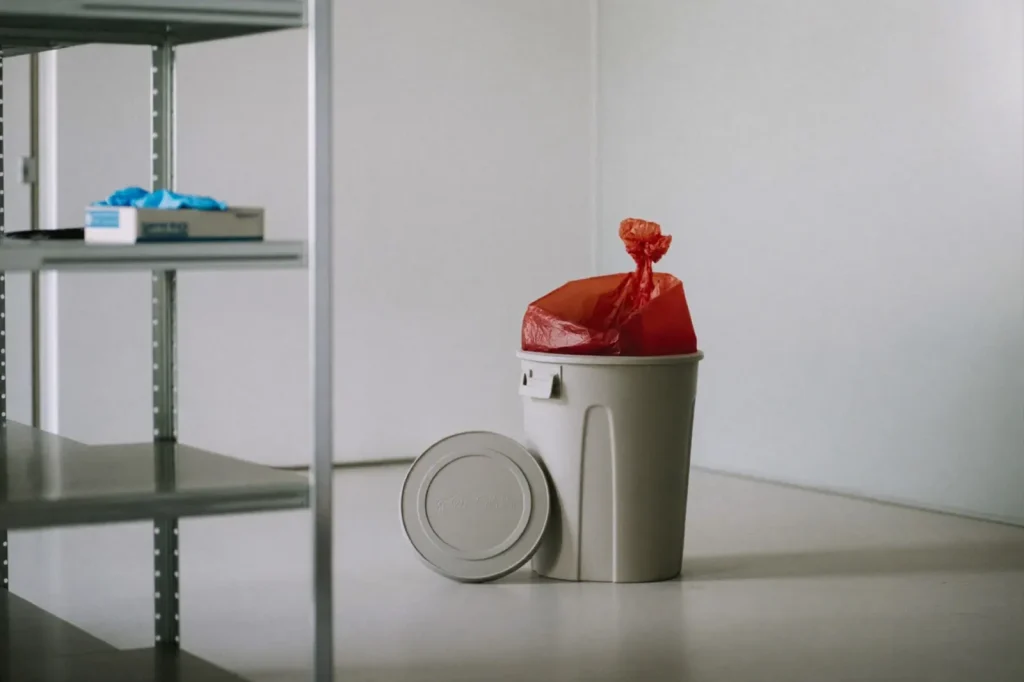
Excluded is not the same as safe to toss loose. Package it so a waste collector cannot be cut or splashed: Florida’s rule tells home users to segregate and package biomedical waste to reduce public exposure (Fla. Admin. Code 64E-16.001(5)), and needles follow the separate household sharps routes described further down. Check the city or county solid waste rules too, since Washington leaves biomedical waste management to local health departments (RCW 70A.228).
When does a paid cleanup company become the legal generator of the waste?
The generator carries the paperwork, the storage clock and the liability for where the bag ends up, so the label matters. California settles it in one line: a trauma scene waste management practitioner who transports trauma scene waste is deemed the generator (Cal. HSC 118321.4). The same practitioner is exempt from separate medical waste hauler registration (Cal. HSC 118321.1(c)), and the CDPH trauma scene page adds that the firm must show a contract with a registered transporter or permitted facility.
Minnesota reaches the same result through a broad definition: a generator is “a person whose activities produce infectious waste” (Minn. Stat. 116.76 subd. 9), and infectious waste includes blood and blood soaked items that drip (Minn. Stat. 116.76 subd. 3). Texas defines a generator as any person whose act or process produces medical waste (30 TAC 326.3(14)), yet its list of 25 covered health care related facility types at 25 TAC 1.134(b) names tattoo studios and funeral establishments and not cleanup contractors. Ask the Texas Department of State Health Services which class your waste falls in before quoting a job.
New Jersey, New York and Pennsylvania write their definitions around medicine. New Jersey’s regulated medical waste is waste “generated in the diagnosis, treatment … or immunization” of people or animals (N.J.A.C. 7:26-3A.6(a)), and its blood class covers items used in patient care, testing or drug development. Pennsylvania’s infectious waste definition begins the same way (25 Pa. Code 271.1). Blood from a home accident does not fit those words neatly, so in those three states the receiving treatment facility’s acceptance terms decide how the waste is classed. Get that in writing.
State by state: generator status, registration, storage clock and household rule in 8 states
The table reads the operative text in each state, not a summary. 5 of the 8 states exclude household waste outright (California, Minnesota, New Jersey, New York, Pennsylvania). Only California names the trauma cleanup trade in statute, and only California, Florida and Pennsylvania put a day count on how long a generator may hold bagged waste before it moves.
| State | Is a cleanup company the generator? | Registration or permit | Storage clock | Household waste |
|---|---|---|---|---|
| California | Yes. A practitioner who transports trauma scene waste is deemed the generator (Cal. HSC 118321.4). | Register with CDPH on Form 8668A; $200 a year (Cal. HSC 118321.1). | Remove on completion; or a dedicated freezer for up to 14 days (Cal. HSC 118321.5). | Household waste is not medical waste (Cal. HSC 117700(e)). |
| Florida | Likely. A generator is any facility or person that produces biomedical waste (Fla. Stat. 381.0098(2)(b); Fla. Admin. Code 64E-16.002(3)). | Permit at 25 lb or more per 30 days; transporters register (Fla. Stat. 381.0098(4), (5)). | 30 days from the first item bagged (Fla. Admin. Code 64E-16.004(1)(a)). | Home users “should” package waste safely; no permit duty (Fla. Admin. Code 64E-16.001(5)). |
| Minnesota | Yes. A generator is a person whose activities produce infectious waste (Minn. Stat. 116.76 subd. 9). | No registration; a written management plan, filed with a $225 fee only for off-site storage or treatment (Minn. Stat. 116.79). | No day limit; a designated, vermin-proof area closed to unauthorized people (Minn. Stat. 116.78 subd. 6). | Waste generated by households is outside the law (Minn. Stat. 116.77). |
| New Jersey | Unclear. Regulated medical waste is defined by diagnosis, treatment or immunization (N.J.A.C. 7:26-3A.6(a)). | Every generator registers yearly; base fee from $85 (N.J.A.C. 7:26-3A.8(a)). | No generator day limit in 7:26-3A.5 to 3A.11. | Home self-care household waste is excluded (N.J.A.C. 7:26-3A.6(b)2). |
| New York | Unclear. The definition covers diagnosis, treatment or immunization (N.Y. Public Health Law 1389-aa(1)); generator duties name hospitals, residential health care facilities and clinical labs (N.Y. Public Health Law 1389-bb). | Not set in PHL 1389-aa or 1389-bb. | Not set in PHL 1389-aa or 1389-bb. | Household waste is excluded (N.Y. Public Health Law 1389-aa(1)). |
| Pennsylvania | Unclear. Infectious waste is tied to diagnosis, treatment, immunization or autopsy (25 Pa. Code 271.1). | Transporters need a Subchapter G license (25 Pa. Code Chapter 284); no generator registration found. | 30 days from full or sealed; 3 business days if putrescent (284.415). | Waste from home self-care is excluded (25 Pa. Code 271.1, (iii)(A)). |
| Texas | Possibly. A generator is anyone whose act produces medical waste (30 TAC 326.3(14)); cleanup firms are not among the 25 listed facility types (25 TAC 1.134(b)). | Small quantity generator at 50 lb a month or less (30 TAC 326.3(14)(A)). | Transporters: over 72 hours of in-transit storage needs a registration (30 TAC 326.3(53)(B)). | A person hauling their own household waste is not a transporter (30 TAC 326.3(58)). |
| Washington | Not defined statewide. RCW 70A.228 defines six waste types and leaves management to local health departments (70A.228.005, .020). | None in RCW 70A.228. | None in RCW 70A.228. | Residential sharps may not go in recycling bins (70A.228.040). |
Two gaps stand out. Minnesota (Minn. Stat. 116.78 subd. 6) and New Jersey set no generator day limit in the sections read, so the practical clock is the hauler’s pickup schedule. Pennsylvania’s 30 day clock starts when a container is full or sealed, but drops to 3 business days once waste turns putrescent (284.415 in 25 Pa. Code Chapter 284), and its processors may hold waste only 72 hours at room temperature, 7 days refrigerated at 45 F or 30 days frozen at 0 F (284.416).
How long may a cleanup company keep sealed bags before pickup?
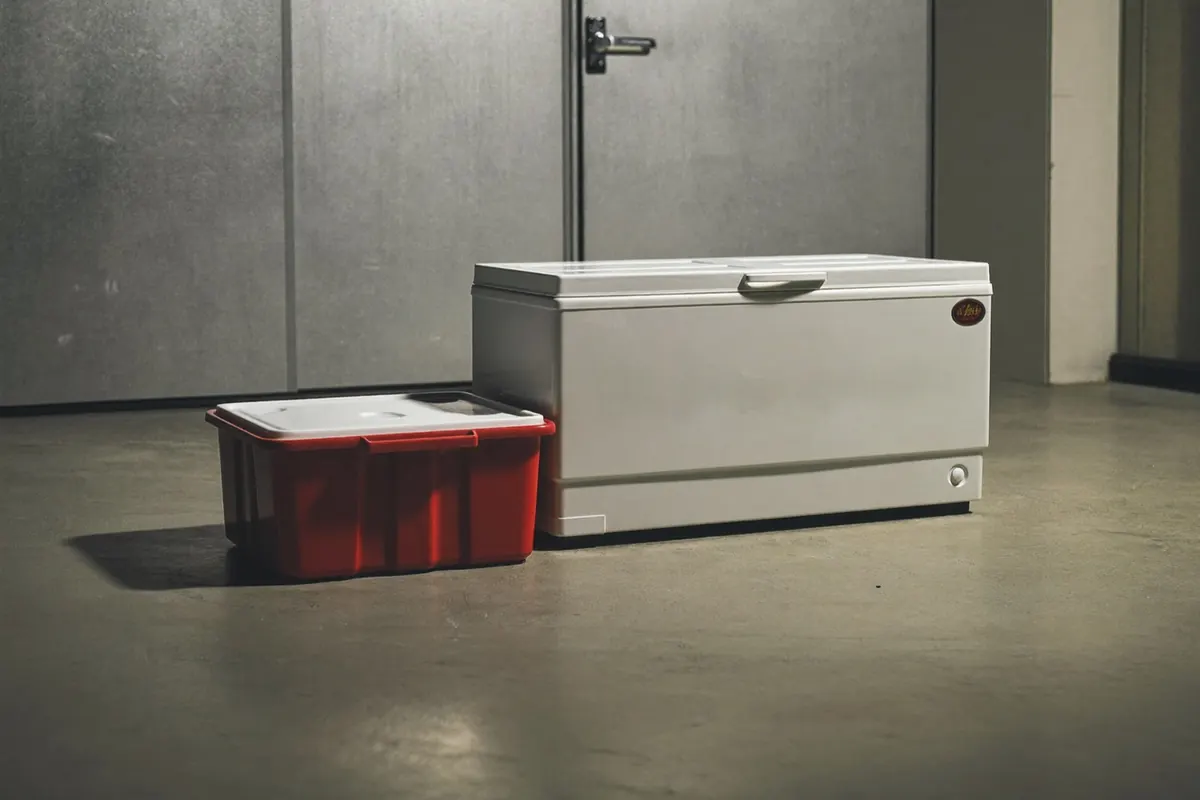
In California the default is zero: trauma scene waste “shall be removed from the trauma scene immediately” when the removal phase ends (Cal. HSC 118321.5(a)). The only holding option is a dedicated freezer at the practitioner’s own business address for no more than 14 days, unless CDPH approves otherwise. A garage chest freezer shared with anything else does not meet the word dedicated.
Florida runs a 30 day clock that starts when the first non sharps item goes into a red bag, or when a sharps only container is sealed (Fla. Admin. Code 64E-16.004(1)(a)). Indoor storage must be locked or otherwise restricted, away from foot traffic and built of materials impervious to liquids; an outdoor trailer or bin also needs the biohazard symbol at least 6 inches across (Fla. Admin. Code 64E-16.004(1)(c), (d)).
Texas puts its clock on the truck: a transporter that holds medical waste in a parked vehicle for more than 72 hours needs a medical waste registration (30 TAC 326.3(53)(B)). A cleanup firm that hauls its own bags to a transfer station should log the departure and arrival times.
What does OSHA 1910.1030 require before a bag leaves the room?
OSHA does not say where the waste goes; 29 CFR 1910.1030(d)(4)(iii)(C) says only that disposal of all regulated waste must follow the rules of the United States, the states and their subdivisions. What OSHA does control is the container. Regulated waste means liquid or semi liquid blood, items that would release blood if compressed, items caked with dried blood that can flake off during handling, contaminated sharps, and pathological waste, per the definitions in 29 CFR 1910.1030(b).
- Sharps go in containers that are closable, puncture resistant, leakproof on the sides and bottom, and labelled or colour coded (29 CFR 1910.1030(d)(4)(iii)(A)).
- A sharps container is closed immediately before it is moved, and placed in a second labelled container if it could leak.
- Labels are fluorescent orange or orange red with the biohazard legend, and red bags or red containers may stand in for labels (29 CFR 1910.1030(g)(1)(i)(C) and (E)).
- Bag strength is a state rule: Florida (Fla. Admin. Code 64E-16.004(2)(c)) and Pennsylvania (284.413 in 25 Pa. Code Chapter 284) both demand 165 grams impact resistance under ASTM D1709 and 480 grams tear resistance under ASTM D1922.
Bag colour, thickness and the 6 inch symbol rule are covered on the biohazard bags page. Label artwork and sizing sit on the biohazard symbol page. The crew side of the job, including the exposure control plan, sits on the crime scene cleanup page.
How is it shipped? UN3291, Division 6.2 and the private carrier exception
The Hazardous Materials Table, 49 CFR 172.101 lists “Regulated medical waste, n.o.s.” as UN3291 in hazard Division 6.2, with packaging rules at 49 CFR 173.197. Non bulk packagings must be UN standard packagings tested to the Packing Group II performance level, and wheeled carts used as outer packaging are capped at a nominal 1,655 litres (437 gallons), according to 49 CFR 173.197(d).
Most cleanup firms never touch those tests because of 49 CFR 173.134(c)(1). Waste moved by a private or contract carrier is excepted from the INFECTIOUS SUBSTANCE label if the outer packaging carries a BIOHAZARD marking under the OSHA standard, and from the 173.197 packaging specs if it travels in rigid non bulk packaging meeting 49 CFR 173.24 and 173.24a. Sharps in closed containers of 18 gallons or less get the same treatment in a vehicle used only for medical waste.
One caution: DOT’s definition at 49 CFR 173.134(a)(5) describes waste from the medical treatment of a human or animal, or from biomedical research. Whether a carrier ships trauma cleanup waste as UN3291 is a question to put to the hauler before the first pickup, along with its state transporter registration number. New Jersey charges commercial transporters $3,950 a year for that registration, according to N.J.A.C. 7:26-3A.8(b).
Where does it end up: autoclave or incinerator?
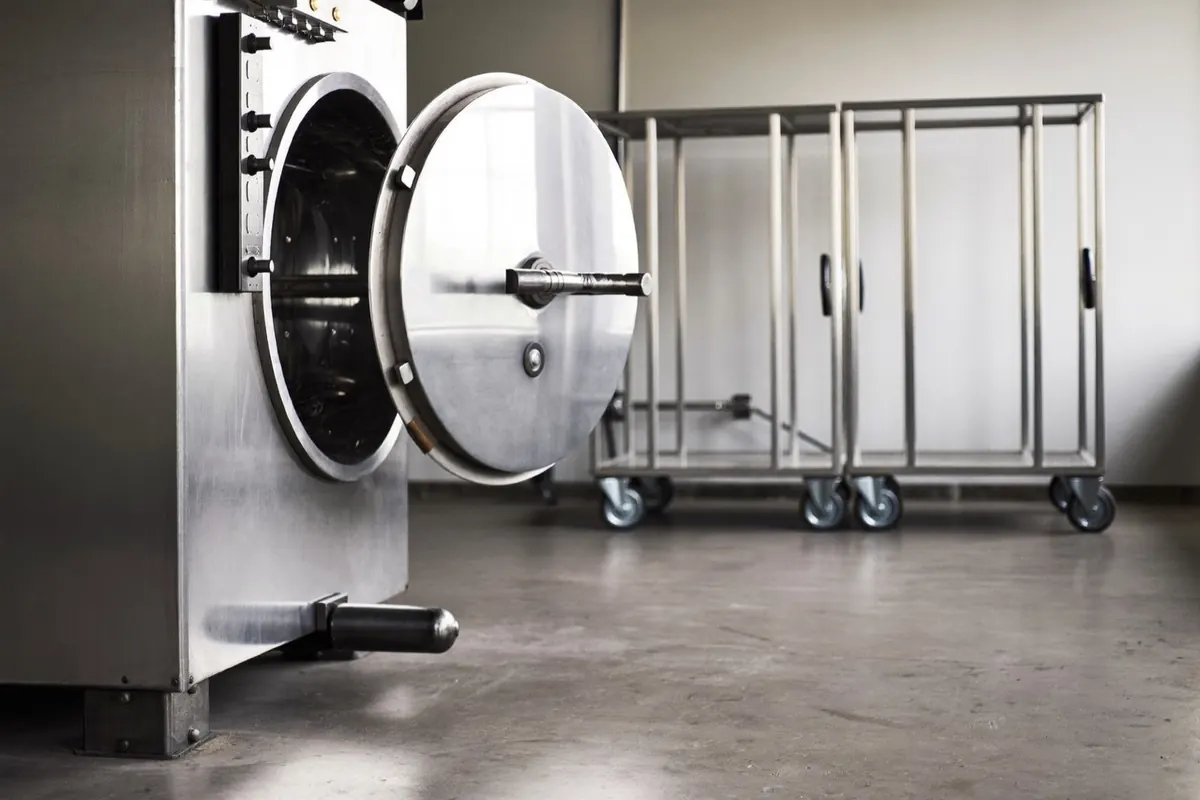
The EPA medical waste page says more than 90 percent of potentially infectious medical waste was incinerated before 1997, and that the number of incinerators has fallen since. The alternatives it lists are steam sterilization such as autoclaving, microwave thermal treatment, electropyrolysis and chemical mechanical systems.
Florida writes the performance targets into its rule. Disinfection means at least a Log 6 kill of the vegetative test organisms and a Log 4 kill of Bacillus stearothermophilus spores with steam; sterilization means a Log 6 spore kill (Fla. Admin. Code 64E-16.002(8) and (25)). Florida’s statute also splits the job: the Department of Health regulates packaging, transport, storage and treatment, while the Department of Environmental Protection regulates incineration and disposal (Fla. Stat. 381.0098(1)).
After treatment the residue usually stops being medical waste. New Jersey excludes incinerator ash and residues that have been both treated and destroyed (N.J.A.C. 7:26-3A.6(b)3 and 4), and Pennsylvania manages incinerator ash as special handling municipal waste (25 Pa. Code 271.1).
What does compliant disposal cost? State fees and one published mail-back price
Haulers rarely publish per pound or per pickup prices, and none of the hauler pages opened for this page did. What is public is the state fee layer and mail-back kit pricing, shown below as printed. Cleanup job pricing is on the biohazard cleanup page.
| Item | Published amount | Source |
|---|---|---|
| California practitioner registration | $200 a year | Cal. HSC 118321.1(d); CDPH medical waste fee schedule |
| Florida generator, storage or treatment permit | $50 to $400 a year (statutory range) | Fla. Stat. 381.0098(4)(e) |
| Minnesota off site management plan filing | $225 one time | Minn. Stat. 116.79 subd. 4 |
| New Jersey generator registration | $85 to $3,500 a year by pounds | N.J.A.C. 7:26-3A.8(a) |
| New Jersey commercial transporter | $3,950 a year | N.J.A.C. 7:26-3A.8(b) |
| 28 gallon sharps mail-back system, MedPro Disposal | $549 listed; a $499 variant also shown | MedPro Disposal 28 gallon mail-back listing, 50 lb cap, not sold in Florida |
New Jersey’s tiers show why weighing every bag matters: crossing 50 pounds a year triples the base fee from $85 to $255, according to N.J.A.C. 7:26-3A.8. MedPro’s listing caps its 28 gallon box at 50 pounds with overweight fees possible, and describes it as a sharps system, so ask before loading anything else into it.
How do you get rid of household needles and lancets?
The FDA sharps disposal page gives two steps: put every used needle in a sharps disposal container immediately, then dispose of the container according to community guidelines once it is about three quarters full. FDA lists four routes: drop boxes or supervised collection sites at pharmacies, hospitals and health departments; household hazardous waste sites; mail-back programs for FDA cleared containers, usually for a fee; and residential special waste pickup.
Some states turn that advice into law. Washington makes it an infraction to place unprotected sharps or a sharps container in a recycling container, after two warnings (RCW 70A.228, 70A.228.040), and Minnesota bans sharps in recyclables for everyone (Minn. Stat. 116.78 subd. 4(a)). Do not reuse the container, FDA adds.
For contractors: what to have on file before the first bag moves
- California: the CDPH registration (Form CDPH 8668A plus the fee), a contract with a registered transporter or permitted facility, and proof of disposal at each renewal (CDPH trauma scene page). CDPH’s list dated 26 August 2026 carries 371 registration numbers over 43 pages.
- Florida: the permit, or a copy, kept at the facility; permits expire every 30 September (Fla. Admin. Code 64E-16.011(1)(g)).
- Minnesota: a written management plan naming your transporter and disposal facility (Minn. Stat. 116.79 subd. 1).
- New Jersey: the annual generator registration, fees due by 20 August (N.J.A.C. 7:26-3A.8).
- Everywhere: the hauler’s state registration number and the tracking form or destruction certificate for each shipment.
Job scope, staffing and pay for this work are on the biohazard cleanup jobs page. Biohazard vocabulary and categories are set out on the what is a biohazard page.
Questions people actually ask
Is dried blood still biohazard waste?
Often, yes. OSHA counts items caked with dried blood as regulated waste when they can release it during handling (29 CFR 1910.1030(b)). Florida’s rule names absorbent materials saturated with blood that have dried, and Pennsylvania lists items caked with dried blood. A carpet pad or mattress that was soaked and dried still goes in a sealed, labelled container.
Do I need a license to haul biohazard waste?
Usually. Florida requires transporters to register, though it may exempt loads under 25 pounds on a single occasion (Fla. Stat. 381.0098(5)). Pennsylvania licenses transporters under Subchapter G of 25 Pa. Code Chapter 284, and New Jersey charges commercial transporters $3,950 a year according to N.J.A.C. 7:26-3A.8. California exempts registered trauma scene practitioners from hauler registration.
What colour should a biohazard waste bag be?
Red is the safe default. Florida requires impermeable red bags (Fla. Admin. Code 64E-16.004(2)(c)); Pennsylvania accepts fluorescent orange, orange red or red, and yellow for chemotherapy waste (284.411); OSHA lets red bags replace labels (29 CFR 1910.1030(g)(1)). The bag also needs the biohazard symbol, at least 6 inches across on Florida bags 19 by 14 inches or larger.
Can a cleanup company store bags in its truck overnight?
Check the state clock. California allows only immediate transport or a dedicated freezer at the business for 14 days (Cal. HSC 118321.5). Texas treats parked vehicle storage over 72 hours as needing a registration (30 TAC 326.3). Florida counts storage in a transport vehicle for more than 3 days as storage under its 30 day limit (Fla. Admin. Code 64E-16.002(26)).
Who can I call to find a registered trauma cleaner in California?
CDPH publishes the list. Its CDPH list of registered practitioners dated 26 August 2026 carries 371 registration numbers, and CDPH notes that registration is not an endorsement of the quality of the work and that it does not require a contractor’s license. CDPH’s Medical Waste Management Program answers questions at (916) 449-5671.
Sources
- California Health and Safety Code 117690, 117700 and 118321 to 118321.5, via california.public.law (Cal. HSC 117700, Cal. HSC 117690, Cal. HSC 118321.1, Cal. HSC 118321.4, Cal. HSC 118321.5). Retrieved 8 November 2026.
- California Department of Public Health, CDPH trauma scene page, the CDPH list of registered practitioners dated 26 August 2026, and the CDPH medical waste fee schedule. Retrieved 8 November 2026.
- Florida Legislature, Fla. Stat. 381.0098 (2025 statutes), and Florida Department of Health rules Fla. Admin. Code 64E-16.001, Fla. Admin. Code 64E-16.002, Fla. Admin. Code 64E-16.004 and 64E-16.011, via Cornell LII. Retrieved 8 November 2026.
- Minnesota Office of the Revisor of Statutes, 2026 Minnesota Statutes Minn. Stat. 116.76, Minn. Stat. 116.77, Minn. Stat. 116.78 and Minn. Stat. 116.79. Retrieved 8 November 2026.
- New Jersey Department of Environmental Protection rules N.J.A.C. 7:26-3A.6 and N.J.A.C. 7:26-3A.8, via Cornell LII. Retrieved 8 November 2026.
- New York State Senate, N.Y. Public Health Law 1389-aa and N.Y. Public Health Law 1389-bb. Retrieved 8 November 2026.
- Pennsylvania Code, 25 Pa. Code 271.1 and 25 Pa. Code Chapter 284, sections 284.411 to 284.416, current through 5 September 2026. Retrieved 8 November 2026.
- Texas Commission on Environmental Quality 30 TAC 326.3 and Department of State Health Services 25 TAC 1.134, via Cornell LII. Retrieved 8 November 2026.
- Washington State Legislature, RCW 70A.228. Retrieved 8 November 2026.
- Occupational Safety and Health Administration, 29 CFR 1910.1030, via eCFR. Retrieved 8 November 2026.
- Pipeline and Hazardous Materials Safety Administration, Hazardous Materials Table, 49 CFR 172.101, 49 CFR 173.134 and 49 CFR 173.197, via eCFR. Retrieved 8 November 2026.
- United States Environmental Protection Agency, EPA medical waste page, last updated 20 April 2026. Retrieved 8 November 2026.
- United States Food and Drug Administration, FDA sharps disposal page, content current as of 10 August 2023. Retrieved 8 November 2026.
- MedPro Disposal, MedPro Disposal 28 gallon mail-back listing. Retrieved 8 November 2026.
- The registration count is a tally of unique TSW numbers in the CDPH list; ratios are arithmetic on the fees above. Nothing was estimated. Our methodology sets out the standing rules. More standards explainers sit in the standards hub.
Medical waste rules change and local health departments add their own. Confirm the current rule with your state health or environmental agency, and ask your hauler and treatment facility how they class trauma scene waste before the first pickup.