The short answer
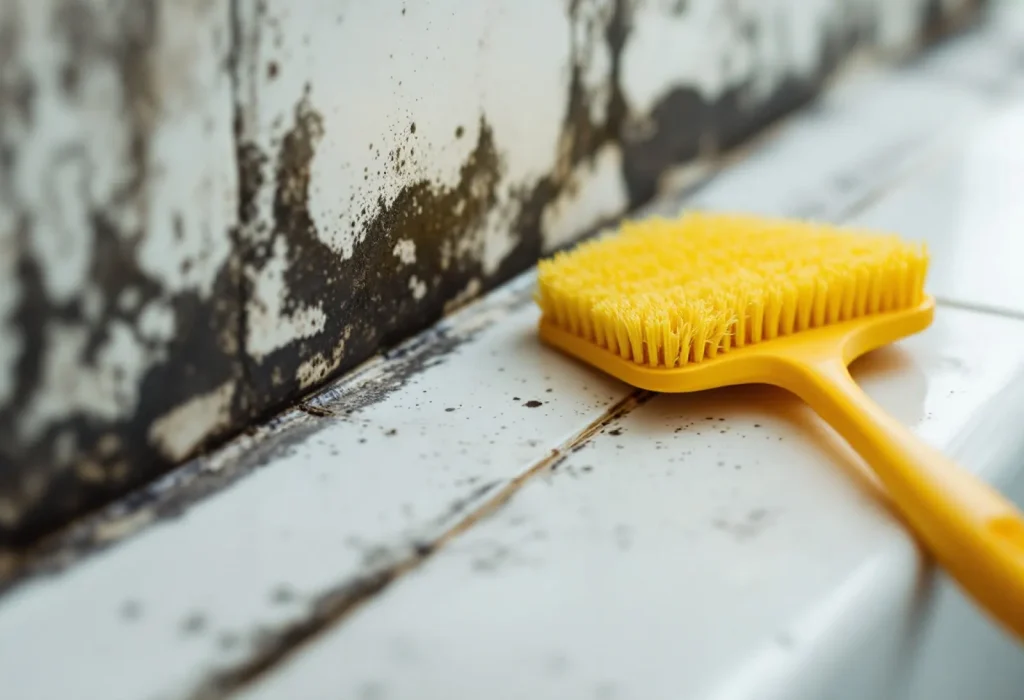
Does ammonia kill mold? In lab tests, ammonium hydroxide stopped two molds at 1 to 2 percent, but EPA’s product database lists no active household ammonia cleaner for mold. EPA and CDC point to detergent and water, or a bleach solution on hard surfaces. Ammonia can dull stone and mar anodized aluminum, and mixed with bleach it makes toxic chloramine gas.
Is any household ammonia bottle EPA-registered to kill mold?
No active one turned up. Under 40 CFR 152.15, a seller who claims, states or implies that a product can be used as a pesticide has to register it, which is why the Clorox and Lysol labels that name mold carry EPA numbers. The EPA ingredient search for ammonia on 2 November 2026 returned eight registration numbers with plain ammonia as the active ingredient: five cancelled and three live. None of the three covers a surface in a house. A search by the name ammonium hydroxide and by CAS number 1336-21-6 returned zero products.
| Product and record | What is in it | Federal status | What it claims against mold |
|---|---|---|---|
| Brillo Parsons All-Purpose Ammonia Cleaner. Brillo Parsons safety data sheet, April 2019 | Ammonia, 4 to 5% | No EPA registration number on the sheet, which says the product is labelled under CPSC rules | Recommended use is consumer household cleaning. The Orgill distributor listing names scuff marks, greasy fingerprints and laundry stains. No mold, mildew or disinfectant claim. |
| Ammonia solution (household). Innovating Science safety data sheet, January 2018 | Ammonium hydroxide, about 4.0% | No EPA registration number on the sheet | A classroom supplier’s sheet with hazard and handling text only. No mold claim. |
| Busan 1215, also sold as Oxamine 6150, EPA number 1448-433 | Ammonia (total), 7.59% | Registered | Per the EPA-accepted Busan 1215 label: algae, bacteria, fungi and mollusks in industrial water such as cooling towers and paper mills. No home surface use. |
| BCMW, EPA number 1448-432 | Ammonia, 7.59% | Registered | Formulating use only. The record lists no pest and no site. |
| Busan 1474, EPA number 1448-442 | Ammonia, 7.59% | Registered | Slime and fungi in oil recovery water, drilling mud and packer fluid. |
| Liqui-Cop, EPA number 54705-7 | Copper ammonia complex, 27.15% | Registered | A crop fungicide. The downy mildew on its pest list grows on crops such as onions, and copper is part of the active ingredient. |
| Barr-Stalfort Disinfectant All Purpose Cleaner, EPA number 3407-52 | Ammonia and pine oil, per its 1968 label | Inactive since 10 October 1989 | No current claim of any kind. |
| New Disinfectant Whistle, with Ammonia Power, EPA number 1913-15 | Not listed in the record | Inactive since 31 December 1987 | No current claim of any kind. |
| Lysol Disinfectant Spray, EPA number 777-99 | No household ammonia. Quat 0.10%, ethanol 58% | Registered | Kills Aspergillus niger and Penicillium chrysogenum on hard, non-porous surfaces in 3 minutes, per the label. |
| Clorox Disinfecting Bleach, EPA number 5813-120 | No ammonia. Sodium hypochlorite 7.5% | Registered | Mold and mildew removal on hard, nonporous surfaces: 1/3 cup per gallon, visibly wet at least 10 minutes, per the label. |
How to check the bottle in your hand
- Look for the words EPA Reg. No. on the back panel. EPA's disinfectant list page calls that number the only accurate way to identify a registered product.
- No number means the label makes no federally reviewed kill claim. The Brillo Parsons cleaner is that case: 4 to 5% ammonia, per the sheet, and no EPA number.
- If there is a number, read the directions for the word mold or mildew and the surfaces named. EPA says products should not be used against organisms their directions do not cover.
Where does the ammonia kills mold advice come from?
Three sources feed it, and none is a label. The first is stain advice. University of Georgia Extension tells readers to wipe mildew from hard surfaces with warm sudsy water and a few drops of ammonia, then try a commercial mildew remover if the stain persists. The Natural Stone Institute brochure, dated 2019, lists biological stains on stone, including mildew and fungi, and offers 1/2 cup of ammonia, bleach or hydrogen peroxide per gallon of water as a cleaning solution. Both are stain directions, not kill claims.
The second is laboratory work on food crops. Garcia and Pantua, 1994, a conference summary on stored corn and copra, tested ammonium hydroxide against Aspergillus ochraceus and Penicillium viridicatum. Per the summary, no mycelium grew on agar at 2.0%. Per the same summary, none grew in broth at 1.0% and 2.0% after 7 to 10 days, and spores failed to germinate after 24 to 36 hours. That is real antifungal activity. It is also a lab medium with long exposure, not a wiped wall.
The third is repetition. A student science fair abstract hosted by Society for Science ranked hydrogen peroxide and ammonia highest in a tile swab test, and peroxide and vinegar highest on plates, using 10 ml of product per 100 ml of water. It is a school project. According to one ranking page, spray 50% clear ammonia and 50% water and expect it to take 24 to 48 hours, though the same page says it kills most mold on contact. It cites no study, standard or maker.
Is quaternary ammonia the same as the ammonia under your sink?
No, and the shared word causes much of the confusion. Household ammonia is ammonia gas dissolved in water, 4 to 5% per the Brillo Parsons safety data sheet. A quaternary ammonium compound, or quat, is a different molecule built around a nitrogen atom. Per the EPA record, the Lysol spray holds alkyl dimethyl benzyl ammonium saccharinate at 0.10% alongside 58% ethanol, and that formula carries the 3 minute mold claim, on hard, non-porous surfaces only.
Even old registrations blur the terms. The EPA product name search still shows products titled Economy Multi-Purpose Disinfectant (Quaternary Ammonia), inactive since 10 October 1989, and Hy Q 10 (Quaternary Ammonia Sanitizer), inactive since 1 May 1987. A claim that quaternary ammonia kills mold says nothing about a jug of clear ammonia from the cleaning aisle.
Can you mix ammonia and bleach to kill mold faster?
Never. A CDC MMWR report sets out the chemistry: ammonia plus sodium hypochlorite forms monochloramine and dichloramine. The National Capital Poison Center ammonia page calls the result chloramine gas, and CDC's mold page says the mix “will produce a poisonous gas.” EPA's Brief Guide to mold and the FEMA mold and mildew booklet give the same warning.
The trap is the ammonia you did not know was there. EPA’s warning covers detergents that contain ammonia as well as ammonia itself, and the Poison Center names glass cleaners as the most common household ammonia products. FEMA’s 2005 booklet specifies a non-ammonia detergent for the wash before its bleach step, and the Brillo Parsons safety data sheet lists any chlorine bleach product as incompatible. Read both ingredient lines before a detergent wash and a bleach wipe share a surface.
If the two have already met, the National Capital Poison Center chlorine gas page says to leave the area immediately, breathe fresh air, open windows and doors, and call 1-800-222-1222.
Does ammonia kill mold on fabric?
No published label or test says so, and the fabric guidance works around it. The University of Georgia Extension steps for apparel are to brush the mildew off outdoors, apply detergent and launder. A remaining stain gets a soak in 1/4 cup chlorine bleach and 3/4 cup water if the fabric allows it, or salt and lemon juice in sun. Ammonia is not in the sequence, and the page warns that it damages silk and wool, saying to dilute it with equal parts water and use it sparingly if you must. Laundering steps by garment type sit on our mold on clothes page.
Upholstery and bedding get a harder rule. The FEMA mold and mildew booklet treats upholstered furniture, rugs, bedding and clothing as porous: an item wet for less than 48 hours may be cleaned and disinfected with a phenolic or pine-oil cleaner, then watched for several days. If mold develops, it goes in the trash. Ammonia is not on that list.
Which surfaces does ammonia damage: stone, aluminum or floor finish?
| Surface | Who says so | What the guide says |
|---|---|---|
| Natural stone | Natural Stone Institute care page | “Frequent or over-use of an ammonia solution may eventually dull the surface of some stone types.” |
| Anodized aluminum | Wilsonart Decorative Metals care sheet | “Ammoniated detergents or petroleum-based cleaners should not be used to clean anodized aluminum surfaces.” |
| UV-cured urethane hardwood finish | hardwood care sheet hosted by Nuvelle Flooring | Lists vinegar and ammonia among items that void all manufacturer warranties and can damage the finish. |
| Fireclay sink | Houzer 2024 maintenance guide | Do not use harsh abrasive or caustic cleaners containing ammonia or alkalis. |
These guides do not ban ammonia everywhere. The Natural Stone Institute itself offers about 1/2 cup per gallon for soap scum on stone, with the dulling warning in the next sentence, and tells readers to consult their stone supplier. Before using it on a finished floor or a coated frame, ask the maker one question: does the warranty exclude ammonia-based cleaners on this finish? The Nuvelle sheet shows why that matters, because the answer there is yes.
Switching to bleach does not clear every surface either. The EPA-accepted Clorox label says to rinse quickly if the solution touches aluminum window frames or gutters because metal corrosion may occur.
What should you use instead on a patch under 10 square feet?
Detergent. EPA's Mold Cleanup in Your Home page says to scrub mold off hard surfaces with detergent and water and dry completely, and warns that ceiling tiles and carpet may have to be thrown away. Its 10 square foot line, in EPA's Brief Guide to mold, marks where a homeowner cleanup stops being the default. EPA's page on bleach and mold does not recommend a biocide as a routine step, and adds that killing mold is not enough, because dead mold must also be removed. That point alone undercuts the search for a stronger chemical.
Where a chemical is wanted on hard surfaces, CDC's mold page allows no more than 1 cup of household laundry bleach in 1 gallon of water, and the worked numbers by bottle strength are on our bleach to water ratio page. EPA says spores will remain in most cases and will not grow if the moisture problem is fixed, so the leak comes first. The evidence on the other home remedy is on our vinegar and mold page. Bleach on porous material is covered on our does bleach kill mold page. Registered and store-shelf products are compared on our mold killer page.
Out of scope: this page covers labels, registrations and surfaces. For health questions about mold, go to EPA, NIH or CDC. CDC's mold page is a good first stop.
Questions people actually ask
Does ammonia kill mold spores?
In one lab summary, yes, slowly. Garcia and Pantua (1994) report that spore germination stopped at 1.0% and 2.0% ammonium hydroxide after 24 to 36 hours, on a lab medium rather than a building surface. No household product carries that claim, and EPA says dead mold must still be removed, so a spore kill would not finish the job.
How long does ammonia take to kill mold?
No label gives a time, because no active registration has a household mold direction for ammonia. Ranking pages disagree with themselves, from on contact to 24 to 48 hours, without a citation. For comparison, the EPA-accepted Clorox label sets at least 10 minutes visibly wet and the Lysol label sets 3 minutes on hard, non-porous surfaces.
Is ammonia or bleach better for mold?
On paper, bleach, because it has the registration. Clorox Disinfecting Bleach, EPA Reg. 5813-120, has labelled mold directions for hard, nonporous surfaces, and ammonia has none. Neither fixes porous material, and Clorox itself says bleach is not recommended there. EPA prefers detergent and water as the routine step. Never use the two together.
Does ammonia work on mold on drywall or wood?
Nothing registered says it does. FEMA’s 2005 booklet tells owners of flooded homes to remove wet or contaminated porous materials such as ceiling tiles, drywall and wood by-products rather than treat them, and EPA says porous items may have to be thrown away. Solid wood is washed with a non-ammonia detergent and hot water, per the same booklet.
Can ammonia clean mildew in a shower?
Stain guidance says it can help on some hard surfaces. University of Georgia Extension describes warm sudsy water with a few drops of ammonia, and the Natural Stone Institute gives about 1/2 cup per gallon for soap scum, with a dulling warning. Neither is a kill claim. Grout and caulk steps are on our mold in shower page.
Sources
- EPA ingredient search for ammonia, with the related searches for ammonium hydroxide and CAS 1336-21-6, US EPA Pesticide Product and Label System API. Retrieved 2 November 2026.
- EPA product name search, US EPA, used for the quaternary ammonia product titles. Retrieved 2 November 2026.
- US EPA product records 1448-432, 1448-433, 1448-442, 54705-7, 3407-52, 1913-15, 777-99 and 5813-120. Retrieved 2 November 2026.
- EPA-accepted Busan 1215 label, accepted 3 October 2016; 1968 label for Barr-Stalfort; EPA-accepted Lysol label, 13 January 2025; EPA-accepted Clorox label, 8 July 2024. All via EPA. Retrieved 2 November 2026.
- 40 CFR 152.15, Purpose of the pesticide definition, Legal Information Institute, Cornell Law School. Retrieved 2 November 2026.
- EPA's disinfectant list page, US EPA. Retrieved 2 November 2026.
- EPA's Brief Guide to mold, US EPA, last updated 18 February 2026. Retrieved 2 November 2026.
- EPA's Mold Cleanup in Your Home page, US EPA, last updated 4 June 2026. Retrieved 2 November 2026.
- EPA's page on bleach and mold, Should I use bleach to clean up mold?, US EPA, last updated 8 September 2026. Retrieved 2 November 2026.
- CDC's mold page, US CDC, dated 26 September 2024. Retrieved 2 November 2026.
- The CDC MMWR report, Chlorine Gas Toxicity from Mixture of Bleach with Other Cleaning Products, California, used for the reaction chemistry only. Retrieved 2 November 2026.
- National Capital Poison Center ammonia page and National Capital Poison Center chlorine gas page, National Capital Poison Center. Retrieved 2 November 2026.
- University of Georgia Extension, Remove Stains From Mildew, Mold, UGA Cooperative Extension Textiles site. Retrieved 2 November 2026.
- Natural Stone Institute care page and Natural Stone Institute brochure, Care and Cleaning of Natural Stone, 2019, Natural Stone Institute. Retrieved 2 November 2026.
- Wilsonart Decorative Metals care sheet, Wilsonart; hardwood care sheet hosted by Nuvelle Flooring, Care and Maintenance Guidelines for UV Cured Urethane Finish Products; Houzer 2024 maintenance guide, Houzer. Retrieved 2 November 2026.
- FEMA mold and mildew booklet, Dealing With Mold and Mildew in Your Flood Damaged Home, FEMA, file dated October 2005. Retrieved 2 November 2026.
- Garcia and Pantua, 1994, Control of Aspergillus ochraceus and Penicillium viridicatum using ammonia on corn and copra, Pest Management Council of the Philippines, summary only, via FAO AGRIS. Retrieved 2 November 2026.
- student science fair abstract, The Effects of Household Remedies on Mold, Society for Science. Retrieved 2 November 2026.
- Brillo Parsons safety data sheet, Armaly Brands, printed 26 April 2019; Orgill distributor listing; Innovating Science safety data sheet, Aldon Corporation, revised 25 January 2018. Retrieved 2 November 2026.
- one ranking page, Does Ammonia Kill Mold?, CGAA, read as an example of the advice in circulation. Retrieved 2 November 2026.
- Registration counts were tallied from the EPA search results on the retrieval date. Our methodology sets out the standing rules, and more mold pages are on the mold hub.
Registrations change. Search the number on your own bottle in EPA’s label system, and follow the label of the product you use.