The short answer
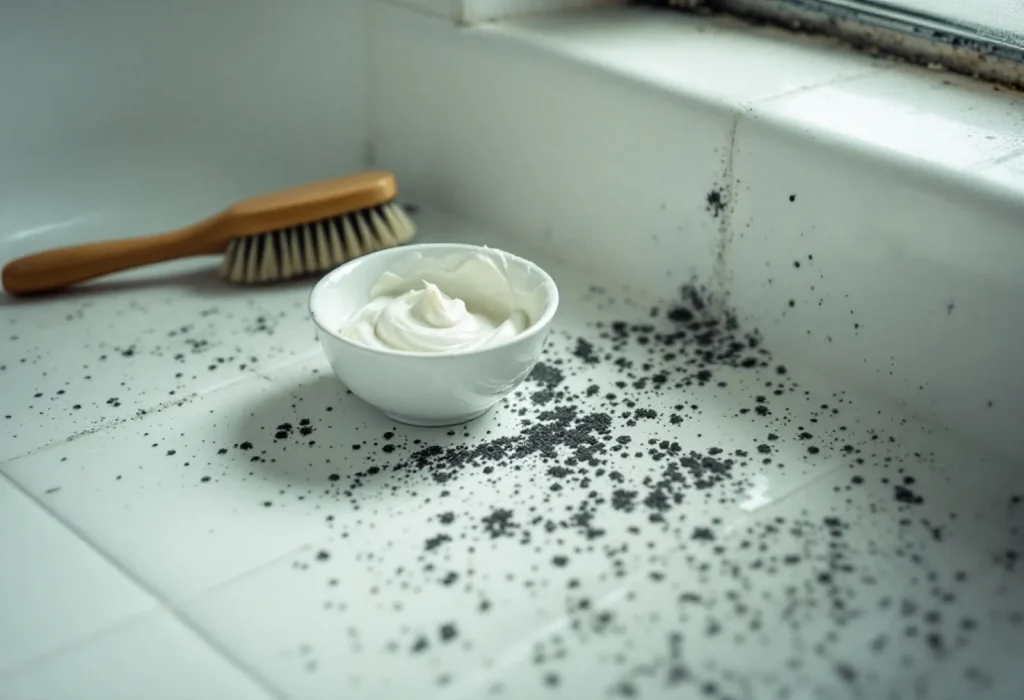
Yes, but only weakly, and the answer to does baking soda kill mold comes from lab dishes rather than walls. A 2023 study needed 12 grams of sodium bicarbonate per litre to stop Aspergillus niger completely, while a common spray recipe works out near 7.3 grams per litre. EPA’s goal is removal: scrub with detergent and water, then dry within 24 to 48 hours.
What do the bicarbonate studies show at 6 to 12 grams per litre?
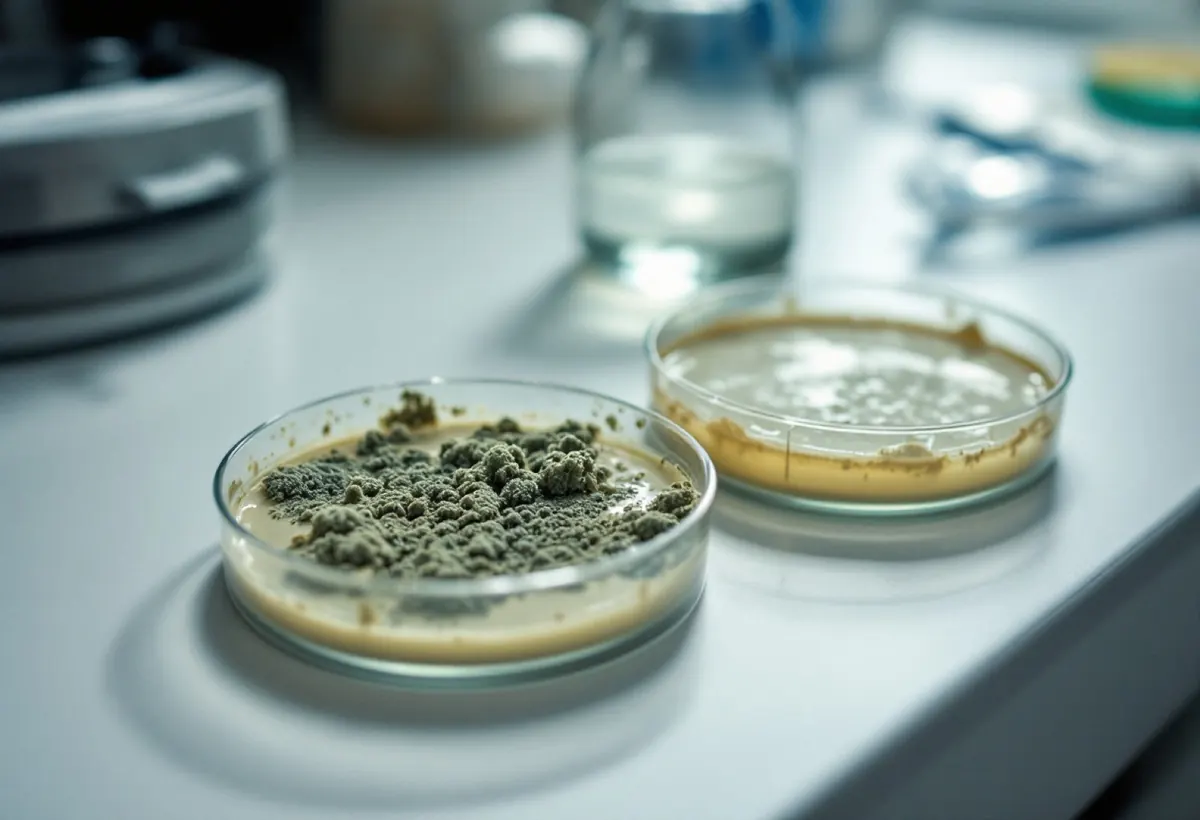
The cleanest dose data for a mold relevant to houses comes from a plum packing study. Guo and colleagues, Frontiers in Microbiology, 2023 grew an Aspergillus niger isolate on potato dextrose agar with sodium bicarbonate mixed in: 6.0 g/L cut colony growth by 40.73% after 4 days, 10.0 g/L by 96.48%, and 12.0 g/L stopped it completely, the paper reports.
Spores told the same story. In the same paper, 91.28% of untreated Aspergillus niger spores germinated within 24 hours, against 35.55% in broth holding 6.0 g/L of bicarbonate, per the authors. That is suppression, not sterilisation: about one spore in three still sprouted.
A second study shows how modest the kill is on a real material. Montville and Shih, Journal of Food Protection, 1991 added bicarbonate salts to cracked corn and counted the natural fungi. Sodium bicarbonate at 1% cut counts by 1.2 log CFU/g according to the abstract, about 94% of colonies, and at 2% by 2.0 log, about 99%. Ammonium bicarbonate at 1% managed 5.9 log on the same corn, the abstract reports.
Two limits follow from those designs. Both measured continuous contact for 24 hours to 4 days in a dish or a grain bin, and neither tested drywall, grout or Stachybotrys chartarum, the species most guides online mean by black mold. The authors offered rising pH, osmotic stress and membrane damage as possible mechanisms rather than settled ones.
Is a quarter tablespoon in a spray bottle strong enough?
A recipe repeated across guides online says to add a quarter tablespoon of baking soda to a spray bottle of water, without naming the bottle size. USDA FoodData Central entry 175040 weighs 1 teaspoon of baking soda at 4.6 g, and the NIST conversion table puts a tablespoon at 14.79 mL against 4.93 mL for a teaspoon, so a quarter tablespoon is about 3.45 g.
| Recipe | Grams per litre | Share of the 12 g/L lab dose |
|---|---|---|
| 1/4 tbsp in 32 fl oz | 3.6 | 30% |
| 1/4 tbsp in 16 fl oz | 7.3 | 61% |
| 1 tsp in 16 fl oz | 9.7 | 81% |
| 1 tbsp in 16 fl oz | 29.2 | 243% |
In a 16 fl oz bottle the quarter tablespoon recipe gives 7.3 g/L according to the USDA and NIST figures, about 61% of the dose that fully stopped growth in the 2023 study, and between the 6 g/L and 10 g/L rows, which inhibited growth by 40.73% to 96.48% there, per Guo and colleagues, Frontiers in Microbiology, 2023. Reaching 12 g/L in the same bottle takes 5.7 g, about 1.23 teaspoons.
A paste is a different case. Sodium bicarbonate dissolves to about 9.3 g per 100 mL at 20 C, according to the ICSC value in the PubChem sodium bicarbonate record, so the liquid in a wet paste sits near 93 g/L, roughly 8 times the lab dose. The catch is contact time: the studies held that concentration for days, while a paste on a vertical wall is rinsed off or dries.
Nine baking soda mold claims, graded against their sources
The table rates each claim that circulates about baking soda and mold by the type of source behind it, from peer reviewed measurements down to no study at all. Grades reflect what the cited source measured, as of 12 November 2026, not how often a claim is repeated.
| Claim | Source type | What the source says | Grade |
|---|---|---|---|
| Kills mold in a lab dish | Peer reviewed, in vitro | 100% growth stop at 12 g/L, 96.48% at 10 g/L (Guo and colleagues, Frontiers in Microbiology, 2023) | Moderate |
| Reduces mold on a real material | Peer reviewed, grain | 1.2 log at 1%, 2.0 log at 2% on corn (Montville and Shih, Journal of Food Protection, 1991) | Moderate, food matrix only |
| Kills mold on a bathroom wall or drywall | No study found | No published test on drywall, grout or caulk among sources opened | None |
| Kills black mold (Stachybotrys) | No study found | Neither study above tested Stachybotrys chartarum | None |
| Prevents regrowth | Agency guidance | EPA ties prevention to humidity below 60% and drying in 24 to 48 hours (EPA's Brief Guide to Mold, Moisture and Your Home) | Moisture is the lever, not the powder |
| Removes visible growth | Agency guidance | EPA: scrub hard surfaces with detergent and water (EPA's Brief Guide to Mold, Moisture and Your Home) | Supported as a scrub, not as a killer |
| Deodorises musty smell | Chemistry only | pH 8.3 base; main mold odour 1-octen-3-ol is an alcohol (PubChem 1-octen-3-ol record) | Weak |
| Boosts vinegar when mixed | Stoichiometry | 2.9 tsp cancels the acid in 1 cup (calculation below) | Contradicted |
| Registered fungicide | Federal Register, CFR | Registered 20 December 1994 for crop fungicides (EPA final rule of 23 December 1996) | True for crops, not indoor mold |
The pattern is consistent: bicarbonate has real antifungal activity, enough that EPA accepted it as a crop fungicide in 1994, but every measured result comes from agar, fruit or grain. On a wall the claim rests on extrapolation, and EPA's Brief Guide to Mold, Moisture and Your Home says killing is not the target anyway.
What happens when baking soda meets vinegar in the same cup?
The fizz is an acid base reaction that uses up the acid. One mole of sodium bicarbonate (84.007 g) reacts with one mole of acetic acid (60.05 g) to give sodium acetate, water and carbon dioxide, using the molar masses in the PubChem sodium bicarbonate record and its companion records.
FDA Compliance Policy Guide 525.825 sets vinegar at 4 grams of acetic acid per 100 mL. One cup (236.6 mL by the NIST fluid ounce) therefore holds 9.46 g of acid, which 13.2 g of baking soda neutralises completely: about 2.9 teaspoons by the USDA weight.
| Baking soda per cup of 4% vinegar | Acid used up | Acid left, g per 100 mL | CO2 released, g | Unreacted soda, g |
|---|---|---|---|---|
| 1 tsp (4.6 g) | 35% | 2.61 | 2.4 | 0.0 |
| 2 tsp (9.2 g) | 69% | 1.22 | 4.8 | 0.0 |
| 1 tbsp (13.8 g) | 100% | 0.00 | 6.9 | 0.6 |
| 2 tbsp (27.6 g) | 100% | 0.00 | 6.9 | 14.4 |
At 1 tablespoon per cup every gram of acid is gone and 0.6 g of soda is left over, so the mixture is a weak sodium acetate solution with a little bicarbonate in it, carrying about 12.9 g of sodium acetate. Whatever acetic acid would have done to the mold has been spent on the fizz.
If you want both, use them in sequence and rinse with plain water between, the EPA detergent and water method, so each stays at full strength on the surface. The acid side is covered on the vinegar page.
Vinegar alone has its own evidence record at the FDA strength of 4 grams per 100 mL. Bleach and vinegar are a different and dangerous pairing, and CDC warns never to mix bleach with any other cleanser. The bleach and vinegar page explains the chlorine gas reaction.
Why does a pH 8.3 paste still leave dead mold to remove?
A freshly made 0.1 molar sodium bicarbonate solution reads pH 8.3 at 25 C, and a 1% solution reads 8.0 to 8.6, per the PubChem sodium bicarbonate record. That is mildly alkaline, far from the strong bases or oxidisers that strip pigment, which is why a dark stain in grout usually survives a baking soda scrub.
EPA's Brief Guide to Mold, Moisture and Your Home, updated 18 February 2026, states that it is not enough to simply kill the mold, it must also be removed. The same page says to scrub hard surfaces with detergent and water, dry them completely, and not to paint or caulk over moldy surfaces, because paint applied over mold is likely to peel.
That makes baking soda useful as a mild abrasive in the scrub, not as a step that replaces it. EPA also notes that porous materials such as ceiling tiles and carpet may have to be thrown away once moldy, a call no powder changes. The detergent route is covered at length on the dish soap page.
Dish soap does the same removal job with a surfactant, and EPA names detergent first.
Is baking soda an EPA-registered fungicide? Yes, for crops since 1994
The EPA final rule of 23 December 1996 records that Church and Dwight obtained registration of sodium bicarbonate and potassium bicarbonate on 20 December 1994 as manufacturing products for formulating into fungicides, used to control powdery mildew on food and non-food crops. The rule added 40 CFR 180.1176 to exempt sodium bicarbonate residues from a tolerance when used as a fungicide or post-harvest fungicide.
EPA waived all data requirements for that rule, citing the historical knowledge of both salts. The same chemical is listed in 21 CFR 184.1736 for use in food with no limitation other than current good manufacturing practice, which is why a grocery box carries no EPA registration number and no mold claim.
The practical reading: EPA accepted bicarbonate against leaf fungi such as powdery mildew on crops, and nothing in that 1996 rule covers mold growing inside walls, on grout or on carpet. Products that make an indoor mold claim are listed on the mold killer page.
The mold killer page compares labelled products by active ingredient.
Shower grout, drywall or carpet: where does a baking soda scrub fit?
EPA’s homeowner guide treats a patch of less than about 10 square feet as a job most owners can handle, and its method is the same on every hard surface: scrub with detergent and water, dry completely. Baking soda slots into that method as follows.
- Tile, grout and tub surrounds. A paste near 93 g/L dissolved bicarbonate plus grit is a reasonable scrub on non porous surfaces under 10 square feet, rinsed and dried after. Recurring shower growth traces back to ventilation and drying time.
- Painted drywall. Surface spots on intact paint can be wiped, but EPA says not to paint over mold, and growth that has entered the paper face sits in a porous material no scrub reaches.
- Carpet. EPA lists carpet among porous materials that may have to be thrown away once moldy. Sprinkling baking soda on the pile changes odour at most. The carpet page sets out when cleaning is realistic.
- Unfinished wood. No bicarbonate study tested wood, so a 4 day agar result says little about a joist that stays damp.
Protective gear does not change because the cleaner is mild. The CDC mold cleanup page advises at least a NIOSH Approved N95 respirator, non latex gloves of vinyl, nitrile or rubber, goggles that provide complete eye protection, and open windows during cleanup.
Does an open box of baking soda stop the musty smell from mold?
Baking soda’s reputation as a deodoriser rests on neutralising acids, which fits a pH 8.3 base. The best known musty mold odour compound is different: the PubChem 1-octen-3-ol record describes 1-octen-3-ol as an alkenyl alcohol, a fungal metabolite with an odour described as green and moldy, not as an acid.
An alcohol has no acid for bicarbonate to neutralise, so the chemistry predicts little effect on that compound, and no test of baking soda against mold odour turned up among the sources opened for this page. A smell that returns after cleaning is better read as a sign of active growth, which EPA links to humidity above 60 percent.
The mold hub collects every cleaner and surface page on this site.
Out of scope: health effects of mold exposure are not covered here; the CDC mold cleanup page and EPA’s mold pages cover them.
Questions people actually ask
How long should baking soda sit on mold?
No EPA guidance or label sets a contact time for baking soda on a household surface. The lab results came from continuous exposure: 24 hours for spore germination and 4 days for colony growth in the 2023 Aspergillus niger study. A paste on a wall gets minutes, not days, so rely on the scrub, the rinse and drying within the 24 to 48 hours EPA sets for wet materials.
What kills mold better, vinegar or baking soda?
Neither has an indoor mold registration in the sources opened here. Vinegar works through acetic acid at 4 grams per 100 mL under FDA guidance, while bicarbonate needed 10 to 12 grams per litre to stop Aspergillus niger on agar. Mixed together they cancel: about 2.9 teaspoons of baking soda neutralises a cup, so use one or the other, or rinse between them.
What is the best homemade mold killer?
EPA’s homeowner guide makes removal, not killing, the goal: scrub hard surfaces with detergent and water, dry within 24 to 48 hours and keep humidity below 60 percent. Where bleach is used, CDC advises no more than 1 cup per gallon of water and never mixing it with ammonia or any other cleanser. Hydrogen peroxide has its own evidence page.
Can I mix baking soda with bleach to clean mold?
CDC’s mold cleanup page says never to mix bleach with ammonia or any other cleanser, and baking soda counts as another cleanser. Bleach also does not need help: the CDC ceiling is 1 cup of bleach per gallon of water, with windows open and at least an N95 respirator, gloves and goggles.
Does baking soda kill mold on clothes?
No study opened for this page tested bicarbonate on fabric. Baking soda dissolves to about 9.3 grams per 100 mL at 20 C, so it dissolves fully in a wash, but a 1% solution reads only pH 8.0 to 8.6 according to PubChem: a mildly alkaline wash, not a fungicide. Laundering removes spores mechanically, which is the same removal logic EPA applies to hard surfaces.
Is it safe to use baking soda on mold around food areas?
Sodium bicarbonate is listed in 21 CFR 184.1736 for use in food with no limitation other than current good manufacturing practice, so residue on a counter is not a chemical concern. The limit is effect, not safety: the same powder needed 12 grams per litre for 4 days to fully stop Aspergillus niger in the 2023 lab test.
Sources
- PubChem sodium bicarbonate record, National Library of Medicine, data from HSDB and others: pH 8.3 for a fresh 0.1 M solution at 25 C (HSDB citing the Merck Index), pH 8.0 to 8.6 for a 1% solution (Commission Regulation (EU) No 231/2012), solubility 9.3 g per 100 mL at 20 C (ICSC 1044), molar mass 84.007. Retrieved 12 November 2026.
- PubChem acetic acid record, PubChem carbon dioxide record and PubChem sodium acetate record, molar masses 60.05, 44.009 and 82.03. Retrieved 12 November 2026.
- PubChem 1-octen-3-ol record, compound class and fungal metabolite role (ChEBI) and odour description (T3DB). Retrieved 12 November 2026.
- Guo and colleagues, Frontiers in Microbiology, 2023: Guo T R, Zeng Q, Yang G and others, Isolation, identification, biological characteristics, and antifungal efficacy of sodium bicarbonate combined with natamycin on Aspergillus niger from Shengzhou nane fruit, Frontiers in Microbiology 13:1075033, published 12 January 2023. Retrieved 12 November 2026.
- Montville and Shih, Journal of Food Protection, 1991: Montville T J and Shih P L, Inhibition of mycotoxigenic fungi in corn by ammonium and sodium bicarbonate, Journal of Food Protection 54(4):295 to 297, abstract via FAO AGRIS. Retrieved 12 November 2026.
- EPA final rule of 23 December 1996, Federal Register via GovInfo: sodium and potassium bicarbonate tolerance exemptions, 40 CFR 180.1176 and 180.1177. Retrieved 12 November 2026.
- 21 CFR 184.1736, Sodium bicarbonate, via eCFR. Retrieved 12 November 2026.
- EPA's Brief Guide to Mold, Moisture and Your Home, United States Environmental Protection Agency, updated 18 February 2026. Retrieved 12 November 2026.
- CDC mold cleanup page, Centers for Disease Control and Prevention, page dated 16 February 2024. Retrieved 12 November 2026.
- FDA Compliance Policy Guide 525.825, Vinegar: definitions, US Food and Drug Administration. Retrieved 12 November 2026.
- USDA FoodData Central entry 175040, Leavening agents, baking soda, SR Legacy, 1 tsp = 4.6 g. Retrieved 12 November 2026.
- NIST conversion table, National Institute of Standards and Technology, Office of Weights and Measures. Retrieved 12 November 2026.
- Recipe concentrations, evidence grades and reaction masses are Remediation Insider calculations from the values above, computed when this page was built. Our methodology sets out the standing rules.
Lab and crop results do not transfer directly to walls, grout or carpet. For growth over about 10 square feet, ask a remediation contractor which materials they will remove, how they will contain the area and how they will confirm the surfaces are dry.