The short answer
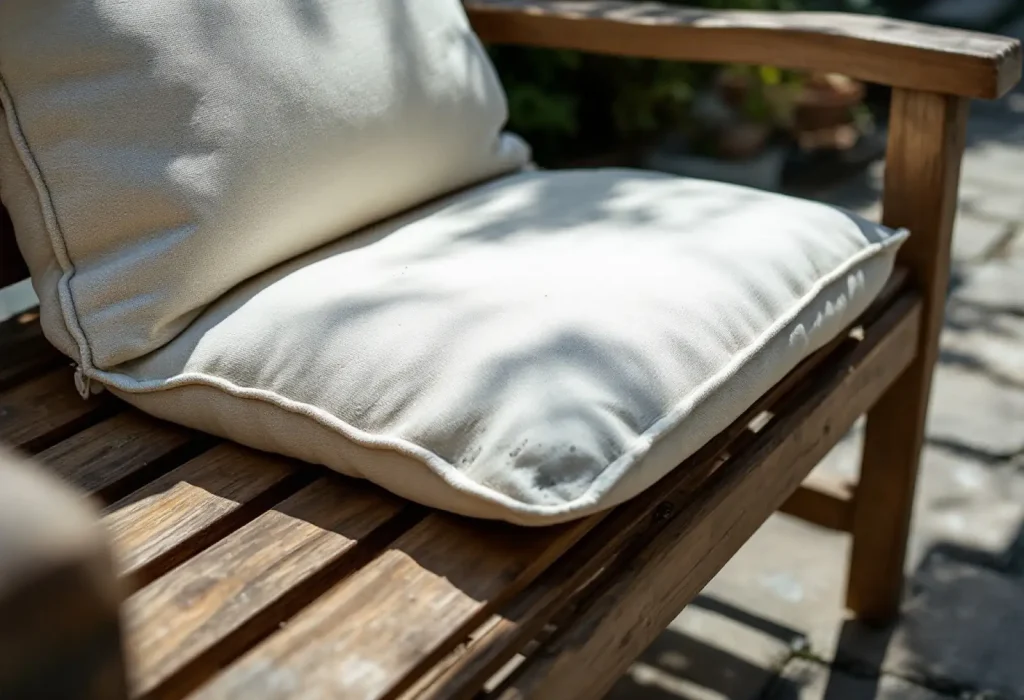
Does sunlight kill mold? Yes, but slowly, and only on the surface the light actually hits. Ground-level sun carries no UV-C, and according to published UV-A doses for Penicillium and Cladosporium spores, 11.8 to 127 J/cm2 per 90% kill, work out to about 0.7 to 7.8 hours of clear reference sun each. Drying does most of the real work, and dormant spores survive it.
Which UV bands in sunlight actually reach a moldy cushion on the patio?
Only UV-A and a sliver of UV-B. According to WHO's Global Solar UV Index practical guide, all UV-C and about 90% of UV-B are absorbed by ozone, water vapour, oxygen and carbon dioxide before sunlight reaches the ground, and NIOSH Publication 2009-105 puts the ozone cutoff at 290 nm. That matters because the doses quoted for germicidal lamps are UV-C doses at about 254 nm, and the sun supplies none of it.
To put numbers on what does arrive, we integrated the ASTM G173-03 reference spectrum published by NLR. It describes a surface tilted 37 degrees toward a sun 41.81 degrees above the horizon, at air mass 1.5 with 0.34 cm of ozone, a clear-sky average chosen for the 48 contiguous US states. According to our integration, that sun delivers 45.42 W/m2 of UV-A and 0.682 W/m2 of UV-B out of 1,000.4 W/m2 in total.
| Band | Reference sun, W/m2 | 6 W germicidal tube, W/m2 | What it means for spores |
|---|---|---|---|
| UV-C (below 280 nm) | 0 (none below 290 nm) | 13.8 at 50 mm, 2.13 at 200 mm | The germicidal band; ozone removes it from sunlight |
| UV-B (280 to 315 nm) | 0.682 | Little: about 95% of output is at 253.7 nm | 95.4% of the sun’s UV-B is at 305 to 315 nm, where spores are least sensitive |
| UV-A (315 to 400 nm) | 45.42 | Little, same reason | Plentiful but needs J/cm2, not mJ/cm2, per 90% kill |
| Total, 280 to 4000 nm | 1,000.4 | n/a | UV is 4.6% of the reference sun’s energy |
The sun beats the tube on raw UV watts: 45.4 W/m2 of UV-A is about 3.3 times the 13.8 W/m2 of UV-C the Trivittayasil and colleagues, Food Science and Technology Research 2015 lamp put on an agar plate 5 cm away. The catch is how much energy each band needs per kill. Lamp arithmetic, distances and safety limits are on does UV light kill mold.
How many hours of midday sun does a 90% spore kill take?
No published study puts moldy furniture in real sun and counts surviving spores by the hour, so we did the arithmetic from the closest primary data. Gierke, Vatter and Hessling, AIMS Microbiology 2024 compiled more than 100 reports of fungal photoinactivation and lists the dose per 1 log (90%) reduction by species, wavelength and setting. Dividing each dose by the reference sun’s band irradiance gives hours: 45.42 W/m2 of UV-A delivers 16.35 J/cm2 per hour, and 0.682 W/m2 of UV-B delivers 246 mJ/cm2 per hour.
| Spore and test setting | Band and wavelength | Published dose per 90% kill | Hours, clear sun | Hours, overcast (31%) | Hours for 99.9% if log-linear |
|---|---|---|---|---|---|
| Penicillium chrysogenum, agar | UV-A, 370 nm | 11.8 J/cm2 | 0.7 | 2.3 | 2.2 |
| Cladosporium cladosporioides, agar | UV-A, 370 nm | 14.4 J/cm2 | 0.9 | 2.8 | 2.6 |
| Penicillium chrysogenum, agar | UV-A, 385 nm | 39 J/cm2 | 2.4 | 7.7 | 7.2 |
| Cladosporium cladosporioides, agar | UV-A, 385 nm | 45.1 J/cm2 | 2.8 | 8.9 | 8.3 |
| Penicillium digitatum, liquid | UV-A, 385 nm | 56.3 J/cm2 | 3.4 | 11.1 | 10.3 |
| Cladosporium cladosporioides, buffer | UV-A, 365 nm | 92.6 J/cm2 | 5.7 | 18.3 | 17 |
| Penicillium expansum, liquid | UV-A, 385 nm | 127 J/cm2 | 7.8 | 25.1 | 23.3 |
| Cladosporium herbarum, liquid | UV-B, 302 nm | 307 mJ/cm2 | 1.3 | 4 | 3.8 |
| Cladosporium cladosporioides, buffer | UV-B, 302 nm | 435 mJ/cm2 | 1.8 | 5.7 | 5.3 |
| Aspergillus niger, cellophane | UV-B, 302 nm | 1,118 mJ/cm2 | 4.6 | 14.7 | 13.7 |
| Aspergillus niger, cellophane | UV-B, 313 nm | 12,000 mJ/cm2 | 48.9 | 157.7 | 146.6 |
How we counted. Hours = published dose / (band irradiance x 3,600 s). 1 W/m2 = 0.1 mW/cm2. Per the method, the 99.9% column triples the 90% time, which is optimistic: Trivittayasil and colleagues, Food Science and Technology Research 2015 found mold spore survival curves with upward concavity, meaning sensitive spores die fast and leave survivors of higher resistance. Each published dose is for one wavelength, while sunlight spreads its UV-A from 315 to 400 nm, so the real clock runs longer than the table, not shorter.
Read the table as a floor. Per the compilation’s data, even the most sensitive pair, Penicillium chrysogenum spores on agar at 370 nm, needs 0.7 hours of uninterrupted clear sun on the exposed face for one 90% cut; a 99.9% cut, the scale disinfection is usually judged on, needs roughly 2.2 hours. Under overcast skies, where EPA's explanation of how the UV Index is calculated applies a 31% transmission factor, every figure grows about 3.2 times.
Where the UV Index fits: under the definition in WHO’s guide, each index point is 1/40 W/m2, or 25 mW/m2, of skin-weighted UV, so a UV Index of 10 means 0.25 W/m2 after weighting; EPA reaches the same figure by dividing the weighted total by 25. That weighting follows sunburn sensitivity, which falls steeply through the UV-A band, so the index cannot be converted into a fungal UV-A dose. Use it only as a timer: higher index, more UV of every band.
Why do dark spores such as Aspergillus niger shrug off the sun’s UV-B?
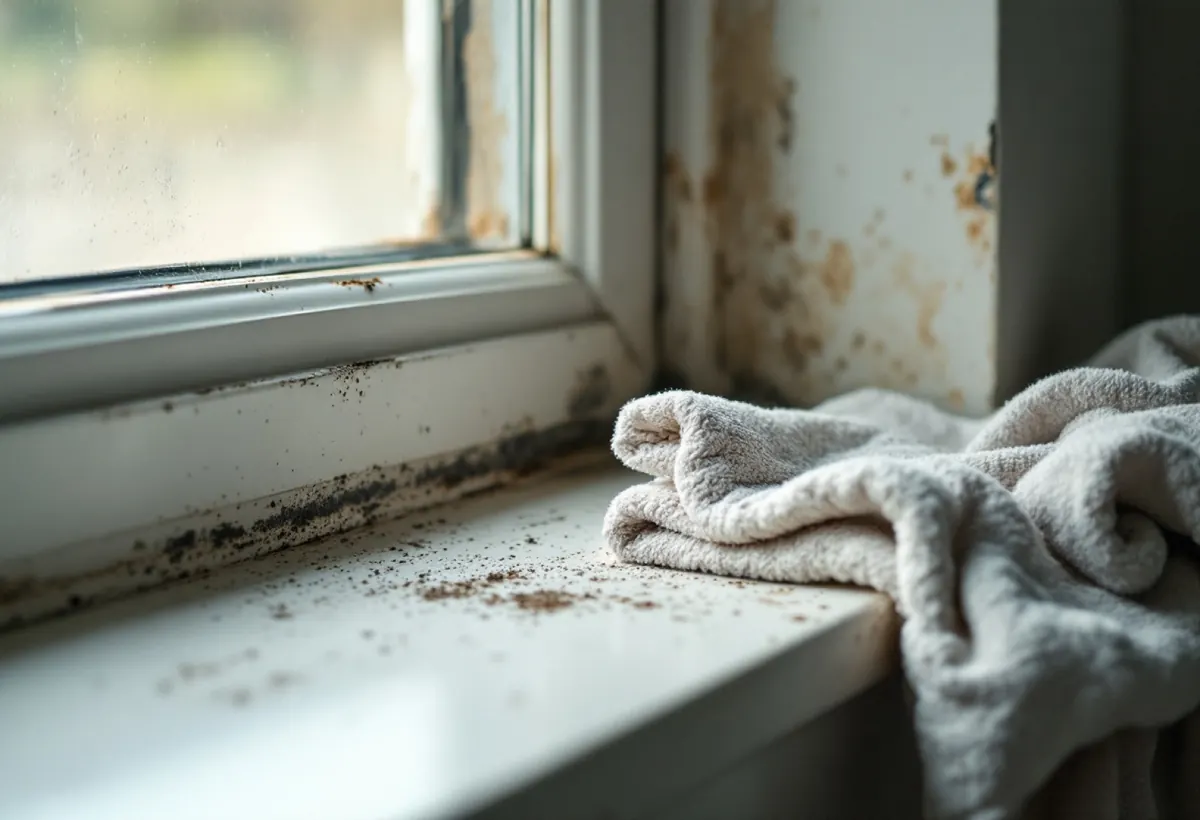
Pigment is the first reason. Gierke, Vatter and Hessling, AIMS Microbiology 2024 note that researchers recognised about 100 years ago that dark, pigmented fungi are relatively resistant to radiation, and Cordero and Casadevall, Fungal Biology Reviews 2017 describe fungal melanin as a pigment that interacts with many electromagnetic radiation frequencies, protecting the cell and harvesting energy. Both species groups in the hours table, Aspergillus and Cladosporium, are dark-spored molds.
Wavelength is the second reason, and it compounds the first. According to the same compilation, Aspergillus niger spores on cellophane needed 1,118 mJ/cm2 per 90% kill at 302 nm but 12,000 mJ/cm2 at 313 nm, about 11 times more. According to our integration of the G173 spectrum, 95.4% of solar UV-B sits at 305 to 315 nm, the weak end. Per the G173 data, at 313 nm the reference sun needs about 49 hours for one 90% cut, roughly 112 times the 107.5 mJ/cm2 median UV-C dose for the same species in liquid.
UV-A works differently, not just more weakly. The a 2025 Tokushima University study in The Journal of Medical Investigation found that UVC and UVA both inactivated Cladosporium sphaerospermum in a dose-dependent way, but the energy needed for the same kill differed significantly; UVC formed cyclobutane pyrimidine dimers in DNA while UVA did not differ from unirradiated controls and instead suppressed the growth rate. Slower growth is useful on a patio; it is not a kill.
For a sense of scale, according to the compilation, Cladosporium cladosporioides spores on agar needed 14.4 J/cm2 of UV-A at 370 nm and 45.1 J/cm2 at 385 nm per 90% kill, against 100 mJ/cm2 of 254 nm UV-C (Gierke, Vatter and Hessling, AIMS Microbiology 2024). That is 144 to 451 times more energy, which is why a 6 W tube at 50 mm would need about 72 seconds where the sun needs hours.
If solar UV is that slow, why do sunny patios stay clean?
Because sun dries surfaces long before it irradiates spores to death. EPA's A Brief Guide to Mold, Moisture and Your Home says the key to mold control is moisture control, asks for water-damaged items to be dried within 24 to 48 hours, and sets indoor humidity below 60%, ideally 30 to 50%. The same guide notes that no mold grows without water or moisture, so a surface the sun keeps dry is protected even while its spores live on.
Drying stops growth without promising death. What drying does to a colony, by water activity and species, is on does mold die when it dries out. Surface heat is a separate lever with its own published temperatures and hold times, set out on what temperature kills mold.
The strongest solar result in the record used conditions no patio matches. Lonnen and colleagues, Water Research 2005 exposed water in batch reactors to 8 hours of simulated sunlight at 870 W/m2 in total and 200 W/m2 of 300 to 400 nm UV, and recorded at least 4 log reduction of Fusarium solani and Candida albicans. That UV level is about 4.4 times the reference sun’s UV-A, so the same dose of 576 J/cm2 would take about 35 hours of clear G173 sun, and it was delivered to spores suspended in clear water, not buried in foam.
Does sun through a window or a windshield do anything?
Less than outdoor sun, and for UV-B effectively nothing. Tuchinda and colleagues, Journal of the American Academy of Dermatology 2006 state that window glass filters out UV-B and transmits UV-A and visible light. Almutawa and colleagues, Photodermatology, Photoimmunology and Photomedicine 2013 add that all types of commercial and automobile glass block the majority of UV-B, while UV-A transmission depends on the glass, with laminated glass blocking more UV-A than tempered glass.
So a moldy cushion on a sunny sill indoors loses the 0.682 W/m2 UV-B band entirely and keeps some unknown fraction of the 45.42 W/m2 UV-A band. A car interior behind a laminated windshield gets even less UV-A. Parking a moldy car in the sun heats and dries the cabin, but no light reaches the carpet underlay, seat foam or cabin filter.
Cushions, rugs and paperbacks: when does a sunny afternoon help, and when does it warp them?
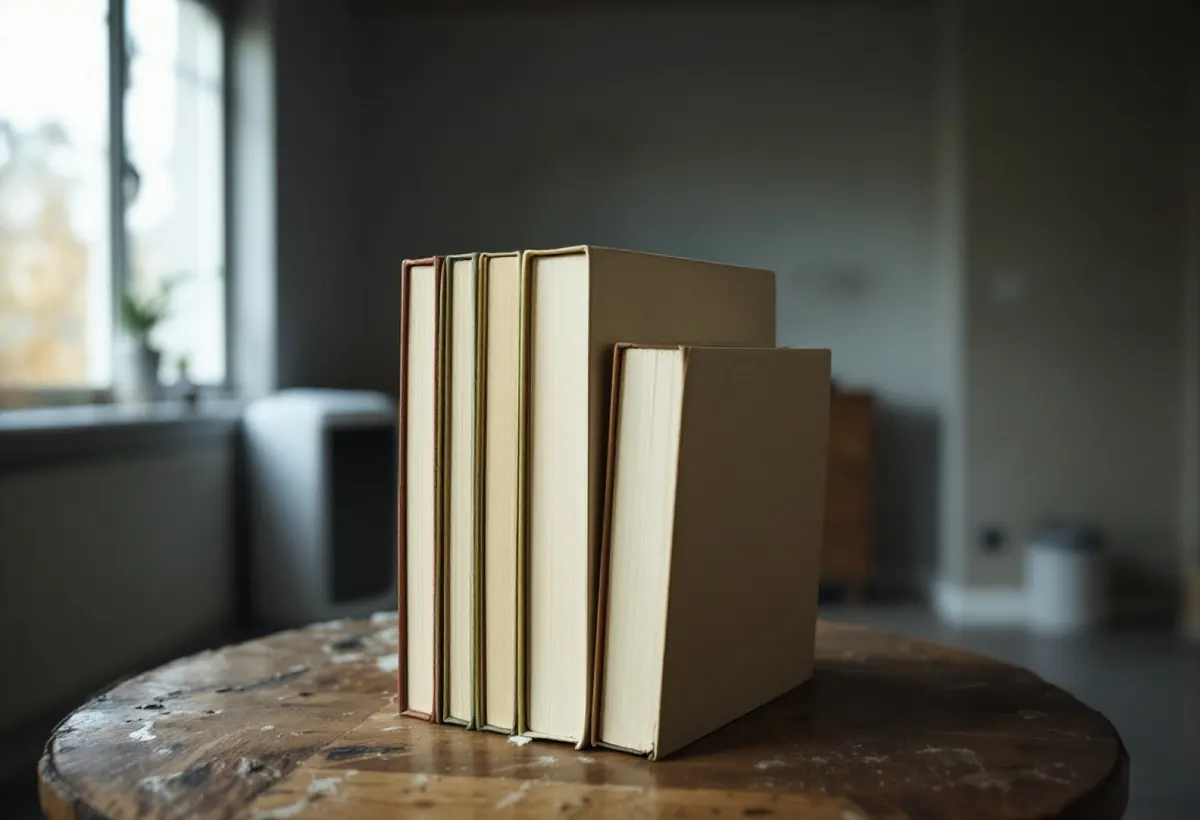
Use the sun as a dryer for things that tolerate it, after the mold has been cleaned off. Conservators draw the line clearly. the American Institute for Conservation tip sheet on water-damaged heirlooms says to air-dry objects indoors if possible because sunlight and heat may dry certain materials too quickly, causing splits, warping and buckling; it adds that moderate light, from open shades or basement lights left on, can help reduce mold and mildew, and that sealed plastic bags of damp items cause mold.
| Item | Put it in the sun? | Why, per the source |
|---|---|---|
| Outdoor cushion, damp from rain | Yes, after cleaning | EPA: dry within 24 to 48 hours; UV reaches the cover, not the foam core |
| Mattress or upholstered chair with growth | No | EPA: porous items may have to be thrown away; sun cannot reach the interior |
| Wood furniture or a framed painting | No, dry indoors | AIC: sun and heat dry some materials too fast, causing splits, warping, buckling; paintings face up away from direct sun |
| Wet paper or books | No, air dry or freeze | LoC: freeze if not dry within 2 days; NEDCC: air drying suits fewer than 100 books |
| Clothes and washable textiles | After washing | AIC: launder or dry clean as you normally would; line drying speeds the dry |
| Rug or doormat | Yes, both faces | Turn it: the face lying down gets no direct sun at all |
For paper, according to the Library of Congress preservation answer on wet or moldy items, the rule is to set items out to air dry immediately and, if newly wet or moldy papers cannot be dried within 2 days, to freeze them; for items with mold stains only, it says to keep relative humidity between 35 and 55% to prevent regrowth. NEDCC leaflet 3.6 on emergency salvage of wet books warns that mold can begin to develop in as little as 48 hours and asks for fans aimed parallel to drying records, never directly at them.
Thick porous items fail the dose test before they fail anything else. EPA's A Brief Guide to Mold, Moisture and Your Home says absorbent or porous materials may have to be thrown away if they become moldy, because mold fills their crevices; the sun treats only the top fibres. Item-by-item steps are on mold on a mattress and mold on furniture.
Out of scope: this page covers what sunlight does to mold, not what mold does to people. For that, start with EPA's A Brief Guide to Mold, Moisture and Your Home.
Questions people actually ask
Does sunlight kill mold on clothes?
Only on the fibres facing the sun, and slowly: according to the published UV-A doses in the 2024 AIMS Microbiology compilation work out to about 0.7 to 7.8 hours of clear reference sun per 90% spore kill on the exposed face. The AIC tip sheet says to launder or dry clean textiles as you normally would, so wash first and use the sun to finish drying. More on mold on clothes.
Does sunlight kill mold on wood?
Not reliably, and it can damage the piece. The American Institute for Conservation warns that sunlight and heat may dry certain materials too quickly, causing splits, warping and buckling, and recommends drying indoors. Light also cannot follow growth into pores and end grain. Cleaning steps are on mold on wood.
Does sunlight kill mold on plastic?
Barely by UV. According to the 2024 AIMS Microbiology compilation, Aspergillus niger spores on cellophane needed 1,118 mJ/cm2 at 302 nm and 12,000 mJ/cm2 at 313 nm per 90% kill, which is days of reference sun. Plastic does dry quickly in sun, so wash the surface with detergent and water, as EPA advises for hard surfaces, and let the sun finish drying.
What permanently kills mold?
Nothing applied once keeps it gone while the water source remains. EPA’s Brief Guide says the key to mold control is moisture control: fix the leak, scrub hard surfaces with detergent and water, dry within 24 to 48 hours and keep indoor humidity below 60%. EPA notes spores float through outdoor and indoor air, so permanence comes from denying them water, not from a product.
What does mold hate?
Dry surfaces and dry air. EPA asks for indoor relative humidity below 60%, ideally 30 to 50%, and the Library of Congress keeps stained paper at 35 to 55% to prevent regrowth. Light helps at the margin: the AIC tip sheet notes moderate light exposure, such as open shades, can reduce mold and mildew.
Is a UV lamp better than the sun for mold?
On dose per second, yes, by a wide margin, because only a lamp supplies UV-C. A Toshiba GL6 tube put 13.8 W/m2 on a plate 50 mm away in a 2015 Kyushu University study, and spores need hundreds of times less UV-C energy than UV-A per kill. The lamp still fails on shadowed or porous growth and is hazardous to skin and eyes; see does UV light kill mold.
Sources
- the ASTM G173-03 reference spectrum published by NLR: Reference Air Mass 1.5 Spectra, ASTM G173-03 tables (ASTMG173.csv), NLR. Band integrals computed by Remediation Insider. Retrieved 17 November 2026.
- WHO's Global Solar UV Index practical guide: Global Solar UV Index, A Practical Guide, World Health Organization, WMO, UNEP and ICNIRP, 2002, WHO/SDE/OEH/02.2. Retrieved 17 November 2026.
- EPA's explanation of how the UV Index is calculated: Calculating the UV Index, US EPA Sun Safety, last updated 12 November 2026. Retrieved 17 November 2026.
- NIOSH Publication 2009-105: Environmental Control for Tuberculosis, Basic Upper-Room Ultraviolet Germicidal Irradiation Guidelines for Healthcare Settings, CDC NIOSH, March 2009. Retrieved 17 November 2026.
- Gierke, Vatter and Hessling, AIMS Microbiology 2024: Fungal photoinactivation doses for UV radiation and visible light, a data collection, vol. 10, doi 10.3934/microbiol.2024032, Tables 1 and 2. Retrieved 17 November 2026.
- Lonnen and colleagues, Water Research 2005: Solar and photocatalytic disinfection of protozoan, fungal and bacterial microbes in drinking water, vol. 39, pp. 877 to 883 (abstract). Retrieved 17 November 2026.
- a 2025 Tokushima University study in The Journal of Medical Investigation: Yamashita and colleagues, Wavelength-dependent differences in survival of Cladosporium sphaerospermum exposed to ultraviolet light, vol. 72, pp. 260 to 265 (abstract). Retrieved 17 November 2026.
- Trivittayasil and colleagues, Food Science and Technology Research 2015: Inactivation Characteristics and Modeling of Mold Spores by UV-C Radiation Based on Irradiation Dose, vol. 21, no. 3, Table 1. Retrieved 17 November 2026.
- Cordero and Casadevall, Fungal Biology Reviews 2017: Functions of fungal melanin beyond virulence, vol. 31, pp. 99 to 112 (abstract). Retrieved 17 November 2026.
- Tuchinda and colleagues, Journal of the American Academy of Dermatology 2006: Photoprotection by window glass, automobile glass, and sunglasses, vol. 54, pp. 845 to 854 (abstract). Retrieved 17 November 2026.
- Almutawa and colleagues, Photodermatology, Photoimmunology and Photomedicine 2013: Current status of photoprotection by window glass, automobile glass, window films, and sunglasses, vol. 29, pp. 65 to 72 (abstract). Retrieved 17 November 2026.
- EPA's A Brief Guide to Mold, Moisture and Your Home, US EPA, last updated 18 February 2026. Retrieved 17 November 2026.
- the American Institute for Conservation tip sheet on water-damaged heirlooms: Tips for the Care of Water-Damaged Family Heirlooms and Other Valuables, American Institute for Conservation. Retrieved 17 November 2026.
- the Library of Congress preservation answer on wet or moldy items: What should I do with a wet/moldy collection item?, Library of Congress, Ask a Librarian. Retrieved 17 November 2026.
- NEDCC leaflet 3.6 on emergency salvage of wet books: Emergency Salvage of Wet Books and Records, Northeast Document Conservation Center. Retrieved 17 November 2026.
- How this page was built is described in our methodology, and more mold pages are on the mold hub.
Hours are a labelled calculation from laboratory doses and the ASTM G173-03 reference spectrum, not an outdoor test. Real sun varies with season, latitude, cloud and angle; check the day’s UV Index and treat every figure here as a minimum.