The short answer
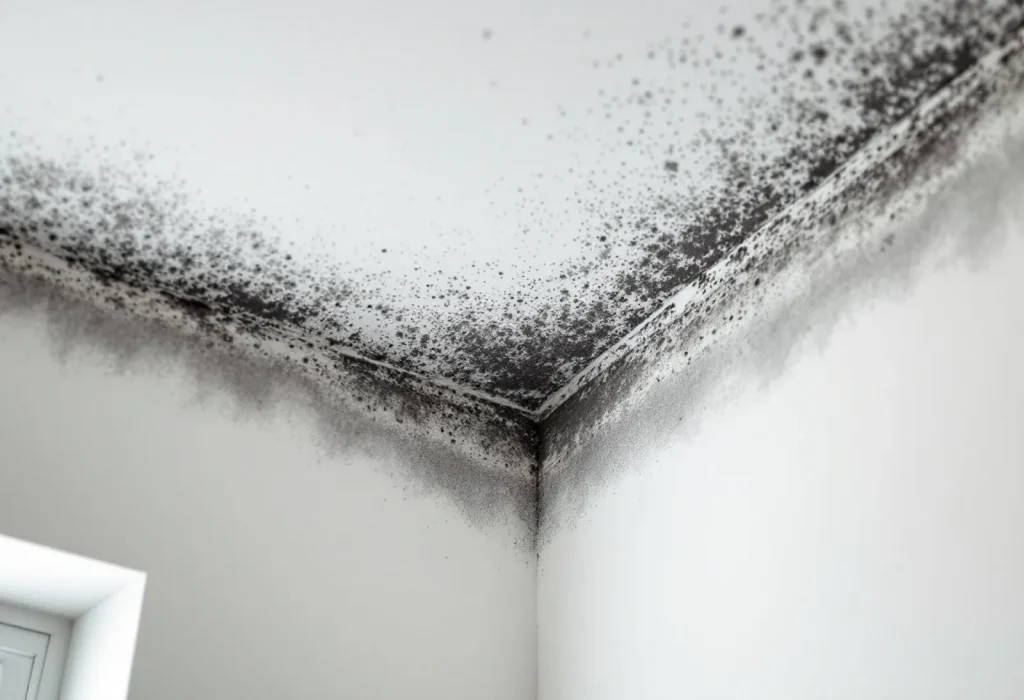
Mold on ceiling paint or drywall means that patch stays damp, and the pattern tells you the water source. Speckle along an outside corner is condensation on a cold surface; a blotch under the attic is warm air leaking up; a brown ring is a leak from above. EPA says a patch under about 10 square feet is usually a DIY cleanup, once the water is fixed.
Which of six ceiling patterns do you have, and what confirms it?
Every source on ceilings agrees on the starting point: EPA's A Brief Guide to Mold, Moisture and Your Home says mold will not grow without water or moisture, and that cleaning without fixing the water problem means the mold will most likely come back. So the useful question is where the water comes from, and on a ceiling there are only a handful of answers. The shape and location of the growth usually narrows it to one before anyone climbs into the attic.
| Pattern | Where | Likely cause | Confirming check | Source |
|---|---|---|---|---|
| 1. Blotchy patches across a top floor ceiling, worst in winter | Ceiling under a vented attic | Warm moist air leaking up through light, wiring, vent and duct holes; thin or missing insulation | Look in the attic above: dark sheathing, frost, gaps in insulation | PNNL BASC; EPA's Mold Course, Chapter 2 |
| 2. Speckle in a band along the wall to ceiling edge of an outside wall | Exterior corners, often bedrooms with doors shut | Condensation on the coldest inside surface | Surface feels cold; pattern fades away from the corner; humidity over 50% | Mumovic, Ridley, Oreszczyn and Davies (2006); EPA Chapter 2 |
| 3. Stain and mold near the outside wall after snow or heavy rain | Eaves, low slope or flat roof | Ice dam meltwater or roof leak wetting the ceiling from above | Stain grows after weather, not after showers; check the roof edge | the Building America Solution Center ice dam guide |
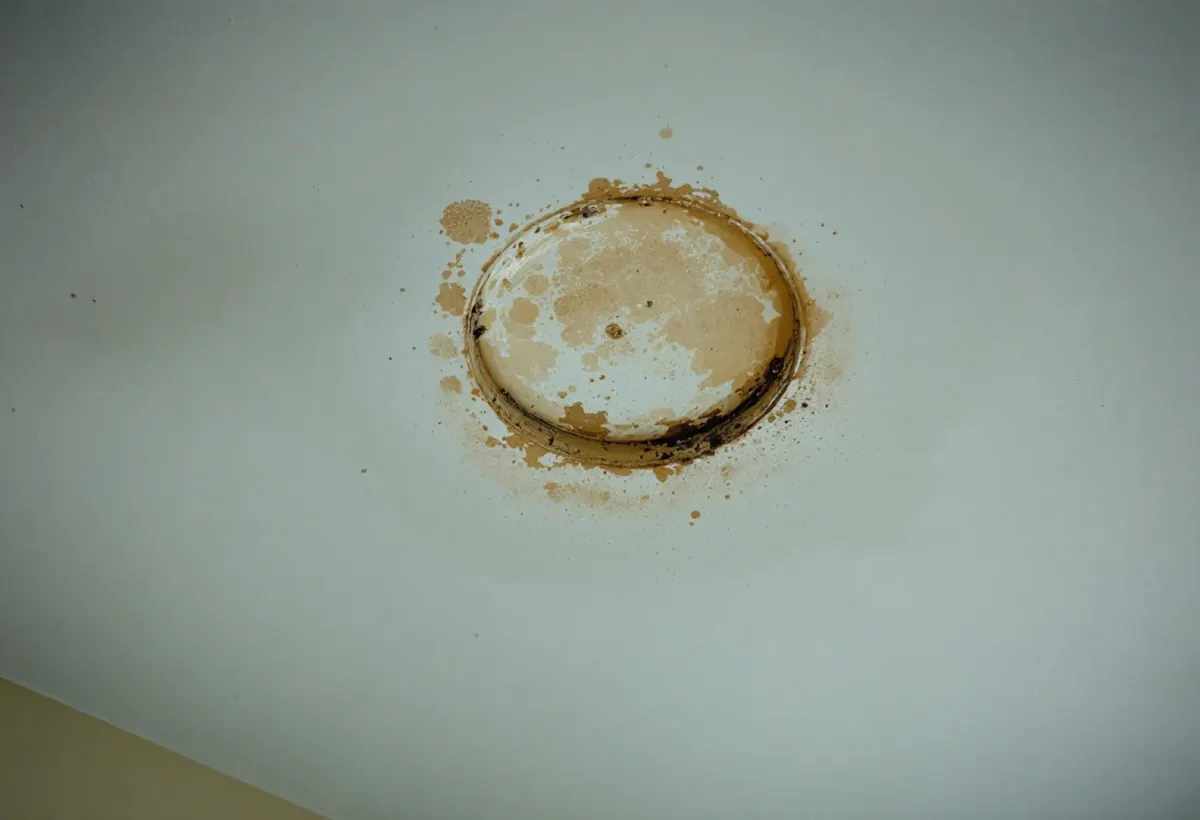
| 4. Brown ring with a darker edge, mold inside the ring | Ceiling under a bathroom, laundry or kitchen upstairs | Supply or drain leak in the floor above | Stain is damp after the fixture above runs; moisture meter reads wet | EPA's Mold Course, Chapter 2 |
| 5. Greasy grey film or spots over the range | Kitchen ceiling | Cooking vapor with no exhaust to outside | Spots cluster over the cooktop; range hood absent or vented inside | Montana State University Extension; EPA brief guide |
| 6. Ring of spots around a supply register | Ceiling diffusers, mostly in cooling season | Condensation on cold duct or register metal | Spots only around the grille; check the duct for missing insulation | EPA Chapter 2 |
Two patterns are not on the table because they belong to another page. Speckle over a shower and straight grey lines at joist spacing are the bathroom cases, read in detail on mold on bathroom ceiling.
Why does mold grow in a line where the ceiling meets an outside wall?
Because that line is the coldest surface in the room. EPA's Mold Course, Chapter 2 says mold is frequently found on walls in cold corners behind furniture where condensation forms, and the junction of an outside wall, the ceiling and the attic above is a three way corner. Mumovic, Ridley, Oreszczyn and Davies (2006), building physicists at University College London, write that mould will often first occur at thermal bridges, where heat flows out faster, because inside surface temperatures are lower and relative humidity higher there.
Their yardstick is the surface temperature factor, f: inside surface temperature minus outside air temperature, divided by inside air temperature minus outside air temperature. The paper says f is close to 1.0 for a well insulated structure, falls below 0.5 for severe thermal bridges, and that 0.75 is generally considered sufficient to avoid mould growth in UK dwellings. According to the paper, mould growth does not need water droplets: it is likely on wallpaper held above 80% relative humidity.
The calculation: a 70 F bedroom at 40 percent humidity
Applying that definition with the National Weather Service vapor pressure equation gives the surface temperature and surface humidity at the corner for four outdoor temperatures. Room air at 70 F and 40% humidity, inside the 30 to 50% band EPA's A Brief Guide to Mold, Moisture and Your Home calls ideal, has a dew point of about 45 F per the same equation. The room air never changes in the table; only the corner does.
| Corner quality, per the NWS equation | 30 F outside | 20 F outside | 10 F outside | 0 F outside |
|---|---|---|---|---|
| f 0.90, well insulated | 66 F, 46% | 65 F, 48% | 64 F, 49% | 63 F, 51% |
| f 0.75, UK criterion | 60 F, 57% | 58 F, 62% | 55 F, 68% | 52 F, 74% |
| f 0.60, weak corner | 54 F, 70% | 50 F, 82%, mold range | 46 F, 95%, mold range | 42 F, condenses |
| f 0.50, severe bridge | 50 F, 82%, mold range | 45 F, 98%, mold range | 40 F, condenses | 35 F, condenses |
Per the arithmetic above, at 20 F outside, a corner at f 0.75 sits near 62% surface humidity, a weak corner at f 0.60 reaches 82%, and a severe bridge at f 0.5 reaches 98%. That is why corner mold can appear in a room a hygrometer says is fine. The humidity thresholds themselves, including the 80% surface line per the UCL paper, are worked through on what humidity does mold grow.
Two fixes follow from the formula. Raise f by insulating the cold corner: Montana State University Extension lists at least R 38 for ceilings and notes that insulation not filling all the nooks and crannies leaves cold surfaces. Or lower the room’s vapor, per the same Extension sheet: 30 to 45% humidity in the heating season, with air left to circulate across cold surfaces and registers left uncovered.
Why do top floor ceilings under an attic grow mold in winter?
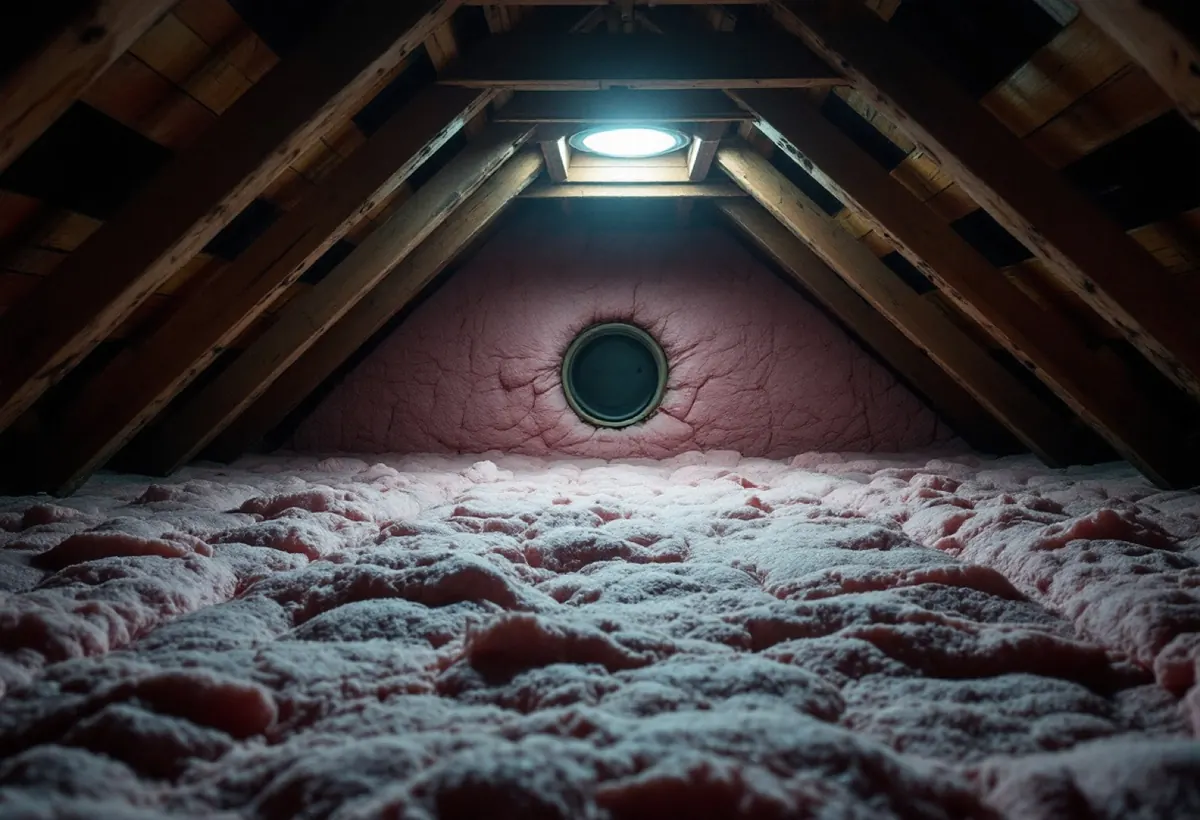
Two things happen at once. the Building America Solution Center guide to condensation in attics, published by Pacific Northwest National Laboratory for the Department of Energy’s Building America program, describes warm moist house air escaping into the attic through penetrations made in the ceiling for recessed lighting, wiring, vent piping and ducts, then condensing, often as frost, on roof trusses and the underside of the sheathing. It says that condensation can quickly lead to mold growth, on the attic side first.
On the room side, EPA's Mold Course, Chapter 2 lists roof materials above ceiling tiles among hidden mold sites, and the EPA brief guide adds the cause: roof leaks or insufficient insulation. Montana State University Extension makes the same point from the room side: where insulation is low or does not fill every nook and cranny, cold surfaces result, so a bay where insulation was pushed aside around a light or hatch is where the room side patch appears.
The confirming check is in the attic, not the room. Look directly above the stain for a gap in the insulation, dark or frosted sheathing, a bath fan duct ending in the insulation, or a light fixture with daylight around it. The attic side is covered on signs of mold in attic.
The fix starts with the holes the BASC guide names: seal around lights, wiring, vent pipes and ducts, then bring insulation up to depth. For the vented attic itself the guide gives 1 square foot of net free vent area per 150 (up to 300) square feet of attic floor, with baffles keeping 2 inches of clearance at the eaves. The same guide recommends 30 to 50% indoor humidity in the heating season, which matches EPA.
Mold near the outside wall after snow: is it an ice dam?
Often, if the stain sits near the eave and appears after a snowfall and thaw. the Building America Solution Center ice dam guide explains that ice dams form when snow sits on a roof and the deck under it warms above freezing from heat escaping the house; the meltwater backs up and can wick back through shingles into the attic, affecting roofs, walls, ceilings and insulation. It recommends R 60 or greater in ventilated attics in climate zones 5 and up, where ice dams are most prevalent.
A stain that tracks weather rather than showers or cooking is the tell for any roof source, including a low slope or flat roof with no attic at all, which EPA's Mold Course, Chapter 2 lists first among common moisture problems as leaking roofs. Roof repair belongs to The Roofing Brief, our sister site. Drying and replacing the wet ceiling itself is on water damage ceiling.
Is kitchen ceiling mold from cooking without a range hood?
Usually, when the spots cluster over the cooktop. Montana State University Extension puts cooking on an electric range without the exhaust vent on at 2.0 pounds of moisture a day for an average family of four, part of a household total of 55.9 pounds, or 6.7 gallons. Warm vapor from an uncovered pot rises to the ceiling directly above it.
EPA's A Brief Guide to Mold, Moisture and Your Home tells households to vent stoves to the outside where possible and to use exhaust fans or open windows whenever cooking or washing dishes, noting that combustion appliances produce water vapor and raise humidity unless vented outside. Montana State adds two low cost steps: cover pots while boiling and make sure every exhaust ends outdoors, not in the attic.
A brown ring under an upstairs bathroom or laundry: leak or humidity?
Treat it as a leak until proven otherwise. EPA's Mold Course, Chapter 2 names leaking or condensing water pipes, especially pipes inside wall cavities or pipe chases, among the common moisture problems, and the pattern is different from condensation: one ring, often with a darker edge, sitting under a tub, toilet, washer or dishwasher on the floor above rather than along a cold edge.
Run the fixture above for several minutes, then check the stain with a pin or pinless moisture meter and compare it with dry ceiling a few feet away. A reading that rises after use points at a drain or overflow; one that stays wet regardless points at a pressurised supply line. Finding and repairing the pipe is plumbing work, covered by our sister site The Plumbing Brief at theplumbingbrief.com.
Timing matters here more than anywhere else on a ceiling. EPA's A Brief Guide to Mold, Moisture and Your Home says wet materials dried within 24 to 48 hours of a leak usually will not grow mold, and that absorbent materials such as ceiling tiles may have to be thrown away once moldy.
Why is there mold on the closet ceiling but nowhere else?
A closet on an outside wall or under the attic gets little heat and little air movement, so its ceiling can run colder than the bedroom outside its door, the corner effect in the table above with the door shut. Chapter 3 of EPA's school and commercial building remediation guide lists walls behind furniture, where condensation forms, among hidden mold locations; a full closet with the door shut does the same thing to its ceiling. Montana State University Extension‘s fix for cold surfaces applies directly: let air circulate across them.
Leave the door open or fit a louvered door through a cold season, keep stored items a few inches off the outside wall, and check the attic insulation over the closet. Clothing and stored contents are covered on mold in closet.
Mold on a popcorn ceiling: why test before scraping in a house built by 1980?
Because federal rules presume the texture is asbestos until a lab says otherwise. 29 CFR 1926.1101, the OSHA construction asbestos standard, defines surfacing material as material sprayed, troweled on or otherwise applied to surfaces, with acoustical plaster on ceilings as its example, and defines presumed asbestos containing material as thermal system insulation and surfacing material in buildings constructed no later than 1980. That presumption binds employers; for a homeowner it is a strong reason to sample first.
Scraping, wire brushing or sanding moldy texture is the step that matters, because it powders the material. Cleaning mold off popcorn texture is rarely practical anyway: it is porous, and EPA's A Brief Guide to Mold, Moisture and Your Home says porous materials may be difficult or impossible to clean completely. The dates, test method and removal rules are set out on popcorn ceiling asbestos.
Can you clean ceiling mold yourself, or is it over EPA’s 10 square foot line?
EPA's A Brief Guide to Mold, Moisture and Your Home sets the household line at about 10 square feet, roughly a 3 foot by 3 foot patch: below it, in most cases, you can handle the job yourself; above it, or after a lot of water damage, it points to its school and commercial guide. Measure the ceiling patch with a tape, including the faint edge, because ceilings photographed from below look smaller than they are.
Table 2 in Chapter 5 of the same EPA guide sorts drywall by area. Under 10 square feet it lists HEPA vacuuming after drying with an N95 respirator, gloves and goggles and no containment; from 10 to 100 square feet it adds removal of damaged material, double bagged in 6 mil polyethylene per Chapter 3, with limited or full protective equipment and limited containment by professional judgment. EPA says an N95 costs about $12 to $25 and that respirators must fit to work.
For hard surfaces, the EPA brief guide method is detergent and water, then dry completely, with gloves and goggles without ventilation holes. It says not to paint or caulk moldy surfaces, because paint over mold is likely to peel, and that chlorine bleach is not recommended as a routine step. Drywall is porous, and the guide says porous materials may have to be thrown away once moldy. Step by step methods and their limits are on DIY mold remediation; the full set of mold pages is on the mold hub.
Out of scope: this page covers buildings and moisture, not health effects. EPA’s mold pages and the CDC are the public references for health questions, and a physician is the person to ask.
Questions people actually ask
Is it bad if there’s mold on my ceiling?
For the building, yes: EPA’s Mold Course says molds gradually destroy the things they grow on, and that a roof leak left long enough lets mold weaken floors and walls by feeding on wet wood. A small patch from condensation is a moisture warning, not an emergency. Find the water source first, then clean anything under about 10 square feet, the EPA household line.
How do I stop mold on my ceiling from coming back?
Fix the water, not the stain. EPA says cleaning without fixing the moisture problem means mold will most likely return. For condensation that means indoor humidity under 60 percent, ideally 30 to 50, insulation at cold corners and attic air sealing; for leaks it means the repair. A $10 to $50 hygrometer, the EPA price, shows whether humidity is the cause.
Can I just paint over mold on the ceiling?
No. EPA’s brief guide says not to paint or caulk moldy surfaces and that paint applied over mold is likely to peel. Clean the surface with detergent and water, let it dry completely, and fix the moisture first, or the spots return under the new coat.
Do I need a mold test for ceiling mold?
Usually not. EPA says that in most cases, if visible mold growth is present, sampling is unnecessary, and that no EPA or federal limits exist for mold spores. Testing helps when growth is suspected but hidden above the ceiling, or to check that a remediation cleaned the area. Popcorn texture in a pre 1981 house needs an asbestos test, which is different.
Should I run the air conditioning if there is mold around a ceiling vent?
EPA’s brief guide says not to run the HVAC system if you know or suspect it is contaminated, because it could spread mold through the building. A ring of spots only on the ceiling around a diffuser is often condensation on cold metal; EPA’s Mold Course shows an uninsulated duct as a condensation source, fixed by insulating the duct.
Sources
- EPA's A Brief Guide to Mold, Moisture and Your Home, United States Environmental Protection Agency, last updated 18 February 2026. Retrieved 21 November 2026.
- EPA's Mold Course, Chapter 2: Why and Where Mold Grows, EPA, last updated 10 November 2026. Retrieved 21 November 2026.
- Chapter 3 of EPA's school and commercial building remediation guide (hidden mold locations, cleanup Methods 1 to 4) and Table 2 in Chapter 5 of the same EPA guide (Mold Remediation Guidelines by area), EPA 402-K-01-001, last updated 14 April 2026. Retrieved 21 November 2026.
- the Building America Solution Center guide to condensation in attics, Building America Solution Center, Pacific Northwest National Laboratory for the U.S. Department of Energy, updated 6 December 2022. Retrieved 21 November 2026.
- the Building America Solution Center ice dam guide, Building America Solution Center, PNNL, updated 6 December 2022. Retrieved 21 November 2026.
- Mumovic, Ridley, Oreszczyn and Davies (2006), Condensation risk: comparison of steady-state and transient methods, Building Services Engineering Research and Technology 27(3), pages 219 to 233, via UCL Discovery. Retrieved 21 November 2026.
- the National Weather Service vapor pressure equation, National Weather Service, El Paso office, Vapor Pressure worksheet. Retrieved 21 November 2026.
- Montana State University Extension, Controlling Condensation in the Home, undated fact sheet. Retrieved 21 November 2026.
- 29 CFR 1926.1101, OSHA asbestos standard for construction, definitions of surfacing material and PACM, via eCFR. Retrieved 21 November 2026.
- The corner surface temperatures and humidities are arithmetic on the f definition and NWS equation above, computed when this page was built; nothing was measured in a building. Our methodology sets out the standing rules.
Ceiling stains with a sagging or soft ceiling, sewage water, or texture that may contain asbestos need a professional assessment before anyone disturbs them.