The short answer
The answer to what humidity does mold grow at is about 80 percent relative humidity measured at the surface and held for days, the limit in ASHRAE Standard 160. EPA tells households to keep room air below 60 percent, ideally 30 to 50 percent, because a 55 F wall in a 70 F room at 50 percent sits near 85 percent.
Why does a 50 percent room grow mold on a 55 F wall?
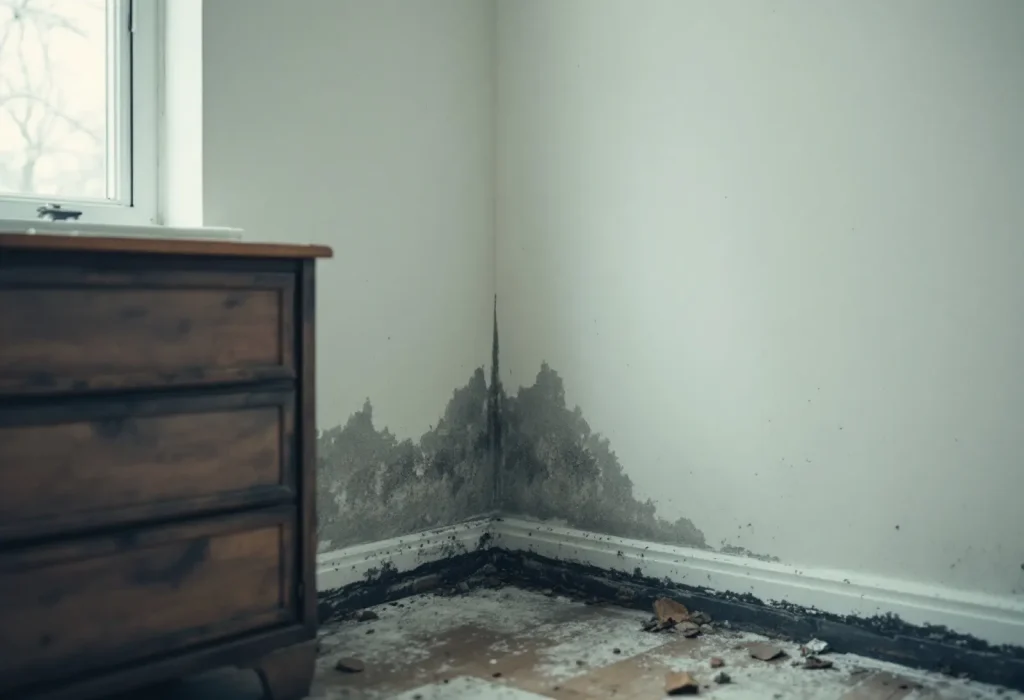
Because a hygrometer reads the air in the middle of the room and mold grows on the surface. The amount of water vapor is the same at both places; what changes is the temperature. Cooler air holds less vapor before it saturates, so the same vapor gives a higher relative humidity next to a cold wall, window frame or closet corner. EPA Mold Course, Chapter 2 names the result: mold is frequently found on walls in cold corners behind furniture where condensation forms.
The arithmetic uses the National Weather Service vapor pressure equation, which gives saturation vapor pressure in hectopascals from temperature in Celsius, and relative humidity as actual vapor pressure divided by saturation vapor pressure. Applied to a room at 70 F and 50 percent, which sits inside EPA’s ideal band, and to an exterior wall surface at 55 F:
| Step | Value | How |
|---|---|---|
| 1. Room temperature | 70 F = 21.1 C | Convert F to C first, as the NWS sheet instructs |
| 2. Saturation pressure of room air | 25.05 hPa | 6.11 x 10^(7.5T / (237.3 + T)) |
| 3. Actual vapor pressure | 12.52 hPa | 50 percent of step 2 |
| 4. Wall surface temperature | 55 F = 12.8 C | Same equation, colder T |
| 5. Saturation pressure at the wall | 14.77 hPa | Cold air holds less vapor |
| 6. Surface RH | 84.8 percent | Step 3 / step 5 x 100 |
| 7. Dew point of room air | 50.5 F (10.3 C) | Wall colder than this gets wet |
The answer, 85 percent, is above the 80 percent surface limit in ASHRAE Standard 160, even though the room meter shows a number EPA calls ideal. That is the gap most humidity charts online leave out: they rate the room reading and say nothing about the coldest surface in it. The same physics explains why mold grows behind wallpaper on exterior walls.
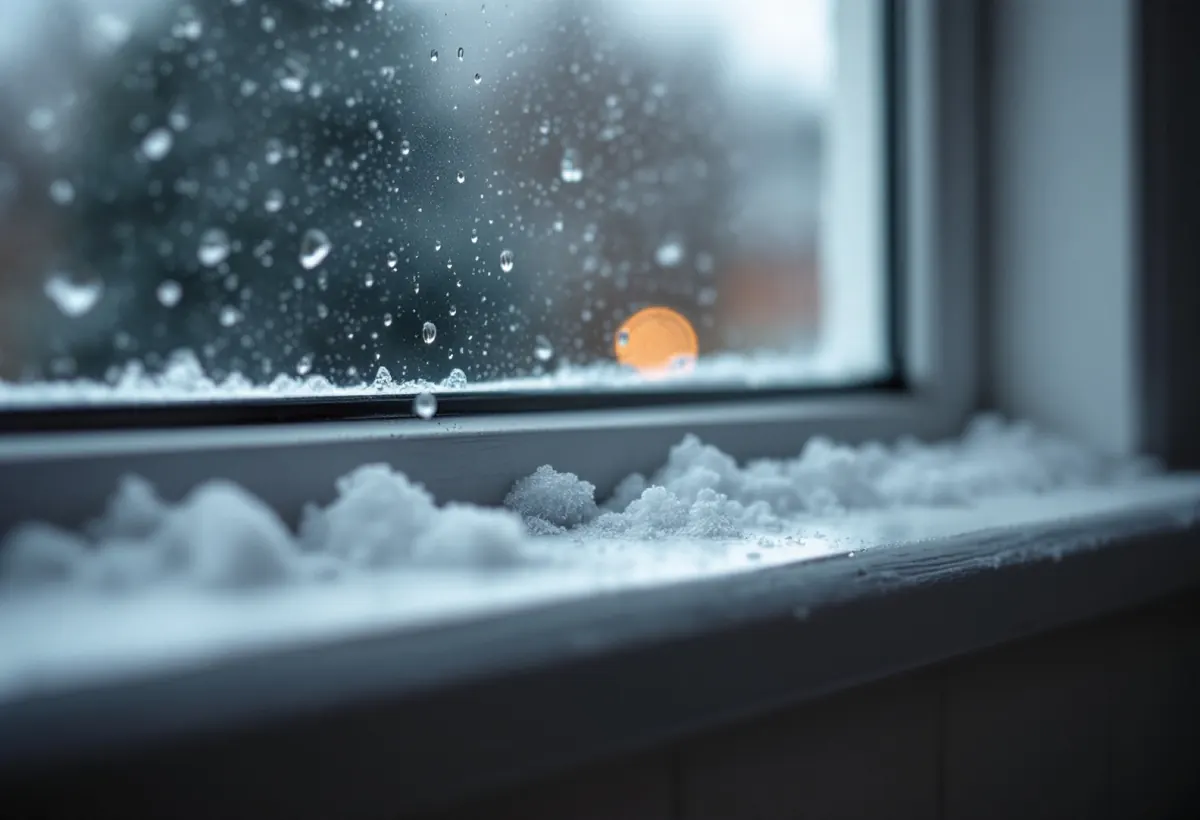
Drop the wall another 3 degrees to 52 F and the surface reaches about 95 percent. At 50.5 F, the dew point, it reaches 100 percent and water condenses as liquid, which is the condensation on a windowpane that EPA's Brief Guide to Mold, Moisture and Your Home treats as a sign of high humidity.
How many days does mold need at 80, 85 and 90 percent surface RH?
The most cited answer comes from Klaus Sedlbauer’s work at the Fraunhofer Institute for Building Physics. Sedlbauer's Fraunhofer IBP isopleth thesis combines published germination measurements into isopleths: lines of equal spore germination time across temperature and surface RH, drawn for two groups of building materials. Below the lowest line, which he calls the LIM (Lowest Isopleth for Mould), the thesis expects no biological activity on that material group.
| Spore germination time at 20 C (68 F) | Category I surface RH, percent | Category II surface RH, percent |
|---|---|---|
| 1 day | 91.0 | 95.5 |
| 2 days | 86.0 | 90.5 |
| 4 days | 83.0 | 87.5 |
| 8 days | 80.5 | 85.0 |
| 16 days | 78.0 | 82.5 |
| No germination expected below (LIM) | 76.0 | 80.5 |
Read across: paper faced drywall at 20 C with its surface held at about 83 percent germinates spores in about 4 days; at 78 percent it takes about 16 days; at 75 percent it should not start at all. Plaster or concrete needs roughly 4 to 5 points more for the same time. The thesis cross checks this against Adan’s plasterboard data, in which spores began germinating after approximately 2 weeks at 20 C and 80 percent RH.
Two cautions from the same work. The isopleths are measured at constant conditions, while real surfaces swing hourly, which Sedlbauer, Krus, Zillig and Kuenzel, IAQ 2001 handles by adding up the fraction of a germination cycle each hour contributes. And the thesis cites Kruppa and colleagues finding growth within 3 days at 70 percent on plasterboard, concrete and sand lime brick that already carried a developed biofilm, so a dirty surface with old growth does not need the clean surface numbers. Where the spores come from in the first place is covered in how mold spreads.
Where do the 60, 70 and 80 percent numbers each come from?
They answer different questions, which is why guides online seem to disagree. EPA’s 60 percent is a room target that leaves margin for cold surfaces; both EPA's Brief Guide to Mold, Moisture and Your Home and EPA Mold Course, Chapter 2 say indoor RH should be kept below 60 percent, ideally 30 to 50 percent. The 70 and 80 percent figures are surface conditions from building physics.
| Source | RH, percent | Measured where | What it means |
|---|---|---|---|
| EPA household guidance | Below 60, ideally 30 to 50 | Room air | Target for occupants, not a growth limit |
| Sedlbauer thesis, xerophilic fungi | 65 | Surface | Not all of these species occur in buildings |
| Sedlbauer thesis, building fungi | About 70 | Surface | Limit below which no growth occurs in buildings |
| Sedlbauer LIM, category I at 25 C | 75 | Surface | Text point used to fix the curve; 79 at 12 C |
| ASHRAE 160 (addendum a) | Under 80, 30 day running mean | Surface | Applies from 5 C to 40 C (41 F to 104 F) |
| ASHRAE 160 criteria removed in 2011 | Under 98 (7 day), under 100 (24 hour) | Surface | Dropped by addendum a |
| Sedlbauer thesis, nearly all species | 80 | Surface | Growth conditions met for nearly all mold fungi |
Addendum a to ANSI/ASHRAE Standard 160-2009, approved by the ASHRAE Board of Directors on 2 February 2011, kept one mold condition for designers: a 30 day running average surface RH under 80 percent while the 30 day surface temperature is between 5 C and 40 C. The two short term conditions it dropped were a 7 day mean under 98 percent and a 24 hour mean under 100 percent.
The USDA Forest Products Laboratory analysis of the ASHRAE 160 mold criteria (Glass, Gatland, Ueno and Schumacher, ASTM STP 1599) notes that many practitioners considered the 30 day rule too stringent, and its own comparison with field data found the rule failed many wood framed wall and roof assemblies where no visible mold grew. A later addendum replaced it with a mold index model that weighs material sensitivity in four classes, from very sensitive pine sapwood to resistant glass and metal. The 80 percent line also appears in the draft of DIN EN ISO 13788 quoted in the Sedlbauer thesis: lasting surface humidity above 80 percent over a longer period.
Which wall temperature turns a 70 F room reading into 80 percent at the surface?
This is the table to use with a hygrometer and an infrared thermometer. Read the room RH at 70 F, then find the surface temperature at which the ASHRAE 160 line of 80 percent is reached and the dew point at which water condenses. Any surface colder than the middle column sits above 80 percent RH for as long as the room holds that reading.
| Room RH at 70 F | Dew point (100 percent at surface) | Surface at 80 percent RH |
|---|---|---|
| 30 percent | 37.2 F (2.9 C) | 42.9 F (6.1 C) |
| 40 percent | 44.6 F (7.0 C) | 50.5 F (10.3 C) |
| 50 percent | 50.5 F (10.3 C) | 56.6 F (13.7 C) |
| 60 percent | 55.5 F (13.0 C) | 61.7 F (16.5 C) |
At 30 percent a surface must fall below 42.9 F before it reaches 80 percent, which few interior surfaces do. At 40 percent the line is 50.5 F. At 60 percent it is 61.7 F, only 8 F below the room, and the surfaces EPA names for condensation (cold water pipes, window glass, uninsulated air conditioning ducts) are the ones that get there first. That is the reason EPA’s 60 percent ceiling is a ceiling and not a target. The winter version of this problem, with the numbers for heating season, is in does mold grow in winter.
EPA's Brief Guide to Mold, Moisture and Your Home lists the fixes in the same terms: reduce the humidity, increase air movement, cover cold surfaces such as cold water pipes with insulation, and increase air temperature. Each one either lowers the vapor pressure or raises the surface temperature in the calculation above.
Does a colder house need more or less humidity for mold to grow?
More at the surface, but cold surfaces reach it more easily. In Fig. 34 of Sedlbauer's Fraunhofer IBP isopleth thesis every isopleth climbs as temperature falls: the category I lower limit runs through 12 C (54 F) at 79 percent; 25 C (77 F) at 75 percent; 30 C (86 F) at 76 percent, and the 1 day line rises from about 91 percent at 20 C to about 95 percent at 10 C. At 5 C even the lower limit sits near 86 percent, and the 1 day line runs off the top of the chart.
The rules set temperature floors too. Addendum a to ANSI/ASHRAE Standard 160-2009 applies its mold condition only while the surface averages between 5 C and 40 C (41 F to 104 F), and the mold index model described by the USDA Forest Products Laboratory treats a surface below 0 C as unfavorable for growth. Normal house temperatures of 60 F to 80 F (16 C to 27 C) sit in the flat part of the isopleths, where humidity, not warmth, decides the outcome.
Can a budget hygrometer tell 50 percent from 60 percent?
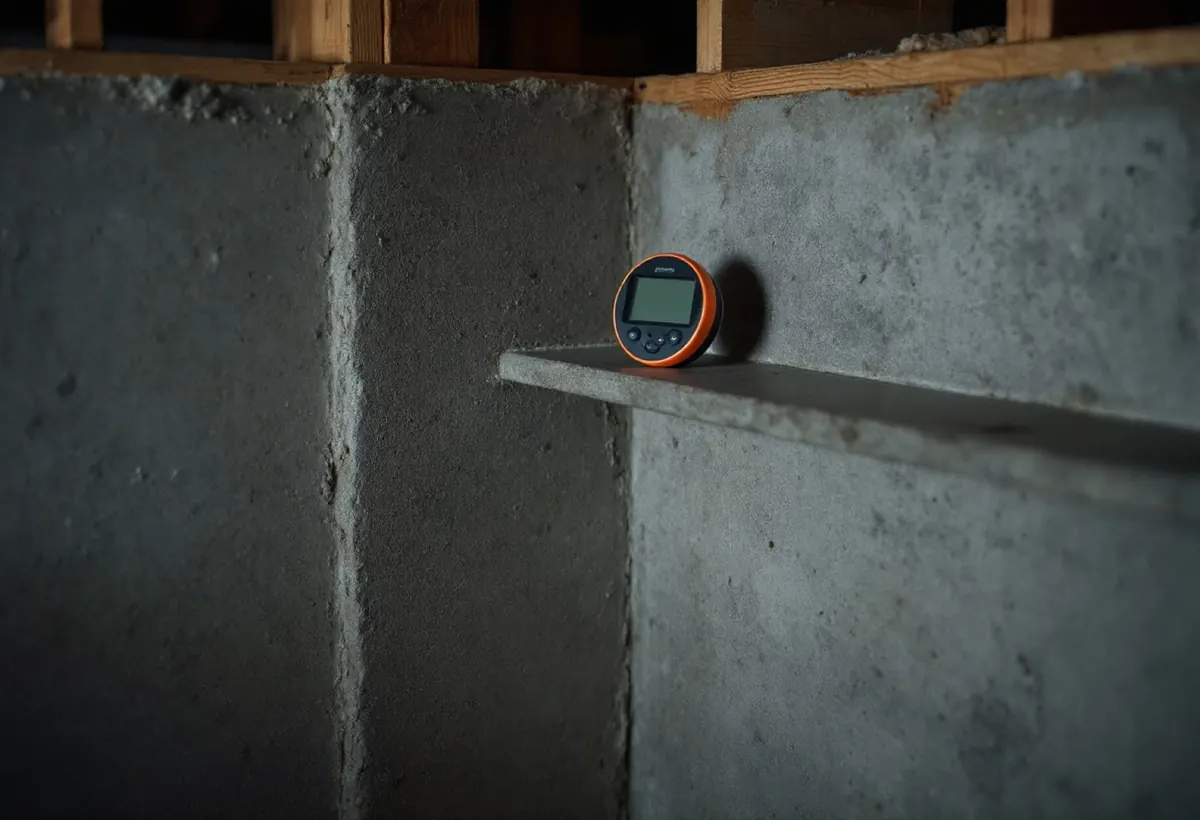
Yes for the room number, with a margin. According to the ThermoPro TP50 specification, the meter (listed at $15.99 on 20 November 2026) is accurate to plus or minus 2 percent RH from 30 to 80 percent and plus or minus 3 percent outside that span, with temperature to plus or minus 1 F. The Sensirion SHT40 product page gives a typical accuracy of plus or minus 1.8 percent RH and a maximum of plus or minus 3.5 percent. EPA's Brief Guide to Mold, Moisture and Your Home puts basic meters at $10 to $50.
Run the TP50’s tolerance through the calculation. A true 50 percent room that reads anywhere from 48 to 52 percent puts the 55 F wall at 81 to 88 percent; a 1 F error in the wall reading moves it from 82 to 88 percent. Either way the wall is above 80, so the conclusion survives the meter error. Near the line, it does not: buy margin by holding the room nearer 50 than 60.
To check a meter, the salt test uses a fixed point measured by the National Bureau of Standards: Greenspan, NBS Journal of Research, 1977 gives a saturated sodium chloride solution an equilibrium RH of 75.47 percent at 20 C and 75.29 percent at 25 C. Seal the meter in a container with damp table salt until the reading settles; a reading far from 75 percent shows the offset to subtract, and ThermoPro’s page describes recalibrating the TP50 to 75 percent this way.
What humidity should a basement or crawl space hold to avoid mold?
The same 60 percent ceiling, read at the coldest surface. By the table above, air at 70 F and 60 percent puts any surface more than 8 F colder than the air above 80 percent, so measure the foundation wall, not just the room. EPA Mold Course, Chapter 2 singles out crawl spaces with high RH, particularly over a bare earth floor, as common sites of hidden mold, and lists mold growing near an HVAC intake as a sign of a ventilation humidity problem.
Material matters as well. The USDA Forest Products Laboratory paper groups concrete, cellular concrete and glass wool as medium resistant, and untreated wood and pine sapwood as very sensitive, so floor joists and sill plates reach the growth line before the foundation wall does. After a leak, EPA’s 24 to 48 hour drying window applies regardless of humidity, and equipment for that is compared in choosing a water damage dehumidifier. Sizing a whole house dehumidifier or air conditioner is HVAC work that thehvacbrief.com covers.
Questions people actually ask
What humidity level keeps mold away?
For room air, EPA’s figure: below 60 percent, ideally 30 to 50 percent. What keeps mold away is the surface staying under about 80 percent, the ASHRAE Standard 160 limit. At 50 percent and 70 F that holds for any surface warmer than about 57 F, so check cold corners, closets on exterior walls and window frames with a surface thermometer.
Can mold grow in 40 percent humidity?
Not on a surface at room temperature. At 40 percent and 70 F the air’s dew point is about 45 F, and a surface has to fall to about 51 F before it reaches 80 percent RH. Cold water pipes, single pane glass and uninsulated rim joists can, and any wet spot from a leak grows mold at any room humidity.
Does running the AC help with mold?
It can, because cooling coils remove water vapor. EPA's Brief Guide to Mold, Moisture and Your Home lists using air conditioners and dehumidifiers when needed among the ways to reduce humidity. EPA’s course also warns that uninsulated ducts carrying cold air can sweat; its fix is insulating the duct on the outside, since the duct surface sits below the room’s dew point.
At what humidity does mold stop growing or die?
Growth stops when the surface falls below the lowest isopleth, about 76 percent for drywall and 80 percent for plaster at 20 C in Sedlbauer’s thesis. Stopping is not dying: in the mold index model used for ASHRAE 160, growth declines gradually, at a rate set by how long conditions stay unfavorable and by the material. Drying and survival are covered in does mold die when it dries out.
Is 65 percent humidity too high for a house?
Yes by EPA’s measure, which sets 60 percent as the upper limit. At 65 percent and 70 F, a surface only about 6 F colder than the room reaches 80 percent, the ASHRAE 160 surface line, by the same NWS calculation used above. EPA’s course names cold corners behind furniture as a common place for that to happen.
How fast does mold grow once humidity is high?
From a leak, fast: EPA's Brief Guide to Mold, Moisture and Your Home says wet materials dried within 24 to 48 hours will in most cases not grow mold. From humidity alone it is slower; Sedlbauer’s isopleths give about 4 days at 83 percent and 16 days at 78 percent on drywall at 20 C. The leak timeline is in how long mold takes to grow after water damage.
Out of scope: this page covers humidity thresholds for growth on building materials. Questions about mold and health belong with EPA's Brief Guide to Mold, Moisture and Your Home and your doctor. More mold guides sit in the mold hub.
Sources
- EPA's Brief Guide to Mold, Moisture and Your Home, United States Environmental Protection Agency, last updated 18 February 2026. Retrieved 20 November 2026.
- EPA Mold Course, Chapter 2, United States Environmental Protection Agency, last updated 10 November 2026. Retrieved 20 November 2026.
- National Weather Service vapor pressure equation, National Weather Service (El Paso office calculator notes). Retrieved 20 November 2026.
- Addendum a to ANSI/ASHRAE Standard 160-2009, Criteria for Moisture Control Design Analysis in Buildings, Section 6.1, ASHRAE. Retrieved 20 November 2026.
- USDA Forest Products Laboratory analysis of the ASHRAE 160 mold criteria: Glass, Gatland, Ueno and Schumacher, Analysis of Improved Criteria for Mold Growth in ASHRAE Standard 160, ASTM STP 1599, USDA Forest Service. Retrieved 20 November 2026.
- Sedlbauer's Fraunhofer IBP isopleth thesis: Klaus Sedlbauer, Prediction of mould fungus formation on the surface of and inside building components, Fraunhofer Institute for Building Physics, English edition; Fig. 34 and pp. 38, 43, 85 and 86. Retrieved 20 November 2026.
- Sedlbauer, Krus, Zillig and Kuenzel, IAQ 2001, Mold Growth Prediction by Computational Simulation, Fraunhofer Institute for Building Physics. Retrieved 20 November 2026.
- Greenspan, NBS Journal of Research, 1977: Lewis Greenspan, Humidity Fixed Points of Binary Saturated Aqueous Solutions, Vol. 81A, No. 1, Table 2. Retrieved 20 November 2026.
- ThermoPro TP50 specification, ThermoPro. Retrieved 20 November 2026.
- Sensirion SHT40 product page, Sensirion AG. Retrieved 20 November 2026.
- Surface RH, dew point and critical wall temperatures are arithmetic on the NWS equation, computed when this page was built. Isopleth values were read from the published figure to the nearest half percent. Our methodology sets out the standing rules.
Thresholds here describe building surfaces under laboratory and design conditions. A wet material from a leak can grow mold at any room humidity.