The short answer
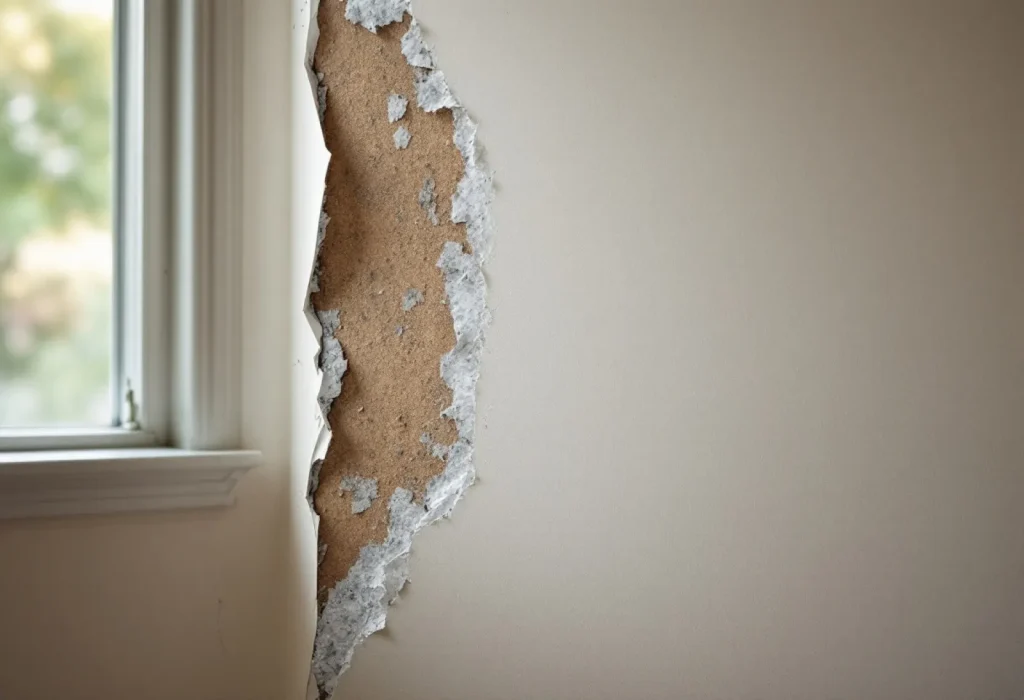
Yes, mold behind wallpaper is common on air conditioned exterior walls in hot, humid climates, because vinyl wallpaper acts as a vapor retarder on the wrong side of the wall. Outdoor humidity moves inward, stops at the vinyl and wets the drywall face behind it. A federal NIST model of a Miami wall kept the drywall behind 0.5 perm vinyl above 80 percent relative humidity for five summer months.
Why does mold grow behind vinyl wallpaper on a cooled outside wall?
Water vapor moves from warm, humid air toward cooler, drier air. In summer the air conditioned room is the cool, dry side, so the drive runs from outdoors inward, as the Building America Solution Center (PNNL) explains. Fiberglass, cellulose and mineral wool pass 40 perms or more per the vapor retarder TechNote hosted by the International Code Council, so the vapor crosses the cavity and the gypsum board easily. It then reaches the vinyl, which barely lets it through.
The National Institute of Standards and Technology modelled exactly this wall in NIST IR 5558 (January 1995). With vinyl wallpaper rated 0.5 perm on the room side and Miami weather, the gypsum surface stayed above 80% relative humidity for a 5 month summer period, according to the report, and monthly means above 80% are the threshold it cites for mold and mildew growth from the International Energy Agency (1990). The authors add that the problem gets worse with lower thermostat settings.
The control case matters. The same NIST wall with only latex paint (10 perms) kept the gypsum surfaces below 80% RH, although above 70% for about 4 months, per the report. The authors call that result marginal but conclude that adding an interior vapor retarder creates much higher humidity at its surface. EPA reaches the same point in plain words in EPA's mold remediation guide, chapter 3: drywall with vinyl wallpaper over it may act as a vapor barrier, trapping moisture underneath.
Diffusion is only half of it. The vapor retarder TechNote hosted by the International Code Council notes that moisture enters walls by diffusion or by air leakage. Building Science Corporation’s Building Science Corporation BSI-130 (March 2022) describes hotel walls where room exhaust and return air pull outdoor air into hollow walls, which then behave like ducts behind the vinyl. Any negative pressure in a room adds humid air to the vapor already arriving by diffusion.
How many perms does each wallcovering let through?
A perm is a measured rate of water vapor flow through a material under the ASTM E96 test, as the Building America Solution Center (PNNL) defines it; the higher the number, the faster a wall can dry through that layer. The code classes run from Class I (nearly vapor tight) to Class III. Vinyl sits low on that scale, but how low depends on weight and on who measured it.
| Wallcovering or layer | Water vapor permeance | IRC class | Where the number comes from |
|---|---|---|---|
| Vinyl wallpaper (as tested) | 0.5 perm (29 ng/s·m²·Pa) | Class II | NIST IR 5558, Table 1, citing Burch et al. 1992 |
| Vinyl wallpaper (listed) | 0.1 perm or less | Class I | Building America Solution Center (PNNL), list of Class I materials |
| Type II vinyl, 20 oz (heavy duty) | Less than 1 perm, wet cup | Class II | Wall Coverings Association, quoted in Building Science Corporation BSI-130 |
| Type I vinyl, 12 oz | About 1 perm, wet cup | Class II or III boundary | Wall Coverings Association, quoted in Building Science Corporation BSI-130 |
| Type I vinyl, 5 oz (light duty) | 4 perms at 50 percent RH | Class III | ASHRAE 2021 Fundamentals ch. 26 Table 6, quoted in Building Science Corporation BSI-130 |
| Kraft paper facing | 0.3 rising to 3 perms as humidity rises | Class II to III | vapor retarder TechNote hosted by the International Code Council |
| Latex paint | 10 perms | Class III (IRC list) | NIST IR 5558, citing ASHRAE 1993 |
| Standard painted drywall | Over 10, up to 40 perms | Vapor permeable | vapor retarder TechNote hosted by the International Code Council |
| Alkyd (oil) or epoxy paint | No figure given | Not for warm humid walls | Oak Ridge National Laboratory advisor sheet |
| Fiberglass, cellulose, mineral wool | 40 perms or more | Permeable | vapor retarder TechNote hosted by the International Code Council, from ASHRAE 2013 |
On NIST’s two figures, latex paint passes 20 times the vapor of the tested vinyl, and a standard fiberglass batt passes at least 80 times as much. Building Science Corporation BSI-130 adds that vinyl wallcovering makers do not publish perm values, which is why the table leans on a 1992 lab measurement, a 2002 trade association figure and an ASHRAE handbook entry.
Which walls are at risk: climate zones 1A, 2A and 3A, exterior, behind furniture?
The vapor retarder TechNote hosted by the International Code Council reads the International Residential Code as defining warm humid climates as Zones 1A, 2A and the part of 3A below the warm humid line. In those zones the PNNL guidance says any vapor retarder in a wall should be Class II or III, above 0.1 perm, and to ensure no low perm finish such as vinyl wallpaper or mirrors is attached to the inside. The Oak Ridge National Laboratory advisor sheet says the same: no alkyd paint, epoxy paint or vinyl wall coverings in a warm humid climate.
- Exterior walls only, mostly. The NIST model is an outside wall. Interior partitions are not exposed to the outdoor vapor drive, unless air leaks connect them to outdoors as in Building Science Corporation BSI-130.
- Low thermostat settings. NIST ran the room at 24 °C (75 °F) and 21 °C (70 °F); colder rooms make the wall surface colder.
- Walls behind furniture. EPA lists walls behind furniture, where condensation forms, among hidden mold locations in EPA's mold remediation guide, chapter 3.
- Manufactured homes. NIST notes HUD standards let makers meet the winter rule with an interior vapor retarder of 1 perm or less in every climate, the kind of wall it found failing in Miami.
- Cold climates in winter, the other way round. The Building America Solution Center (PNNL) notes condensation can form on cold wall surfaces from outward diffusion of indoor moisture. That is the winter version of mould on wallpaper in a bedroom with a cold outside wall.
Can you check for mold behind wallpaper without stripping it?
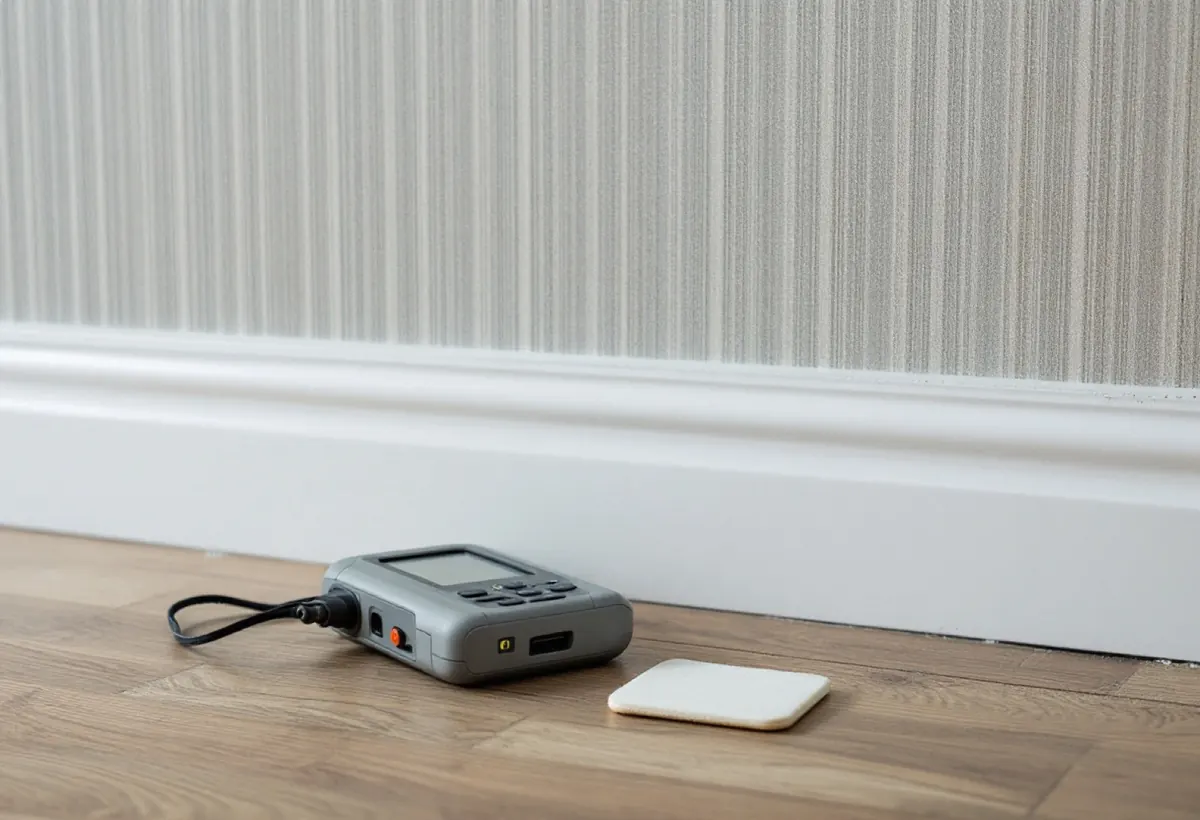
Partly. EPA’s homeowner guide says to suspect hidden mold when a room smells moldy and no source is visible, or after known water damage, and names the back side of wallpaper among hiding places in EPA's homeowner mold guide. A moisture reading then tells you where the wall is wet, which is where growth is likely.
A pinless meter reads through the covering. The Tramex ME5 specification page states the ME5 detects moisture through paint and wallpaper, with a shallow setting that reaches about 9 mm (3/8 inch) and a deep setting to about 30 mm (1 1/4 inches). The Tramex drywall meter guide gives the reading rule: a raised deep reading with a normal shallow one indicates moisture further into the structure that has not reached the surface layer. The ME5 scale is comparative, so scan an interior partition first as a dry baseline.
A pin meter gives a number, but each pin hole punctures the vinyl seal. Push pins in at a seam or behind a switch plate rather than across open field. The percentage bands that separate dry from wet gypsum are set out on their own page. Drywall moisture readings lists them. EPA’s EPA mold course, chapter 3 also describes a borescope, an optical probe pushed through a small drilled hole, to look inside a wall without opening it.
Choosing between pin, pinless and dual depth meters is covered separately, with prices from the makers. Moisture meters for water damage compares them. Testing the air is rarely the next step: EPA's homeowner mold guide says that where mold is visible, sampling is in most cases unnecessary, and no EPA or federal limit exists for mold in indoor air.
Is it under 10 square feet? Sizing the job before the first strip
EPA sets its tiers by total moldy area: under 10 square feet, 10 to 100, and over 100. Under 10 sq ft is roughly a 3 by 3 foot patch in EPA's homeowner mold guide; on an 8 foot wall it is a strip only 1.25 feet wide, about one width of wallpaper. Hidden mold usually runs wider than the stain that gave it away, so measure after opening a test area, not before.
| Area of moldy wallboard | EPA cleanup method | PPE | Containment |
|---|---|---|---|
| Small, under 10 sq ft | Method 3: HEPA vacuum | N95 respirator, gloves, goggles | None required |
| Medium, 10 to 100 sq ft | Methods 3 and 4: HEPA vacuum, then remove and bag | Limited or full, by judgment | Limited: one layer of 6 mil fire retardant poly, slit entry |
| Large, over 100 sq ft | Methods 3 and 4 | Full: full face respirator with HEPA filter, disposable suit | Full: double poly layers plus an airlock |
EPA's mold remediation guide, chapter 3 also names this exact case as grounds for a more cautious plan: when extensive hidden mold is expected, such as behind vinyl wallpaper. The general tier rules, with the PPE detail, sit on our levels page. Mold remediation levels sets them out. For the minimum respirator tier, the N95 page covers fit and filters. N95 mask for mold has the detail.
How do you take off moldy wallpaper without a spore release?
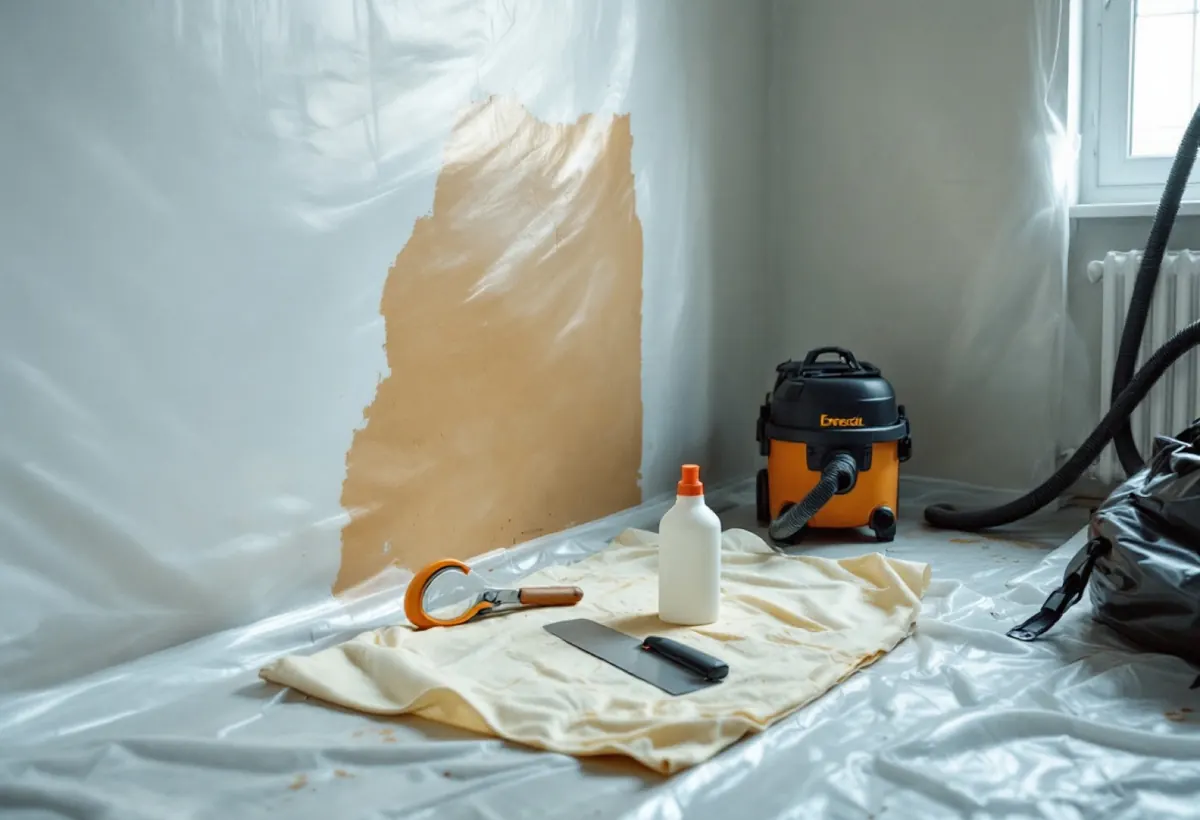
Slowly, and wet. EPA's homeowner mold guide warns that removing wallpaper can lead to a massive release of spores if mold grows on its underside, and EPA's mold remediation guide, chapter 3 lists actively stripping or peeling wallpaper among the actions most likely to put mold in the air, next to using fans to dry items. The EPA mold course, chapter 5 recommends moist techniques, such as a damp cloth or pad, to keep dust and mold out of the air.
- Fix the source first: an exterior leak, a negative pressure room or a thermostat set very low, per the Building America Solution Center (PNNL) and NIST IR 5558 findings above.
- Turn off fans and close supply vents in the room; EPA’s limited containment seals vents and doors with 6 mil sheeting.
- Lightly mist the vinyl and score it so the water reaches the paste, then lift sheets slowly and fold the moldy face inward.
- Bag each sheet at the wall. EPA Method 4 double bags discarded material in 6 mil polyethylene.
- HEPA vacuum the exposed wall and the floor (EPA Method 3), then inspect the drywall face in raking light.
Do not spray bleach and leave it. EPA says in its remediation guide that dead mold must still be removed, and EPA's homeowner mold guide says not to paint or caulk moldy surfaces, because paint applied over mold is likely to peel. Primers sold as mold killing are reviewed on their own page. Mold killing paint covers what they can and cannot do.
Does the drywall paper face have to go too?
Usually, if growth reached the paper. In EPA Table 2, wallboard is the one wall material that is never damp wiped: the only methods listed are HEPA vacuuming under 10 square feet and HEPA vacuuming plus removal above that. EPA explains why for porous materials in its remediation guide: mold infiltrates them and fills empty spaces, so it can be difficult or impossible to remove completely.
The NIST model puts the wet zone at the gypsum surface directly behind the vinyl, the paper face, not deep in the core. So a stain that HEPA vacuums off a dry, hard face with no softening may be surface only, while staining that has soaked into the paper, or board that reads wet, is a cut out. EPA’s mold course, EPA mold course, chapter 2, adds that vapor barriers can keep damp materials from drying quickly enough to prevent mold, so a board that stayed wet for months is not a 24 to 48 hour drying case. For the visible surface mold that shows up on painted walls, a separate page applies. Mold on walls covers it.
What should go back on the wall in Miami or Houston?
On an exterior wall in Zones 1A, 2A or warm humid 3A, the Building America Solution Center (PNNL) says to finish with Class II or Class III materials such as gypsum board and latex paint and let the wall dry to the interior. In the perm table above that means latex paint (10 perms in NIST’s data) or the lightest Type I vinyl at 4 perms, not a 20 oz Type II commercial vinyl. The PNNL text adds that a product with a maker’s perm rating above 0.1 may be used even if its material type is on the Class I list, so ask the maker for the ASTM E96 perm figure and the test method before buying.
Keep the room drier too. EPA's homeowner mold guide advises indoor humidity below 60%, ideally between 30 and 50%, and NIST found the wall worse at 70 °F than at 75 °F. If the musty smell comes back after rebuilding, trace it before covering the wall again. Mold smell lists where else it hides.
Out of scope: this page does not cover health effects. For those, see EPA’s homeowner guide (EPA's homeowner mold guide) and the CDC mold page.
Questions people actually ask
Can mold grow behind wallpaper in a cold climate?
Yes, by a different route. In winter the vapor drive runs outward, and PNNL notes condensation can form on cold wall surfaces from indoor moisture. NIST’s 1995 model found a wall with an interior vapor retarder performed acceptably in Madison, Wisconsin, so in cold climates indoor moisture meeting a cold outside wall is the route to check, not vinyl trapping summer vapor.
How long does it take mold to grow behind wallpaper after a leak?
EPA says that in most cases mold will not grow if wet materials are dried within 24 to 48 hours. Wallpaper slows that drying, and vinyl at 0.5 perm barely lets the board dry into the room, so a wall wet from a leak behind vinyl can stay wet well past 48 hours. Check it with a meter after the second day.
Can I spray a mold killer through the seams instead of removing it?
No. EPA states that dead mold must still be removed and that a biocide such as chlorine bleach is not recommended as a routine practice during remediation. Spraying through a seam also cannot reach the full area, and EPA says paint applied over moldy surfaces is likely to peel. Strip the covering wet, HEPA vacuum, and decide on the drywall under the EPA Table 2 wallboard rows.
Do I need a mold test before taking the wallpaper down?
Usually not. EPA’s homeowner guide says that when visible growth is present, sampling is in most cases unnecessary, and no EPA or federal limit exists for indoor mold. A moisture meter scan of the wall is more useful before stripping, because it maps the wet area and estimates whether the job is under or over 10 square feet.
Is peel and stick wallpaper safer than vinyl?
Not on the evidence available. No published perm rating for a peel and stick wallcovering was found for this page, and a vinyl face behaves like the vinyl rows in the table above. Ask the maker for an ASTM E96 perm figure. On a cooled exterior wall in Zones 1A, 2A or 3A, PNNL guidance calls for an interior finish above 0.1 perm.
Sources
- NIST IR 5558: Burch, Saunders and TenWolde, Manufactured Housing Walls That Provide Satisfactory Moisture Performance in all Climates, National Institute of Standards and Technology, January 1995. Table 1 permeances and Miami results. Retrieved 17 November 2026.
- Building America Solution Center (PNNL): Class I Vapor Retarders Not Installed in Above Grade Walls in Warm Humid Climate, U.S. Department of Energy Building America, Pacific Northwest National Laboratory. Retrieved 17 November 2026.
- vapor retarder TechNote hosted by the International Code Council: TechNote, Vapor Retarders: Reducing Moisture Risk in Frame Walls, Table 2 from the 2013 ASHRAE Handbook of Fundamentals. Retrieved 17 November 2026.
- Oak Ridge National Laboratory advisor sheet: Building America Building Science Advisor, Vapor Open Walls, Oak Ridge National Laboratory. Retrieved 17 November 2026.
- Building Science Corporation BSI-130: Hotel Mold, Building Science Corporation, effective date 14 March 2022, quoting ASHRAE 2021 Fundamentals chapter 26 Table 6 and the Wall Coverings Association. Retrieved 17 November 2026.
- EPA's mold remediation guide, chapter 3 and EPA Table 2 (chapter 5), Mold Remediation in Schools and Commercial Buildings, U.S. Environmental Protection Agency, last updated 29 April 2026 and 14 April 2026. Retrieved 17 November 2026.
- EPA's homeowner mold guide: A Brief Guide to Mold, Moisture and Your Home, U.S. Environmental Protection Agency, last updated 18 February 2026. Retrieved 17 November 2026.
- EPA mold course, chapter 2, EPA mold course, chapter 3, EPA mold course, chapter 5 and EPA mold course, chapter 6, Mold Course, U.S. Environmental Protection Agency, last updated 10 November 2026. Retrieved 17 November 2026.
- Tramex ME5 specification page and Tramex drywall meter guide: Moisture Encounter ME5, Tramex Ltd. Retrieved 17 November 2026.
- Mold, Centers for Disease Control and Prevention. Retrieved 17 November 2026.
- Ratios (for example latex paint against vinyl) are arithmetic on the published figures above, computed when this page was built. Our methodology sets out the standing rules. More guides on the mold hub.
Perm ratings vary by product, weight and test method. Confirm the ASTM E96 figure for a specific wallcovering with its maker, and the wall design for your climate zone with your local building department.