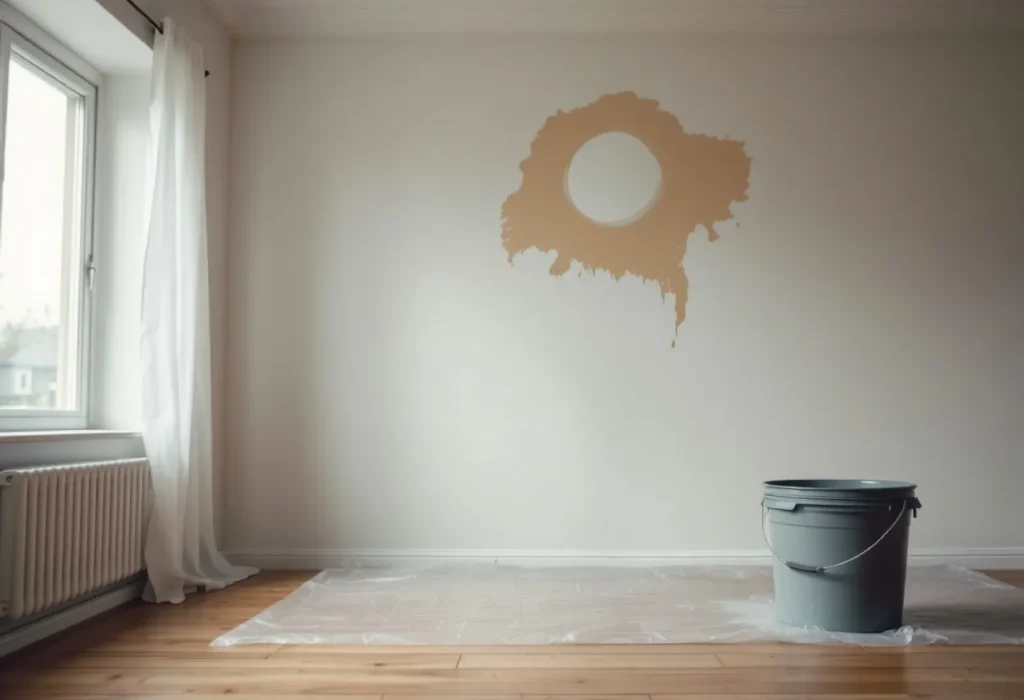
The short answer
A water bubble in ceiling paint or drywall is trapped water, and you should usually drain it under control: breaker off if a light is near, bucket on plastic below, then one small hole at the lowest point. One inch of trapped water weighs about 5.2 pounds per square foot, four times the 1.3 psf sag limit USG sets for half inch ceiling board.
Is the paint holding the water, or is the drywall?
A ceiling bubble forms when water reaches the back or face of the ceiling board, usually 1/2 inch or 5/8 inch gypsum, faster than it can run off. If the paint skin has let go of the paper face, the paint itself becomes a bag: it is shiny, rounded and moves like a water balloon, and the board above may still be firm. If the water has soaked the gypsum board, the whole panel sags between the joists, the tape seams open, and the bulge is dull and soft. The second case is the one that drops.
The EPA Table 1 water damage guidance draws the same line for wallboard: it may be dried in place if there is no obvious swelling and the seams are intact; if not, remove, discard and replace it. The same table says ceiling tiles, fiberglass insulation and cellulose insulation that get wet should be discarded and replaced, which matters if the bubble sits below a blown attic.
USG’s own installation notes in the USG SA924 wood framed systems manual warn that its gypsum panels should not be exposed to excessive or continuous moisture, and that water based textures and high humidity can make ceiling panels sag even without a leak. A drywall bubble is therefore never just cosmetic: the board has already lost stiffness.
Early staining before any bulge forms is covered on our page about early signs of water damage on a ceiling.
How heavy is a ceiling bubble at 1 inch deep?
Per the USGS Water Science School density table, water at 70 F weighs 62.3 pounds per cubic foot. A flat layer 1 inch deep therefore puts 5.19 pounds on every square foot of ceiling, which is 0.62 US gallons or 2.36 litres (2.36 kg) per square foot per inch.
Compare that with the USG SA924 wood framed systems manual: to prevent objectionable sag, the weight of unsupported insulation laid on new ceiling panels should not exceed 1.3 psf for half inch board on framing 24 inches on centre, and 2.4 psf for half inch board on 16 inch framing or five eighths board at 24 inches. One inch of pooled water is about 4.0 times the first figure, on board that is wet and weaker than the new panel the limit was written for.
A real bubble is a dome, deepest in the middle, so it holds less than a flat pond of the same depth. The table works the dome shape through: a bubble 24 inches across and 1.5 inches deep at the centre holds about 1.5 gallons and weighs 12.3 pounds; one 36 inches across and 2 inches deep weighs about 36.8 pounds, hanging from paper and paint.
| Bubble (diameter, depth at centre) | US gallons | Litres | Pounds | Kilograms | Average psf over the bubble | Times the 1.3 psf USG limit |
|---|---|---|---|---|---|---|
| 6 in across, 0.5 in deep | 0.03 | 0.1 | 0.3 | 0.1 | 1.3 | 1.0x |
| 12 in across, 1 in deep | 0.25 | 0.9 | 2.1 | 0.9 | 2.6 | 2.0x |
| 18 in across, 1 in deep | 0.55 | 2.1 | 4.6 | 2.1 | 2.6 | 2.0x |
| 24 in across, 1.5 in deep | 1.48 | 5.6 | 12.3 | 5.6 | 3.9 | 3.0x |
| 36 in across, 2 in deep | 4.42 | 16.7 | 36.8 | 16.7 | 5.2 | 4.0x |
| 48 in across, 3 in deep | 11.81 | 44.7 | 98.4 | 44.6 | 7.8 | 6.0x |
The weight is also the reason to stand clear while it drains. A 36 inch bubble releases roughly 4.4 gallons, so a single 5 gallon bucket can overflow on a bubble that size; set two buckets or a plastic bin on sheeting before the first hole.
Near a light, sagging, or under a bathroom: which path are you on?
Three questions decide the order of work: is electricity in the wet zone, is the board itself saturated, and what is directly above. The first step comes from Ready.gov flood guidance, which says to turn off the electricity to prevent electric shock if it is safe to do so, and not to touch electrical equipment that is wet or while standing in water.
A bubble that forms around a ceiling light, fan or smoke alarm is a different job: water runs along the cable and collects in the box, so the circuit stays off until an electrician has checked it. That case has its own page on water in a light fixture.
Should you pop it, and in what order?
Yes, when it is a contained bubble and the power question is settled. A controlled hole lets the water out through a pencil sized opening into a bucket; left alone, the bubble keeps loading the board at about 5.2 pounds per square foot per inch until the paint skin splits or the panel tears at a screw line, which releases the same water all at once and takes more board with it.
- Power. If any fixture, fan, smoke alarm or junction cover is inside or touching the wet area, switch that circuit off at the panel, not the wall switch, per Ready.gov. If the panel is in a wet room or you would stand in water to reach it, leave it and call an electrician.
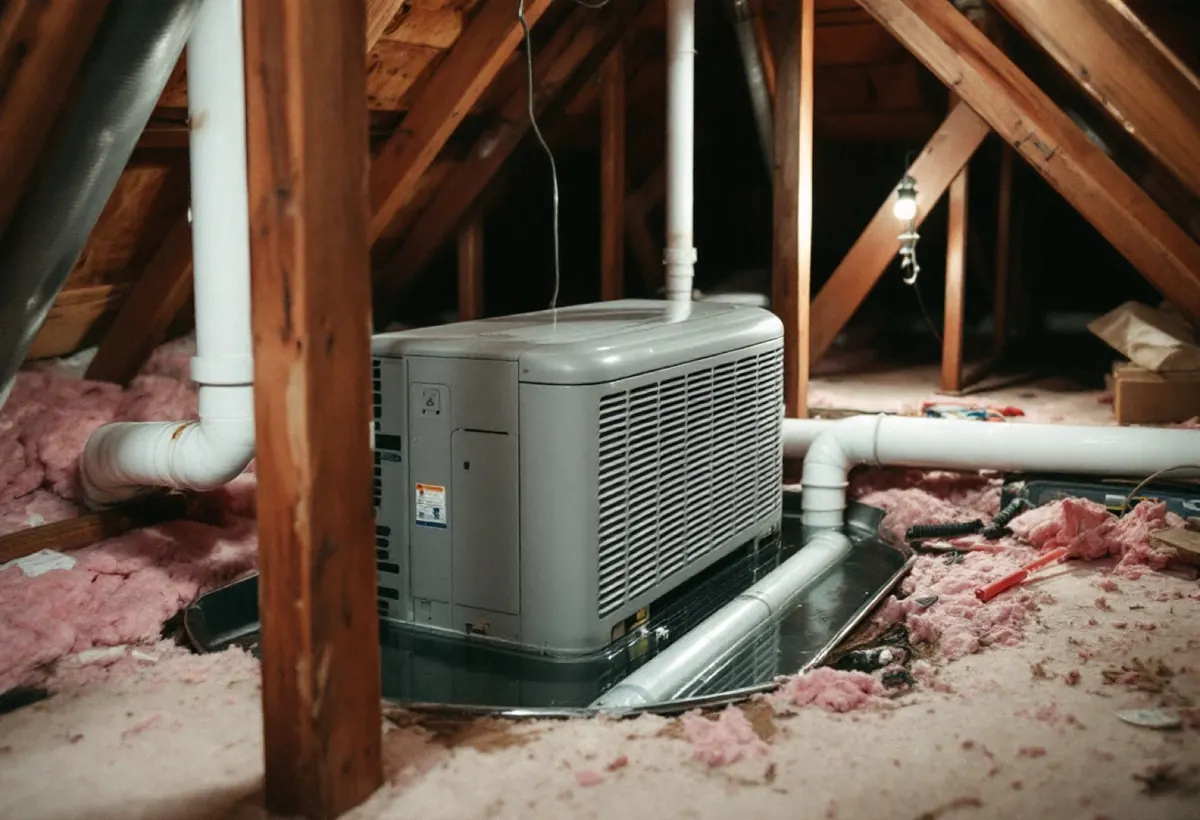
- Stop the source. Close the fixture shutoff or the main water valve if a bathroom or kitchen sits above; switch the cooling system off at the thermostat if an attic air handler sits above.
- Contain. Plastic sheeting on the floor, a bucket (two for a bubble wider than about 24 inches) centred under the lowest point, furniture moved out of the drip zone.
- Puncture. Use a screwdriver or awl on a stable step ladder set to the side, reach in, and make one hole about the width of a pencil at the lowest point. Widen it slightly if it only weeps.
- Drain and record. Let it empty fully, then photograph the ceiling, the bucket level and the area above before anything is cut out.
- Dry. EPA’s target is to dry wet materials within 24 to 48 hours; swollen board or open seams come out rather than dry in place.
Do not push on the bubble to test it, and do not stand directly beneath it while puncturing. On a drywall bubble wider than a dinner plate, the 12.3 pound figure from the 24 inch row of the table is the load you are releasing.
Once it has drained, the EPA brief guide to mold and moisture notes that if wet materials are dried 24 to 48 hours after a leak, in most cases mold will not grow. Drying method and cut lines are covered on our page about water damage on a ceiling.
Water bubble in ceiling but no leak: where else does it come from?
No visible leak usually means the water is arriving out of sight or out of season. Three sources, each covered by a code document or extension service below (USG, IRC, NDSU), produce a bubble with a dry roof and no dripping pipe, and each leaves a pattern you can check from the room above or the attic.
Air conditioning condensate in the attic
An evaporator coil makes water every hour it cools. The Connecticut DAS Advisory 25-01, dated 5 September 2025, quotes the 2021 IMC and IPC rule that a secondary drain or auxiliary drain pan is required for each cooling or evaporator coil where overflow would damage building components, and lists four IRC compliance methods, one being a water level detection device conforming to UL 508. The North Carolina OSFM interpretation of M1411.3.1 adds that the pan must be 3 inches larger than the unit in overall width and length. A bubble under an air handler means the primary drain clogged and the backup failed or was never fitted.
Condensation on the back of the ceiling board
The USG SA924 wood framed systems manual warns that where a polyethylene vapor retarder sits behind ceiling board in cold or damp weather, the insulation must go in before or immediately after the board, or moisture can condense on the back of the gypsum and make it sag. That produces soft, wide bulges in cold spells with no rain link.
Ice dams and slow roof leaks
NDSU Extension explains that an ice dam forms when snow melts on a roof warmed by heat lost from the house, refreezes at the colder eaves, and backs meltwater up under the shingles into the attic or eaves, which can lead to water stains on the ceiling. A bubble near an exterior wall after a thaw fits that path even when the shingles look sound. Roof repair itself belongs to our sister site, theroofingbrief.com.
| Where the bubble is | Sources to check above it | Timing that points to it |
|---|---|---|
| Below a bathroom | Toilet base seal, tub or shower drain, overflow, supply lines | Grows after showers or flushes, dry overnight |
| Below an attic air handler | Blocked primary condensate drain, full or rusted auxiliary pan | Appears in cooling season, worse on humid days |
| Top floor, near an exterior wall | Ice dam backing meltwater under shingles, flashing | After snow and a thaw, or after wind driven rain |
| Top floor, mid room, cold weather | Condensation on the back of the board under a plastic vapor retarder | Cold or damp spells, no rain link, often new construction |
| Below a kitchen or laundry | Dishwasher, sink trap, washing machine hoses | Tracks appliance runs |
A bubble below a bathroom is almost always plumbing or a failed seal at the tub, shower or toilet; pipe and fixture repair is covered by theplumbingbrief.com. Once the source is stopped the ceiling work is the same, and the 24 to 48 hour EPA drying window starts from the moment the water stops.
After it drains, does the ceiling board have to come out?
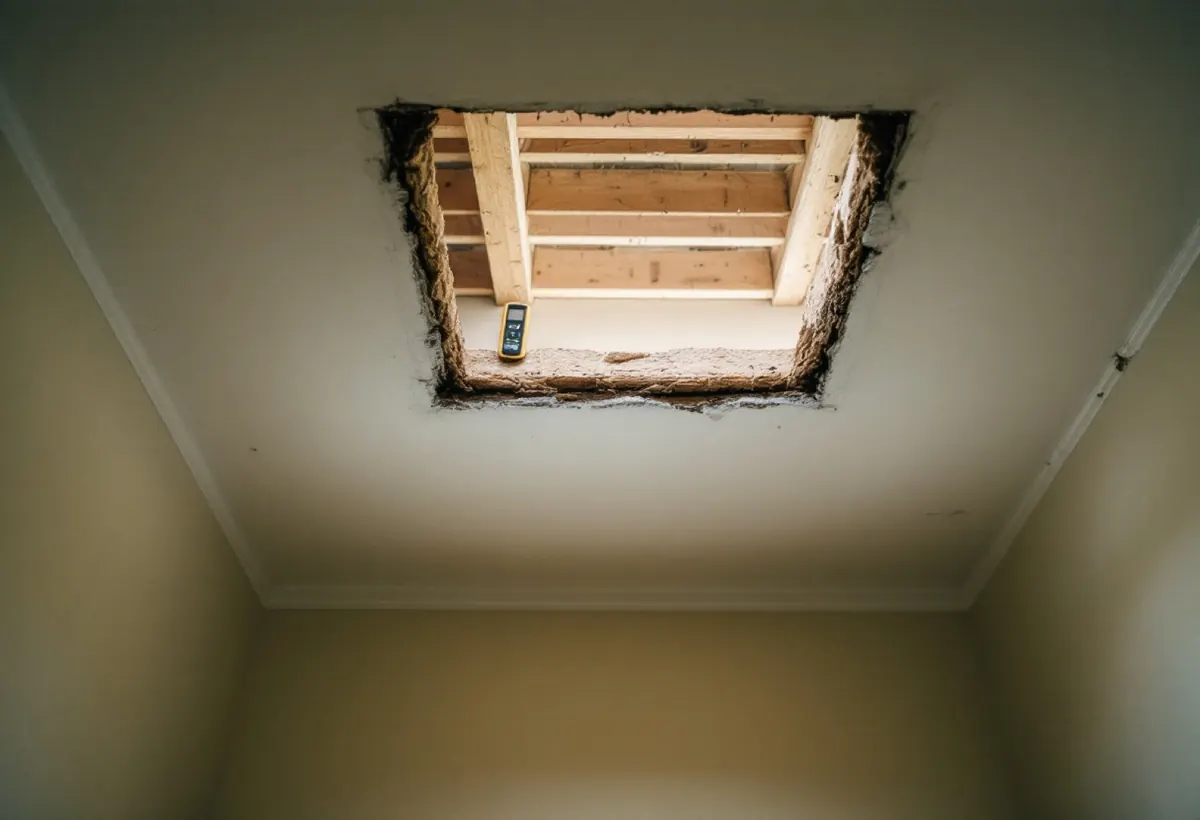
Use the EPA Table 1 water damage guidance test. Board that is flat again, firm, and has intact seams can be dried in place; board that stays swollen, crumbles at the hole, or has open or bulged tape joints comes out and is replaced. Anything above it that got wet, such as fiberglass batts or blown cellulose, is on the EPA discard list too, so check the attic side before patching.
Timing matters more than looks. A paint bubble that drained in an hour and dries within the 24 to 48 hour window is a patch and repaint; a ceiling that held water for days usually needs a moisture reading before anyone closes it up. Our page on wet drywall sets out readings and replacement lines, and the timeline is on how long mold takes to grow after water damage.
Repainting over a drained bubble without fixing the source only resets the clock: the next leak finds the same weakened paint bond. More water pages sit in the water damage hub.
What does an HO-3 policy say about a leak that bubbled the ceiling?
Policy wording decides this, not the bubble. The NJM New Jersey HO-3 (03/18) policy form, a filed homeowners form, shows the clauses that come up most. Its dwelling coverage excludes constant or repeated seepage or leakage of water, or condensation of humidity, moisture or vapor, over a period of weeks, months or years, unless the water and the resulting damage were unknown to all insureds and hidden within the walls or ceilings or above the ceilings. A bubble that grew for a month after you first saw a stain reads differently from one that appeared overnight.
The same NJM form treats rain separately for personal property: its Coverage C windstorm peril does not cover property inside a building damaged by rain unless wind or hail first opened the roof or a wall. Its Reasonable Repairs additional coverage pays the reasonable cost of measures taken solely to protect covered property from further damage, which is where a bucket, a tarp and a drain hole sit, and its Section I Conditions list prompt notice as the first duty after a loss.
Read your own declarations page and form rather than this one, and ask the insurer or a licensed agent three things in writing: is the source a covered peril, does the seepage or wear exclusion apply, and does tear out to reach the source count as covered. Your state insurance department can explain how it handles disputes. The coverage question in general is on our page asking does homeowners insurance cover water damage.
Renters should report a bubble to the landlord in writing the same day, with photos, because the ceiling is the owner’s building. The tenant side, including what a renters policy is for, is set out on water damage in an apartment.
Questions people actually ask
Who do I call for a water bubble in the ceiling?
Call by source. An electrician first if the bubble touches a light, fan or smoke alarm, per Ready.gov’s rule on wet electrical equipment. A plumber if a bathroom or kitchen sits above, an HVAC technician if an attic air handler does, a roofer for rain or thaw leaks, and a water mitigation firm if the board is soaked or the area is wider than about 24 inches.
Will a water bubble in the ceiling go away on its own?
The water may evaporate through the paint, but the bubble keeps loading the board at about 5.2 pounds per square foot per inch of depth while it does, and the source is still active. EPA’s guidance is to dry wet materials within 24 to 48 hours, which a sealed paint bag rarely manages. Drain it under control and find the source.
Is a water bubble in the ceiling an emergency?
Treat it as urgent when the board sags beyond the paint skin, when seams open, when it touches a light or alarm, or when it is wider than about 24 inches: a bubble that size and 1.5 inches deep weighs roughly 12.3 pounds. A small paint blister under 1 inch deep with the source stopped is a same day job, not a 911 call.
Water bubble in ceiling from rain: is it always the roof?
Not always. Rain driven by wind can enter at flashing, a window head or a vent boot, and NDSU Extension notes that winter ice dams back meltwater under shingles after a thaw rather than during rain. If the bubble appears on humid summer days with dry weather, check the attic air handler’s auxiliary pan first.
Can I just paint over the bubble once it is dry?
Only after the source is fixed, the board passes EPA’s test of no swelling and intact seams, and the loose paint is scraped back to a sound edge. Stained areas usually need a stain blocking primer before topcoat, and board that held water for more than 48 hours should get a moisture reading before it is closed up.
Sources
- USGS Water Science School density table, U.S. Geological Survey: density and weight of water by temperature (62.300 lb per cubic foot at 70 F). Retrieved 12 November 2026.
- NIST Special Publication 811, Appendix B.8, National Institute of Standards and Technology: gallon (U.S.) to litre factor 3.785412. Retrieved 12 November 2026.
- USG SA924 wood framed systems manual, United States Gypsum Company, SA924 rev. 3-02: ceiling insulation weight limits, condensation and sag precautions, moisture exposure limits. Retrieved 12 November 2026.
- Ready.gov flood guidance, U.S. Department of Homeland Security: electrical safety around water. Retrieved 12 November 2026.
- EPA Table 1 water damage guidance, U.S. Environmental Protection Agency, Mold Remediation in Schools and Commercial Buildings, Chapter 4, Table 1, last updated 8 September 2026. Retrieved 12 November 2026.
- EPA brief guide to mold and moisture, U.S. Environmental Protection Agency, last updated 18 February 2026. Retrieved 12 November 2026.
- NDSU Extension, North Dakota State University Extension, Reduce ice dam and icicle damage, January 2023. Retrieved 12 November 2026.
- Connecticut DAS Advisory 25-01, Connecticut Department of Administrative Services, Office of the State Building Inspector, 5 September 2025. Retrieved 12 November 2026.
- North Carolina OSFM interpretation of M1411.3.1, North Carolina Department of Insurance, Office of the State Fire Marshal, 28 April 2019. Retrieved 12 November 2026.
- NJM New Jersey HO-3 (03/18) policy form, New Jersey Manufacturers Insurance Group, homeowners policy form HO-3 (03/18): Section I perils, Reasonable Repairs, Section I Conditions. Retrieved 12 November 2026.
- The bubble weight table and load chart are arithmetic on the USGS and NIST figures above, computed when this page was built. Our methodology sets out the standing rules.
This page describes published policy language and guidance, including one HO-3 form; it does not say what any reader’s own policy pays. If water is near wiring and you cannot reach the breaker without standing in water, stay out of the room and call an electrician.