The short answer
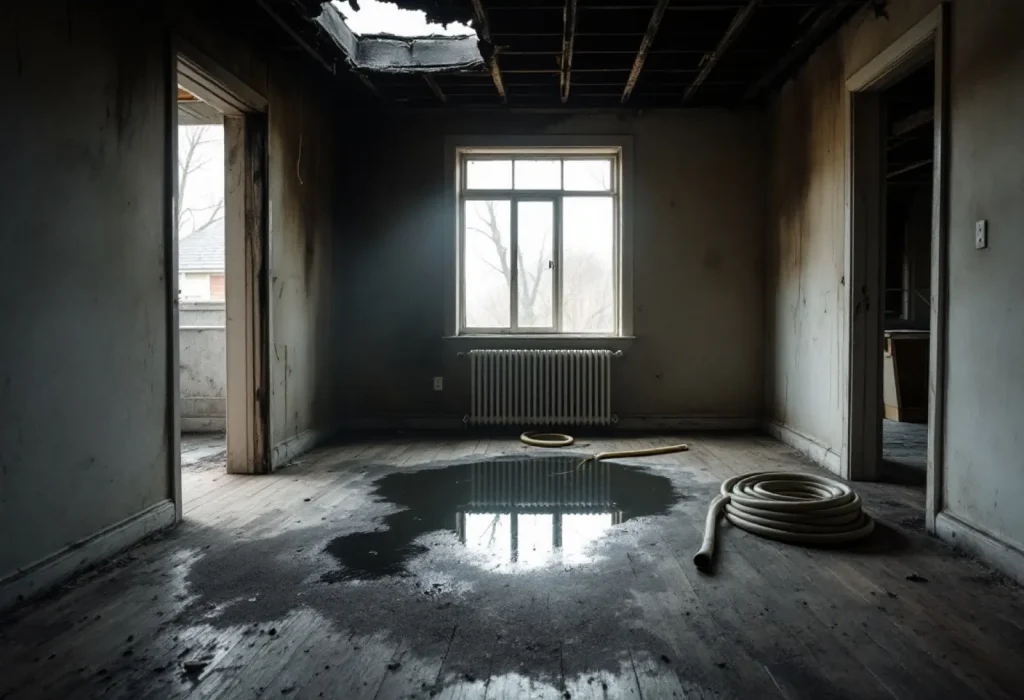
Water damage after fire is usually bigger than the burn: one 1.75 inch attack line flowing 150 to 180 gallons a minute puts 1,500 to 1,800 gallons into a house in 10 minutes, and the National Park Service reports 3,524 gallons for an average fire department fire. EPA says water damaged areas should be dried within 24 to 48 hours to prevent mold.
How many gallons does a 10 or 20 minute attack put into a house?
Multiply hose flow by minutes flowing. According to the Ann Arbor Fire Department pump operations reference, its first 200 foot 1.75 inch pre-connect flows 180 gallons per minute, so 10 minutes on that one line is 1,800 gallons. At 8.34 pounds per gallon, per the USGS Water Science School, that is about 15,012 pounds of water.
| Hose flow, source | gpm | 5 min (gal) | 10 min (gal) | 20 min (gal) | 10 min weight (lb) |
|---|---|---|---|---|---|
| 1 in booster reel (Ann Arbor FD) | 40 | 200 | 400 | 800 | 3,336 |
| 1.75 in handline, NIST tests | 120 | 600 | 1,200 | 2,400 | 10,008 |
| Interior attack cap (San Diego) | 150 | 750 | 1,500 | 3,000 | 12,510 |
| 1.75 in pre-connect (Ann Arbor) | 180 | 900 | 1,800 | 3,600 | 15,012 |
| 2.5 in line, 1.125 in tip (Ann Arbor) | 265 | 1,325 | 2,650 | 5,300 | 22,101 |
| Two lines, NFPA 1710 minimum | 300 | 1,500 | 3,000 | 6,000 | 25,020 |
Read the 10 minute column against the one measured average. The National Park Service fire prevention article reports that an average fire requires the discharge of 3,524 gallons by a fire department, about 29,390 pounds. At the 300 gallon per minute two line minimum, that average works out to about 11.7 minutes of flow, per the table arithmetic.
Two cautions on the table. Nozzles are adjustable: the San Diego Fire Rescue drill manual, chapter 15 tells its pump operators to treat 150 gpm as the maximum for an interior attack and 200 gpm for an exterior attack when the setting is unknown. And flow is not continuous, so a 20 minute fire does not mean 20 minutes of open nozzle. The table gives the ceiling for each scenario, not a measurement of any one fire.
What does each hoseline flow, from a 1 inch booster reel to two 1710 attack lines?
Hose size sets the scale of the water damage. The Ann Arbor Fire Department pump operations reference lists a 200 foot, 1 inch rubber booster reel at 40 gpm, the smallest flow on the chart. For the 1.75 inch line, NIST researchers flowing a 1.75 inch handline in a test structure ran it at about 120 gpm, according to NIST Technical Note 1938, and the same Ann Arbor reference pumps its pre-connects at 180.
The standard behind the top bar is NFPA 1710. The National Fire Sprinkler Association summarises its single family requirement as an uninterrupted 300 gpm from two hose lines, each flowing at least 100 gpm, and 400 gpm from three lines for an apartment. This page relies on that published summary rather than the standard text itself.
That minimum is set for the fire attack, not for the size of the room that burned: two lines at the 300 gpm figure the National Fire Sprinkler Association reports deliver 3,000 gallons in 10 minutes, per the table above.
Where does the hose water go once the nozzle shuts off?
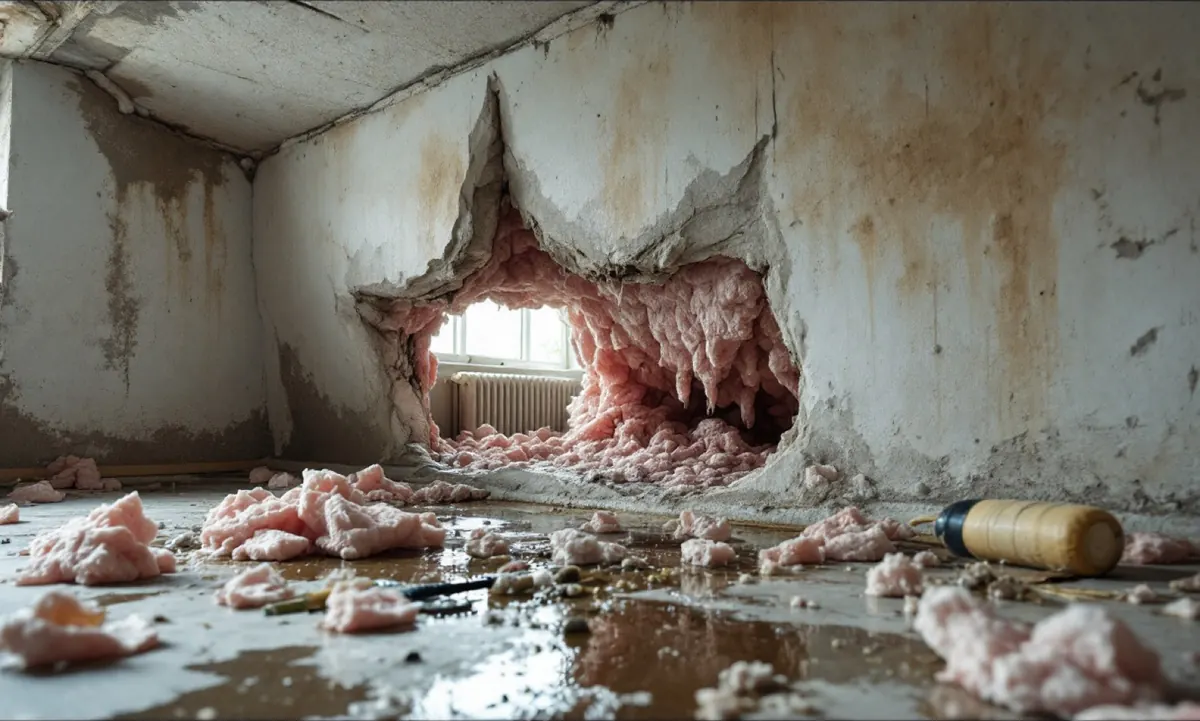
Down and sideways. Using the USGS Water Science School figure that a million gallons fills a cube about 51.1 feet on a side, one cubic foot holds about 7.5 gallons. If 1,500 gallons from 10 minutes on one 150 gpm line stayed on a 1,000 square foot floor, it would stand about 2.4 inches deep, per the USGS conversion. It does not stay: it soaks into the floor system, runs down wall cavities and comes through the ceiling below.
Ceilings hold more than they look. As an illustration, fifty gallons caught in attic insulation above one room weigh about 417 pounds at the USGS 8.34 pounds per gallon, and that load hangs on the gypsum board fastened under the joists. For wet fiberglass and cellulose insulation, EPA’s Table 1 action is to discard and replace it.
Firefighters also open the building on purpose. The U.S. Fire Administration After the Fire (FA-46) says crews may have broken windows and cut holes in the roof to slow the fire and clear smoke, and cut holes in walls to make sure the fire is not hidden inside them. Each opening lets rain in until it is boarded, and each wall hole is a place to check moisture in the cavity behind it.
A home sprinkler puts in far less. The same National Park Service fire prevention article reports a typical home system running 10 minutes discharges 280 gallons, about one twelfth of the fire department average. Sprinkler discharge has its own page: fire sprinkler water damage.
Is firefighting water clean water under EPA’s 24 to 48 hour drying table?
No published table treats it that way. EPA writes that its EPA Table 1, Water Damage: Cleanup and Mold Prevention guidelines are for damage caused by clean water, and that if the water source is known or suspected to be contaminated with sewage or with chemical or biological pollutants, personal protective equipment and containment are required by OSHA, and an experienced professional should be consulted if the crew lacks expertise in contaminated water.
Fire water picks up what it runs through. The U.S. Fire Administration After the Fire (FA-46) warns that the soot and dirty water left behind after a fire may contain things that could make you sick, and says not to enter until the fire department says it is safe. The HO 00 03 form itself lists smoke, soot, fumes, acids and chemicals in its definition of pollutants.
Restorers grade the water before they dry it. The ANSI/IICRC S500 standard (Fifth Edition, 2021) describes the procedures to be followed and the precautions to be taken in water damage restoration, and IICRC publishes a separate position statement on the category of water damage. How the categories are defined is set out in IICRC water categories.
One practical rule follows from the EPA wording: EPA says not to use fans before determining that the water is clean or sanitary, so on a fire job the air movers wait for that call. Ask the drying contractor which S500 category was assigned to each room and why, and get the answer on the moisture log.
Which fire wet materials stay and which go within EPA’s 48 hours?
The EPA guide to mold and moisture sets the clock: water damaged areas and items should be dried within 24 to 48 hours to prevent mold growth. The EPA Table 1, Water Damage: Cleanup and Mold Prevention says what to do with each material in that window. Its actions are written for clean water, so treat them as the minimum on a fire job.
| Material | EPA Table 1 action (clean water) | What it means after a fire |
|---|---|---|
| Fiberglass insulation | Discard and replace | Attic batts above the fire room hold hose water against the ceiling |
| Cellulose insulation | Discard and replace | Loose fill soaks up water and adds weight to the ceiling |
| Ceiling tiles | Discard and replace | Any tile ceiling under the fire floor catches runoff |
| Wallboard | May be dried in place if there is no obvious swelling and the seams are intact; if not, remove, discard, and replace | Heat exposed gypsum near the fire is judged separately |
| Wood surfaces | Remove moisture immediately; dehumidifiers, gentle heat and fans; caution with heat on hardwood floors | Heat on a wet hardwood floor can damage it, so EPA flags it |
| Carpet and backing | Extract with a water extraction vacuum; dehumidify; dry within 24 to 48 hours | Subfloor under it must be dried too |
| Concrete or cinder block | Extract water; dehumidifiers, fans and/or heaters | Basement slabs collect runoff from above |
EPA adds that mold may grow even on materials dried inside 48 hours, and will not always grow after 48 hours: the window is a guideline. Table 1 has no row for plaster, so plaster walls are dried and monitored by moisture reading, as set out in structural drying.
In what order do board up, water extraction and smoke cleaning happen?
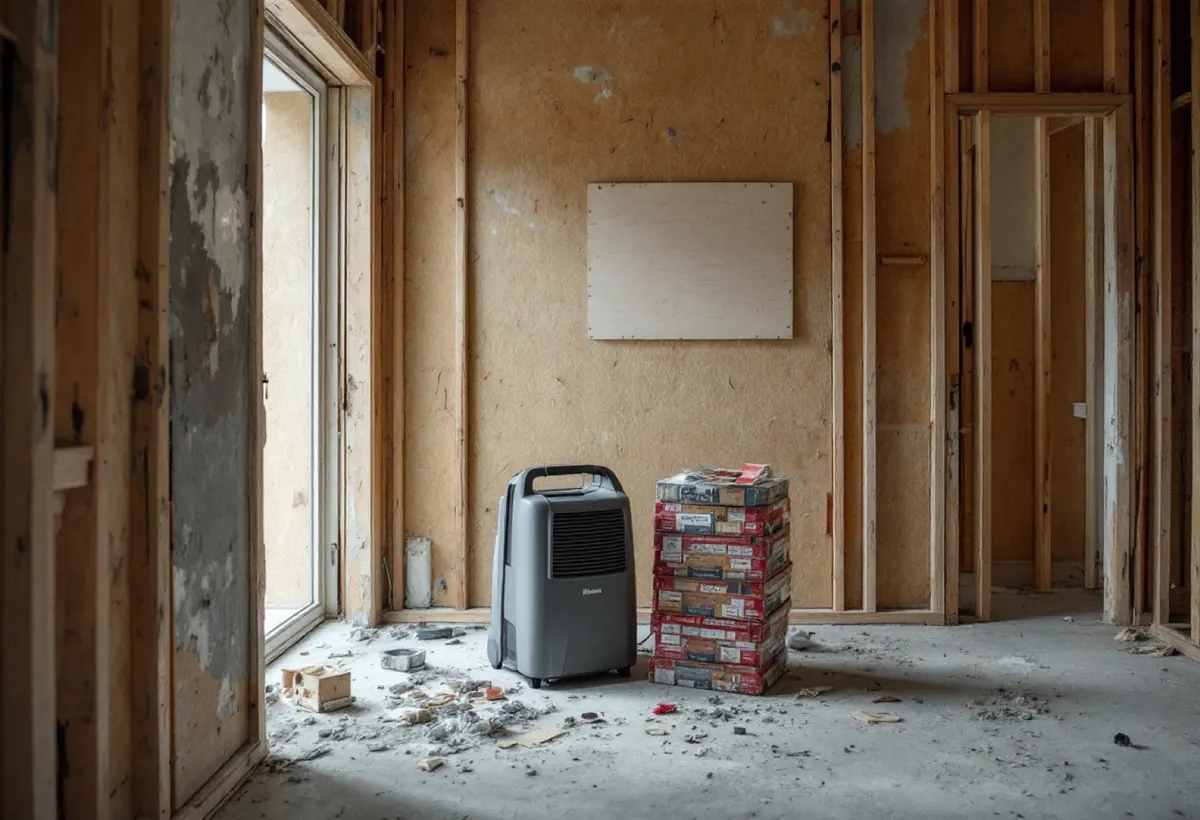
Clearance comes first. The U.S. Fire Administration After the Fire (FA-46) says not to enter until the fire department says it is safe, and that firefighters will have unsafe water, electricity and gas turned off or disconnected before they leave: “Do not try to turn them back on by yourself.” It also says some owners may need to board up windows and doors so no one can get in.
Water goes before soot because water runs on a clock. EPA’s 24 to 48 hour window starts when the hoses stop; no comparable published deadline for soot was found while researching this page. In the sequence above, smoke residue is cleaned once surfaces are dry, which is the work described in fire damage.
Electricity is the hazard that changes the order. The CPSC release of 11 July 2023 says not to touch wet appliances that are still plugged in, and to have a professional or the utility evaluate the home and replace wiring, breakers and fuses that have been under water; electrical repair is an electrician’s work. Wet receptacles are covered in water in an electrical outlet.
The Oregon Division of Financial Regulation fire claim guide draws the outer line: take reasonable steps to prevent further damage or theft, save all receipts, but do not rush into repairs or rebuilding before getting instructions from the adjuster. The first days, step by step, are in what to do after a house fire.
What does the HO-3 form say about the water the fire department used?
The ISO HO 00 03 10 00 special form, in the sample copy posted by the Oklahoma Insurance Department, has no clause titled firefighting water. What it has is a set of clauses that each touch it, read in the table below. Insurers file their own editions, so this is the ISO baseline, not any one policy.
| HO 00 03 clause | What the text says | Why it matters after a fire |
|---|---|---|
| Coverage A, dwelling | “We insure against risk of direct physical loss to property described in Coverages A and B” | Open perils: the question is whether an exclusion applies |
| Exclusion A.3, Water Damage | Defined as flood and surface water; sewer or sump backup; and water below the surface of the ground | None of the three paragraphs names water applied by firefighters |
| Coverage C, personal property | Named perils, the first being “Fire Or Lightning” | Contents are paid only for listed perils |
| Additional Coverage 2, Reasonable Repairs | Pays reasonable cost of necessary measures taken solely to protect covered property from further damage | Board up, tarps and extraction receipts |
| Additional Coverage 4, Fire Department Service Charge | Up to $500 for fire department charges you assumed by contract or agreement | Not paid inside the city or district that sent the fire department |
| Exclusion, Neglect | Neglect of an insured to use all reasonable means to save and preserve property at and after the time of a loss | Leaving water to sit is the risk this clause names |
| Mold, fungus or wet rot | Excluded, with a carve back for hidden mold from plumbing, heating, air conditioning or automatic fire sprinkler discharge | The carve back does not name fire hose water |
The ISO HO 00 03 10 00 special form Loss Of Use section adds Additional Living Expense: if a covered loss makes the home not fit to live in, it covers the necessary increase in living expenses for the shortest time required to repair. The Oregon Division of Financial Regulation fire claim guide says the first payment will likely be an emergency advance and may include living expenses.
Questions to put to the adjuster, in writing: under which peril is the suppression water being handled; does the mold, fungus or wet rot exclusion apply to growth from hose water; and will the inspection cover attics, crawl spaces, insulation and the HVAC system, the full inspection the Washington Office of the Insurance Commissioner tells policyholders to request for smoke. Filing the smoke side of the claim is covered in smoke damage insurance claim, and the rest of the fire hub is at fire and smoke.
Questions people actually ask
Are burned houses still wet after the fire is put out?
Usually. The National Park Service reports 3,524 gallons for an average fire department fire, about 29,390 pounds at 8.34 pounds per gallon, and what does not run out the doors soaks into insulation, subfloor and wall cavities. EPA says fiberglass and cellulose insulation that gets wet should be discarded and replaced rather than dried in place.
Can I turn the power back on to run fans after a house fire?
Not by yourself. The U.S. Fire Administration says firefighters will have unsafe utilities turned off or disconnected and that owners should not try to turn them back on. The CPSC says wiring, breakers and fuses that have been under water should be evaluated and replaced by a professional or the utility, so fans and dehumidifiers wait for that check.
Does homeowners insurance pay for mold from firefighting water?
The ISO HO 00 03 form excludes mold, fungus or wet rot, then carves back hidden mold caused by discharge from plumbing, heating, air conditioning or automatic fire sprinkler systems. Water from a fire hose is not on that list. Ask the insurer in writing how its own edition treats mold from suppression water, and contact the state insurance department if the answer is unclear.
Why did firefighters break my windows and cut holes in the walls?
The U.S. Fire Administration’s After the Fire guide (FA-46, January 2019) says crews break windows and cut roof holes to slow the fire’s growth and clear the dark smoke that blocks their view, and cut holes in walls to make sure fire is not hidden inside them. Those openings need boarding or tarping, which the HO-3 Reasonable Repairs coverage addresses.
Would a home fire sprinkler have caused less water damage?
Yes, by the figures the National Park Service reports: a typical home sprinkler system running 10 minutes discharges 280 gallons, against 3,524 gallons for an average fire handled by a fire department, roughly one twelfth. The U.S. Fire Administration adds that homes with sprinklers show little damage from flames, heat, smoke and water.
Does the fire department charge for putting out a house fire?
Where a department does bill, the ISO HO 00 03 form plans for it. According to that form, there is a Fire Department Service Charge coverage of up to $500 for charges you assumed by contract or agreement, with no deductible, and it does not apply when the property sits inside the city, municipality or protection district that sent the fire department.
Sources
- National Park Service fire prevention article, “Fire Prevention 52: Thinking Green with Fire Sprinklers”, U.S. National Park Service, last updated 1 December 2016. Retrieved 21 November 2026.
- Ann Arbor Fire Department pump operations reference, “Pump Operations and Hydraulic Reference”, City of Ann Arbor Fire Department, October 2023. Retrieved 21 November 2026.
- San Diego Fire Rescue drill manual, chapter 15, “Fire Hydraulics”, City of San Diego Fire Rescue Department drill manual, revised February 2023. Retrieved 21 November 2026.
- NIST Technical Note 1938, Willi, Madrzykowski and Weinschenk, “Impact of Hose Streams on Air Flows Inside a Structure”, National Institute of Standards and Technology. Retrieved 21 November 2026.
- National Fire Sprinkler Association, “Fire Service Hose-Lines and NFPA 14 Requirements”, 31 January 2020 (summary of NFPA 1710 flow requirements). Retrieved 21 November 2026.
- USGS Water Science School, “A Million Gallons of Water: How Much Is It?”, U.S. Geological Survey. Retrieved 21 November 2026.
- EPA guide to mold and moisture, “A Brief Guide to Mold, Moisture and Your Home”, U.S. Environmental Protection Agency. Retrieved 21 November 2026.
- EPA Table 1, Water Damage: Cleanup and Mold Prevention, Mold Remediation in Schools and Commercial Buildings (EPA 402-K-01-001), U.S. Environmental Protection Agency. Retrieved 21 November 2026.
- U.S. Fire Administration After the Fire (FA-46), U.S. Fire Administration, FEMA, January 2019. Retrieved 21 November 2026.
- Oregon Division of Financial Regulation fire claim guide, “Filing a Homeowner Claim After a Fire”, Oregon Department of Consumer and Business Services. Retrieved 21 November 2026.
- ISO HO 00 03 10 00 special form, Homeowners 3 Special Form, Insurance Services Office, Inc., copyright 1999, sample copy posted by the Oklahoma Insurance Department. Retrieved 21 November 2026.
- Washington Office of the Insurance Commissioner, “Smoke damage and your homeowner or renter insurance”. Retrieved 21 November 2026.
- ANSI/IICRC S500 standard, “ANSI/IICRC S500 Standard for Professional Water Damage Restoration”, Fifth Edition, 2021, IICRC standard page. Retrieved 21 November 2026.
- CPSC release of 11 July 2023, U.S. Consumer Product Safety Commission, 11 July 2023. Retrieved 21 November 2026.
- Gallon, weight and depth figures are labelled arithmetic on the published values above; no flow, price or outcome was invented. Our methodology sets out the standing rules.
This page describes published fire service figures, EPA guidance and a sample policy form. It does not say what any reader’s policy pays. Read your own policy, and ask your insurer, your state insurance department or a licensed professional about a specific claim. Electrical inspection and repair is an electrician’s work.