The short answer
A water damaged rug can usually be saved if the water was clean and the rug is dried flat within 24 to 48 hours, the window EPA and CDC give for wet carpet and home contents. Rugs soaked by sewage or floodwater, and any foam backed rug, are discards under NDSU and CDC guidance, while a valuable wool or silk rug goes to a specialist for washing and disinfection.
Clean, gray or black water: which rugs can you still save?
The water source decides more than the fiber does. NC State Extension sorts water three ways: clean water from broken supply lines, tub or sink overflows and rainwater; gray water from dishwashers, washing machines, punctured waterbeds or broken aquariums; and black water from sewage, seawater, rivers or streams. It adds that gray water left untreated longer than 48 hours may change to black as microorganisms multiply. The full category rules sit on the IICRC water categories page.
| Water | Washable throw rug | Large or foam backed rug | Valuable wool or silk rug |
|---|---|---|---|
| Clean: supply line, tub or sink overflow, rainwater | Machine wash (NDSU) | Extract and dry within 24 to 48 hours (EPA Table 1) | Dry flat; send out if a swab test shows dye bleeding (NPS) |
| Gray: dishwasher or washer discharge, waterbed, aquarium | Hot water wash with a biocide (NC State) | Professional biocide plus hot water extraction (NC State) | Specialist wash and biocide (NC State) |
| Black: sewage, seawater, rivers, streams | Hot wash with a biocide once your water supply is known safe (NC State, NDSU) | Discard; foam backed rugs always (NDSU, NC State) | Specialist wash to a sanitary condition, or discard (NC State) |
NDSU Extension is blunt on the contaminated row: wall to wall carpeting, most large area rugs and any rug with foam backing should be discarded if flooded with contaminated water, and except for valuable rugs, professional cleaning generally is not worth the time and expense. CDC's disaster cleanup guidelines go further and list rugs among the items to throw away if you cannot clean or dry them quickly. The household version of that rule, item by item, is in what to throw away after a flood.
Wool, silk, cotton, jute or synthetic: how does each fiber react to water?
Many rugs carry a fiber label on a back corner, according to Rugs and Floods in Cleanfax, written by rug specialist Lisa Wagner. Natural fibers absorb water more readily than synthetics and are the most prone to dye migration and mold, so wool, silk and cotton rugs get pulled and dried first in that triage order. The table joins 6 fiber groups to the published cleaning and drying limits for each.
| Fiber | What water does | Cleaning limit | How to dry | Keep or toss | Source |
|---|---|---|---|---|---|
| Wool | Absorbs water readily and is prone to dye migration and mold (Cleanfax); scales lock together and felt with agitation (Clorox) | No liquid chlorine bleach, even dilute (Clorox); NC State bars its bleach rinse on wool | Flat, never in a tumble dryer (Clorox) | Keep after clean water; specialist after gray or black | Clorox; NC State; Cleanfax |
| Silk and art silk | Fragile when wet; careless extraction left permanent pile damage on an art silk rug (Cleanfax) | Bleeding dyes go to a preservation professional (NPS) | Flat; extract through a nylon screen, with the pile (Cleanfax) | Specialist only | NPS; Cleanfax |
| Cotton (flat weave, rag, foundations) | Interior cotton swells when wet and buckles the rug; cotton warps and wefts are mold prone (Cleanfax) | Washable throw rugs: hot water and a biocide; bleach may shift color (NC State) | Flat, reshaped while damp (AIC) | Keep if washable and dried fast | NC State; AIC; Cleanfax |
| Jute | Turns brown when wet as it releases oils; mildew and dry rot if left damp (Cleanfax) | Low moisture cleaning, or a wash with an acid side rinse (Cleanfax) | Fast, face down, never hung wet; stretched jute rarely squares again (Cleanfax) | Often toss; the trade author says jute rugs generally are not worth saving | Cleanfax |
| Synthetic (nylon, olefin, polyester) | Absorbs less than natural fiber, but interior jute and cotton and adhesive backings are mold prone (Cleanfax) | Nylon should not be treated with bleach (NDSU) | Limit traffic: wet latex backing weakens and can separate, then regains most strength dry (NC State) | Keep after clean water; tufted rugs after a flood are often a total loss (Cleanfax) | NDSU; NC State; Cleanfax |
| Foam or rubber backed | Backing holds water against the floor; NDSU singles it out | No cleaning route listed after contaminated water | No drying route listed | Toss after contaminated water (NDSU) | NDSU |
Two rows need a warning label. Wool is the fiber most often ruined by home bleach: Clorox's wool care answer says liquid chlorine bleach is absolutely not recommended on wool, even dilute, and NC State Extension limits its own quarter cup per gallon backing rinse to non wool carpet. Jute fails in the opposite way: it browns from its own oils when it gets even a little too wet, and a Cleanfax article on jute rugs notes that the longer a jute rug takes to dry, the more problems arise.
Woven or tufted: what does the back corner say about the salvage odds?
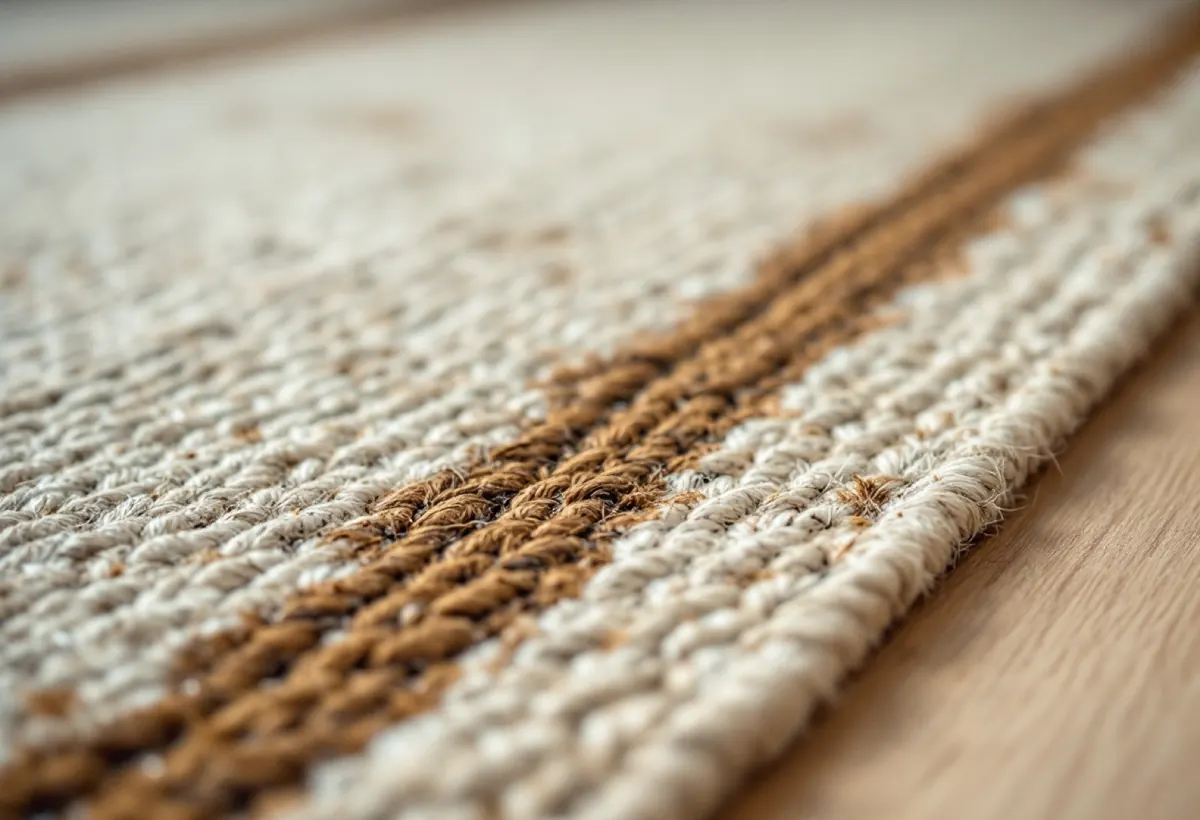
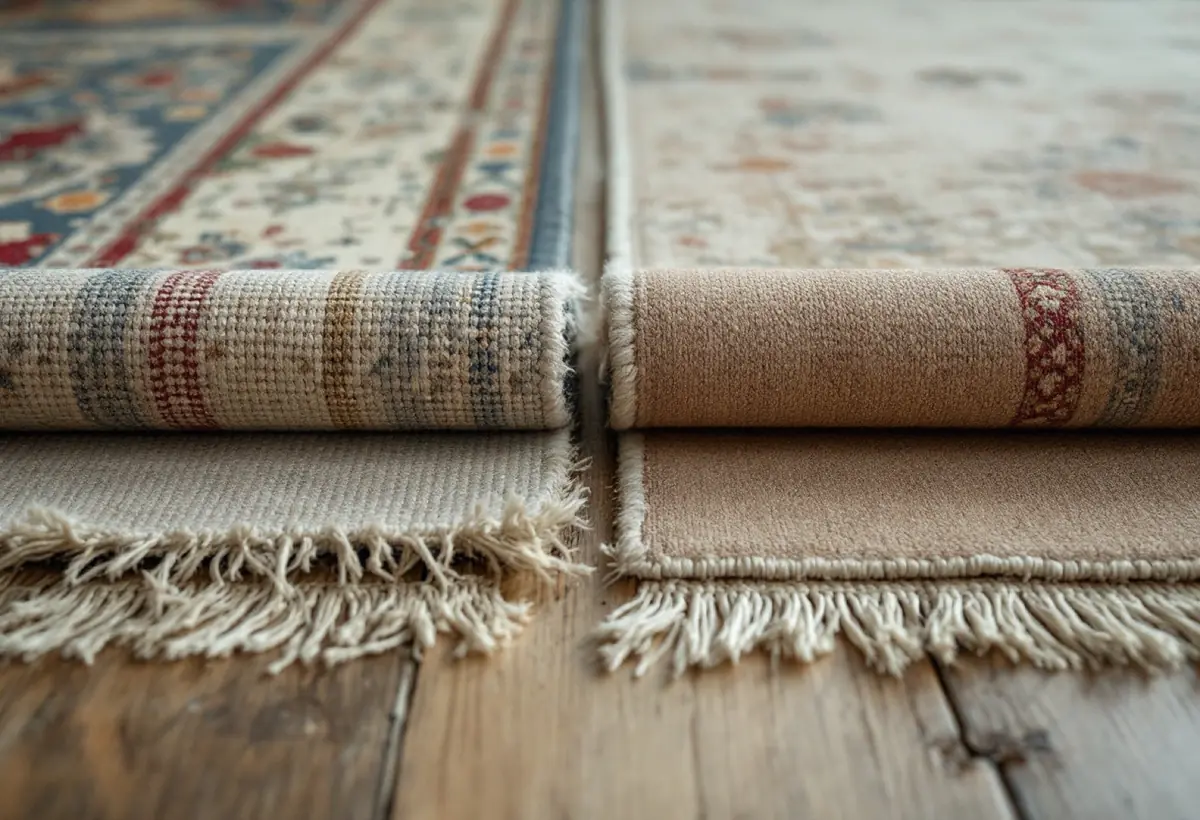
Flip a back corner over. In Rugs and Floods in Cleanfax, a woven rug shows its design and colors clearly on the back, by hand or by machine, and that is the rug to save first. A tufted rug shows a cloth cover, glue or rubber on the back; tufted rugs left wet too long tend to fall apart, and the adhesive and backing are extremely susceptible to mold, so they are often a total loss after a flood.
The same article puts the price question plainly: a commodity tufted rug often costs less to replace than to save, while the wet rug in the family room may be worth a hundred dollars or a hundred thousand. The decision is not made by fiber alone. NC State Extension says valuable area rugs need extensive cleaning and a biocide, and must be restored to a sanitary condition or discarded.
Weight matters before anyone carries the rug out. According to the National Park Service's wet textile guidance, published November 2020, textiles soak up water and become about 50% heavier than when dry, and should never be picked up by a corner; slide a sheet, towel or wood and canvas stretcher under a wet rug to lift it.
How do you dry a rug flat with air on both sides?
Table 1 of EPA's Mold Remediation in Schools and Commercial Buildings gives carpet and backing three actions for clean water: remove water with a water extraction vacuum, cut room humidity with a dehumidifier and speed drying with fans, all inside 24 to 48 hours. Its footnote adds a rule people skip: do not use fans before determining that the water is clean or sanitary, because contaminated water calls for protective equipment and containment under OSHA.
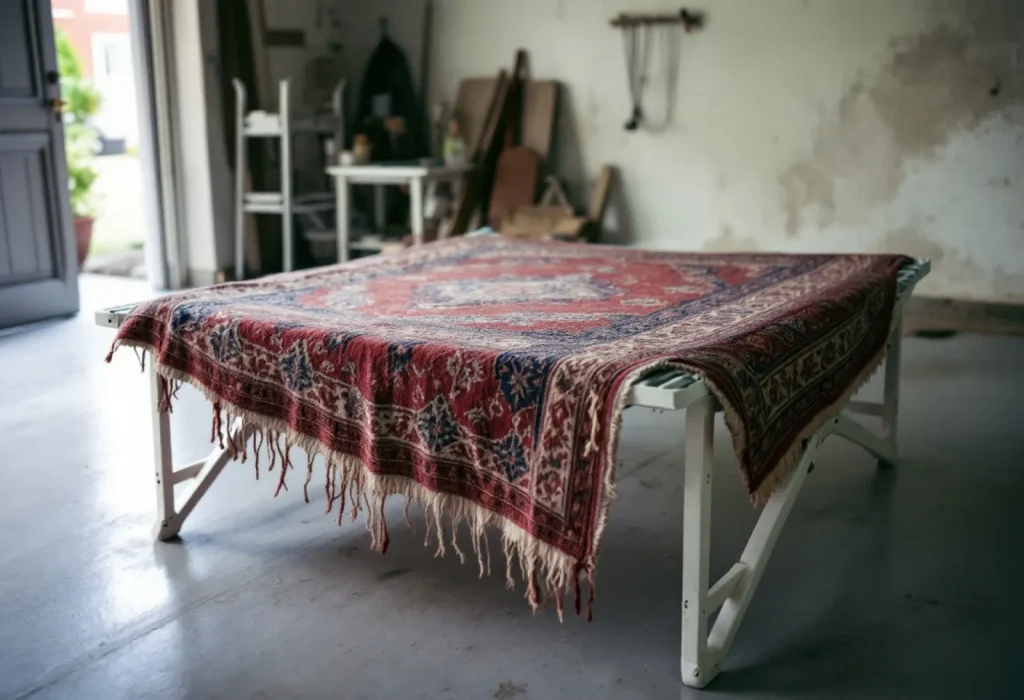
Lay the rug flat. Rugs and Floods in Cleanfax says never hang a wet rug to drip dry, since hanging drives more dye migration and can cause irreversible structural damage, and recommends warm, dry air across both sides. the National Park Service's wet textile guidance has heirloom textiles laid flat on a clean cloth or polypropylene sheet and air dried in a room with a dehumidifier or fan. Raising the rug on blocks or a slatted rack is how both sides get that air.
- Extract with the direction of the pile, and through a nylon screen on silk or art silk (Cleanfax).
- Never roll or stack wet rugs without a barrier; plastic sheeting or cotton sheets stop dye moving from face to back (Cleanfax).
- Do not seal a damp rug in plastic bags, and drain the dehumidifier often (AIC).
- If the rug dries outdoors in sun, lay it face down so fading hits the back (Cleanfax).
Dry the floor too. EPA Table 1 notes that the subfloor under carpet or other flooring must also be cleaned and dried, and NC State Extension says particleboard swells and disintegrates when it stays wet for a few days. Wall to wall carpet and pad have their own steps on how to dry wet carpet.
What changes at 24 hours and at 48 hours?
Four published clocks overlap. NDSU, reviewed April 2009, says carpet soaked more than 24 hours should be replaced. NC State says to dry carpet within 24 hours with oscillating fans and air conditioning, and that do it yourself cleaning is an option only for clean water found within 48 hours. Table 1 of EPA's Mold Remediation in Schools and Commercial Buildings and CDC's disaster cleanup guidelines both use 24 to 48 hours.
Read the EPA footnote before trusting the clock. Even if materials are dried within 48 hours, mold growth may have occurred, and mold will not always occur after 48 hours: EPA calls the figure only a guideline. EPA's home mold cleanup page adds that porous materials such as carpet may have to be thrown away once moldy, because mold fills the crevices. Visible growth on a rug is covered in mold on carpet.
Out of scope: this page does not cover health effects of mold exposure; EPA’s mold pages at EPA's home mold cleanup page are the federal reference.
Can a water damaged rug go in the washing machine?
A small washable throw rug, yes. NC State Extension says washable throw rugs usually clean adequately in a washing machine with hot water and a biocide: 1 cup of chlorine bleach per load in a standard large capacity washer and 1½ cups in an extra large capacity washer, with a warning that this much bleach may affect the rug’s color. It also says not to wash anything until you know a private well has not been contaminated by floodwater.
A wool rug is different. Clorox's wool care answer recommends cool water, a mild detergent and minimal agitation to limit felting, says liquid chlorine bleach is not recommended on wool even dilute, and says never to tumble dry wool; it allows machine washing only where the care label does. A rug that has gained about 50% in water weight, per the National Park Service, also strains a home washer, which is one reason large rugs go to a plant with its own washing and drying facilities, the route NDSU names for contaminated carpet.
Why did the rug dry bumpy, brown or with bled colors?
Bumps and ripples come from the foundation. Rugs and Floods in Cleanfax says interior cotton fibers swell when wet, which causes extreme buckling, and the American Institute for Conservation tip sheet says to reshape a textile while it is still damp to approximate its original contours. Loosely built jute rugs stretch out of shape when moved wet, and a Cleanfax article on jute rugs says that once they lose their shape, getting them square again is next to impossible.
Brown tide lines on jute or on white wool woven on a jute foundation are the jute releasing oils, per the Cleanfax jute article; some cleaners dry such rugs face down so the browning wicks to the back, or face up on a platform with warm, dry air run underneath. Bled colors are a dye test failure. NPS has you run a cotton swab wetted with soapy water over the fabric; dye on the swab means the rug goes to a preservation professional, and a bleeding rug should never be folded because colors transfer from one side to the other.
What should you ask a rug cleaner or conservator before handing over a wet rug?
EPA’s mold guidance names carpet and rug cleaning specialists for expensive or sentimental items and says to ask for and check references and look for affiliation with professional organizations. The published guidance supports four sharper questions:
- Do you wash and dry in your own plant? NDSU points contaminated carpet to companies with their own cleaning and drying facilities and prefers hot water extraction.
- Which method on gray or black water? NC State says biocide, contact time and hot water extraction; absorbent compound, bonnet, dry foam or shampoo are not adequate and can spread contamination.
- How will you protect unstable dyes? Cleanfax notes a 20 minute disinfectant dwell, or several soaks, can make dyes that are not colorfast bleed.
- Will you test the dyes first? NPS describes a soapy cotton swab test before any wet cleaning.
For an heirloom or antique rug, the AIC tip sheet points to its Find a Conservator directory and the phone line (202) 452-9545, and advises photographing a textile covered by insurance before salvage and documenting each step. Whether a rug is covered is set by policy wording, so ask your insurer, and the state insurance department if the answer is unclear, which water source the policy names; the general picture is in does homeowners insurance cover water damage. Mattresses follow a different rule set on water damaged mattress, and the rest of the water damage hub covers the room around the rug.
Questions people actually ask
How do you fix a water damaged rug?
Identify the water first. For clean water, extract it, lift the rug off the wet floor and dry it flat with air on both sides inside 24 to 48 hours, per EPA Table 1. Reshape buckled areas while damp, as the AIC tip sheet advises. Rugs hit by gray or black water need a biocide wash, which NC State assigns to a professional for anything bigger than a washable throw rug.
Is my rug ruined if it gets wet?
Usually not, if the water was clean and drying starts at once. NC State treats clean water found within 48 hours as a do it yourself job. The rugs that rarely survive are foam backed rugs and large rugs after contaminated water, which NDSU says to discard, and tufted rugs left wet too long, which Cleanfax says tend to fall apart.
What can you put on a rug after water damage to stop the smell?
For a musty smell on a dry rug, NDSU describes sprinkling baking soda over the pile, working it in with a broom or sponge mop, leaving it overnight and vacuuming twice, the second pass in a different direction. Skip chlorine bleach on wool, which Clorox says is not recommended even dilute, and on nylon, which NDSU says should not be bleached.
Can a rug be saved after sitting wet for three days?
Treat it as a specialist job at best. NDSU says carpet soaked more than 24 hours should be replaced, and EPA sends materials wet longer than 48 hours to its mold remediation table. A valuable rug can still be assessed, but NC State says it must be restored to a sanitary condition or discarded.
Should you roll up a wet rug to carry it out?
Not without a barrier. Cleanfax says never roll or stack wet natural fiber rugs without plastic sheeting or cotton sheets between layers, because dye bleeds from face to back. According to the National Park Service, a wet textile is about 50% heavier and should be lifted on a sheet or stretcher, never by a corner.
Sources
- NDSU Extension: Cleaning Flood-Damaged Carpets and Rugs, NDSU Agriculture Ag Hub, North Dakota State University, reviewed and revised April 2009. Retrieved 21 November 2026.
- NC State Extension: Water-Damaged Carpets and Rugs, NC State Extension Publications, published 11 June 2014, reviewed 27 March 2024. Retrieved 21 November 2026.
- Table 1 of EPA's Mold Remediation in Schools and Commercial Buildings: Table 1, Water Damage Cleanup and Mold Prevention, EPA 402-K-01-001, US EPA. Retrieved 21 November 2026.
- EPA's home mold cleanup page: Mold Cleanup in Your Home, US EPA. Retrieved 21 November 2026.
- CDC's disaster cleanup guidelines: Guidelines for Cleaning Safely After a Disaster, Centers for Disease Control and Prevention. Retrieved 21 November 2026.
- the National Park Service's wet textile guidance: Preservation Matters, Disasters: Saving Wet Textiles After a Flood, National Center for Preservation Technology and Training, National Park Service, November 2020. Retrieved 21 November 2026.
- the American Institute for Conservation tip sheet: Salvaging Water-Damaged Textiles, emergency tip sheet, American Institute for Conservation. Retrieved 21 November 2026.
- Clorox's wool care answer: Can You Bleach Wool?, Clorox. Retrieved 21 November 2026.
- Rugs and Floods in Cleanfax: Lisa Wagner, Rugs and Floods: Textile Triage During a Water Loss, Cleanfax magazine. Retrieved 21 November 2026.
- a Cleanfax article on jute rugs: Lisa Wagner, Jute Rugs: What You Should Know About This Problematic Rug, Cleanfax magazine. Retrieved 21 November 2026.
- How we read and cite sources is set out on our methodology page.
This page describes published extension, agency, conservation and trade guidance. It does not say what any insurance policy pays; read your own policy and ask the insurer or a licensed professional.