The short answer
A mold clearance test passes when the work area shows no visible mold, the moisture source is fixed, the remediation followed its written protocol, and any samples meet criteria set in that protocol before work began. EPA says no federal numeric limit exists for mold spores. Texas, New York and Washington, DC put the assessment into law.
What does a mold clearance test have to show to pass?
Four sources set the bar, and they agree on less than most summaries suggest. The EPA schools and commercial buildings guide, chapter 3 lists the end points of a finished job: the water problem completely fixed, no visible mold, no mold damaged materials, no moldy odors, and, where sampling was done, indoor mold types and concentrations similar to those outside. EPA calls the final call a judgment call with no easy answer.
Texas turns that judgment into a checklist. Under 16 TAC 78.140 the licensed mold assessment consultant must use visual, procedural and analytical methods, the area must be free of all visible mold and wood rot, and the work must match the protocol and work plan. New York’s statute, New York Labor Law 947, uses almost the same words for projects over 10 square feet.
| Criterion | EPA guidance | IICRC S520 (2024) | Texas, 16 TAC 78 | New York, Labor Law Art. 32 |
|---|---|---|---|---|
| No visible mold in the work area | Yes: visible mold and mold damaged materials should not be present | Return to Condition 1 | Yes: free of all visible mold and wood rot, 78.140(a) | Yes: no visible mold, 947 |
| Moisture source fixed | Yes: the water problem must be completely fixed | Not public | To the extent feasible, 78.140(b) | To the extent feasible, 947 |
| Moisture readings recorded | Not stated | Not public | Yes: temperature, humidity and material moisture in the report, 78.140(d) | Not stated |
| Air samples compared to outdoors | If sampled, indoor types and levels similar to outside | Condition 1 means normal fungal ecology | Analytical method and pass criteria set in the protocol, 78.100(i) | Criteria set in the remediation plan, 945 |
| Surface samples | May be useful to show an area was adequately cleaned | Not public | Allowed as an analytical method; skipped if visual fails, 78.140(c)(3) | Not stated |
| A numeric spore count that means pass | None: no EPA or other federal limits | None published | None in the rule; set per project | None in the statute |
| Containment still standing during the test | Not stated | Not public | Yes, if walk in containment was used, 78.140(a) | Not stated |
The IICRC S520 standard (2024 edition, per the IICRC Mold Remediation Specialist candidate handbook) frames success as returning a structure from Condition 3 or Condition 2 to Condition 1, and its exam outline names a post remediation verification, or PRV, with an Indoor Environmental Professional (IEP) testing the space. The Los Angeles County vendor specification spells out the target: Condition 1 is normal fungal ecology as defined by IICRC S520. Normal is the word that matters; the target is a background level, not zero spores.
Is there a federal spore count that means you passed?
No. The EPA mold testing page states that no EPA or other federal limits have been set for mold or mold spores, and that there are no EPA regulations or standards for airborne mold contaminants. Chapter 3 of EPA’s schools guide adds that sampling therefore cannot check a building against a federal mold standard, because none exists.
Any page that quotes one fixed pass number, such as a set count per cubic meter, is quoting a consultant’s or a contract’s own criterion. Texas makes that explicit: 16 TAC 78.100 subsection (i) requires the remediation protocol to name at least one nationally recognized analytical method for each area and the criteria for judging whether results pass, before the work starts. EPA’s testing page says sample analysis should follow methods recommended by the American Industrial Hygiene Association (AIHA).
What a sound report compares instead is pattern. An indoor spore trap is read against an outdoor sample taken the same day, and against the types found before the work. Our page on mold spores in air explains what the lab counts and why genus mix matters more than a single total.
Which states require a clearance by law, and who may sign it?
Four jurisdictions below were read from the statute or rule text on 11 November 2026. Three require a post remediation assessment with a written result; Florida regulates who may do it rather than whether it happens. The full licensing picture by state is on our state mold licensing page.
| Jurisdiction | Law | Trigger | Who performs it | Independence rule | Paperwork and deadline |
|---|---|---|---|---|---|
| Texas | Occupations Code 1958; 16 TAC 78.140 and 78.150 | Containment and TDLR notification at 25 contiguous sq ft or more | Licensed mold assessment consultant | Same license holder may not assess and remediate one project, 1958.155 | Passed clearance report; Certificate of Mold Damage Remediation within 10 calendar days of the stop date |
| New York | Labor Law Article 32, sections 930 to 947 | Project means areas greater than 10 sq ft | Mold assessment licensee | No licensee may assess and remediate the same property, 936 | Written passed clearance report at the end of each project |
| Washington, DC | DC Code Title 8, Chapter 2B; 20 DCMR Chapter 32 | Set by DOEE rule | Licensed indoor mold assessment professional | None: DOEE rejected a separation rule in 2021 | Verification report within 10 days of completion; remediator passes it to the client within 10 days |
| Florida | Florida Statutes 468.8419 | Not in this section | No post remediation duty in this section | Assessor may not remediate a structure it assessed within 12 months, and the reverse | Not in this section |
New York ties the clearance to the plan written before work. Labor Law 945 requires the remediation plan to state the proposed clearance procedures and criteria for each type of remediation in each type of area, so the passed clearance report under section 947 is graded against criteria the client could read in advance.
If remediation fails in New York, the licensee issues a written final status report to the client and the remediation licensee and recommends a new assessment, completion of the plan, or a fix to the cause. Texas has the same device in 16 TAC 78.140 subsection (e) for a consultant who leaves before the project passes.
Can the company that removed the mold also clear it?
In Texas and New York, no. Texas Occupations Code 1958.155 says a license holder may not perform both mold assessment and mold remediation on the same project, and bars one person from owning an interest in both firms on that project, with an exception for school district employees. Labor Law 936 bars one licensee from both roles on the same property and bars shared ownership the same way.
Florida reaches the same end with a clock. Florida Statutes 468.8419 bars a mold assessor from remediating a structure it assessed within the previous 12 months, bars a remediator from assessing a structure it remediated in that window, and makes a third violation a third degree felony. It exempts Division I contractors certified under section 489.105(3).
Washington, DC chose the opposite. In the DOEE final rulemaking on 20 DCMR Chapter 32, adopted 19 April 2021, DOEE rejected a request from the Children’s Law Center to forbid one licensee doing both jobs, citing cost and delay for landlords. Outside these laws, buyers write independence into contracts: the Los Angeles County vendor specification requires its mold consultant to be a Certified Industrial Hygienist unaffiliated with the remediation vendor.
What to ask any clearance provider, and why: whether the firm or an owner has any stake in the remediation company (the conflict all three statutes target), which lab will analyze the samples (Texas requires a lab licensed under 16 TAC 78.62), and what written pass criteria it will use before it arrives.
What happens, in order, on clearance day?
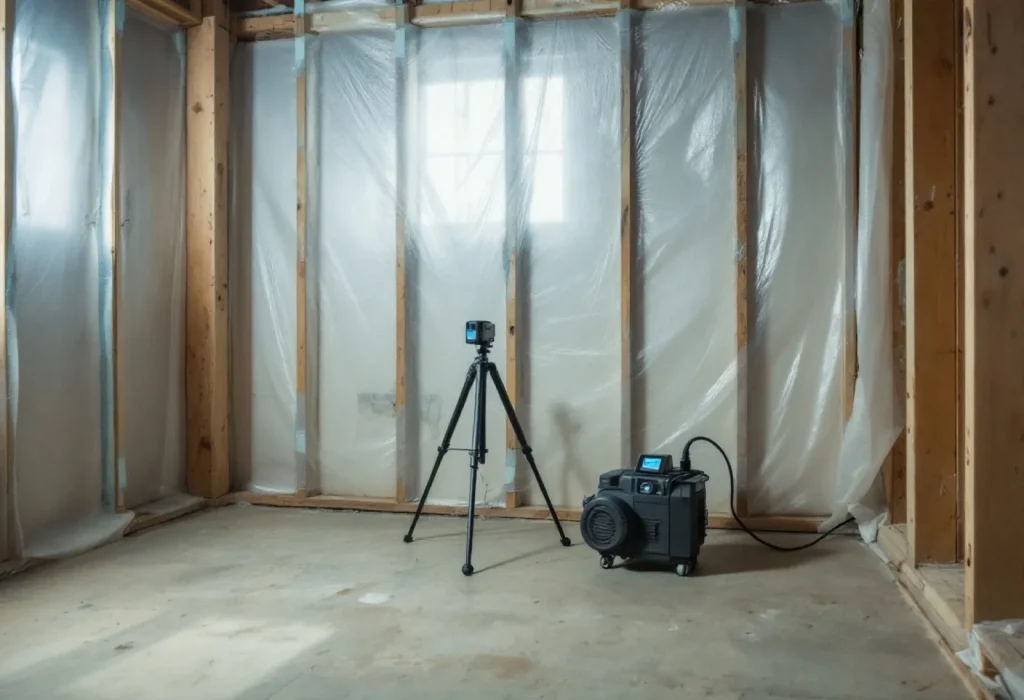
Containment stays up. 16 TAC 78.140 requires the post remediation assessment to happen while walk in containment is in place, and the DOEE requirements page says containment used for the work must remain for the post assessment. A clearance booked after the plastic is down and the walls are closed has lost its best evidence.
The visual check comes first and can end the visit. Under 16 TAC 78.140(c)(3), if visual inspection finds deficiencies that fail clearance, analytical methods need not be used, so no lab fee is spent on a room with visible growth. The step that follows a pass is paper: Texas requires the report to list observations, sample types and locations, temperature, humidity and material moisture readings, lab results, photographs, and a clear statement that the project passed.
The physical work being checked is described on our mold remediation process page.
How much do the clearance samples cost at the lab?
Per the EMSL Analytical 2026 commercial price list, one spore trap air sample costs $68 at two week turnaround, $123 at 24 hours and $328 at 3 hours, and a tape lift costs the same. Rush is 4.8 times the slow rate, which matters when a crew is waiting to close walls.
| Sample set, per the EMSL 2026 list (illustrative) | Samples | Count | 2 week | 24 hour | 3 hour |
|---|---|---|---|---|---|
| One room, air only | 1 outdoor, 1 indoor, 0 tape | 2 | $136 | $246 | $656 |
| Two rooms, air and surface | 1 outdoor, 2 indoor, 2 tape | 5 | $340 | $615 | $1,640 |
| Same set after one failed round | 2 outdoor, 4 indoor, 4 tape | 10 | $680 | $1,230 | $3,280 |
A failed round repeats the lab bill, which is why the third row doubles the second. The visit fee that sits on top of these lab charges is covered on our mold inspection cost page, and the difference between pre work testing and clearance on our mold testing page.
What does the Texas certificate do at sale or at renewal?
Under 16 TAC 78.150 subsection (b), the licensed remediation contractor must give the owner a Certificate of Mold Damage Remediation, on a form adopted by the Texas Commissioner of Insurance, within 10 calendar days after the project stop date. The assessment consultant, not the remediator, states that the contamination was remediated per the protocol, and states separately whether the underlying cause was fixed so the mold is reasonably certain not to return.
The paper follows the house. Texas Occupations Code 1958.154 and 78.150(e) require an owner who sells to give the buyer a copy of every certificate issued in the 5 years before the sale.
It also matters to insurers. Texas Insurance Code 544.303 bars an insurer writing residential property insurance in Texas from making an underwriting decision based on previous mold damage or a mold claim when the property was remediated and either a certificate under 1958.154 shows the cause was remediated, or an independent assessor or adjuster found no evidence of mold damage. Whether a given policy covers the remediation itself is a separate question for the policy wording, the Texas Department of Insurance and a licensed agent; ask them which mold exclusion or endorsement applies and whether the clearance fee counts as part of the loss. Our page on whether homeowners insurance covers mold remediation reads the standard policy language.
For contractors: what makes clearance criteria defensible in Texas and New York?
- Write them before mobilizing. 16 TAC 78.100 subsection (e) requires the consultant to deliver the protocol at least one calendar day before remediation starts, and (e)(6) requires clearance procedures and criteria in it.
- Name the method per area. 78.100(i)(1) asks for at least one nationally recognized analytical method for each remediated area, and (i)(2) for the criteria that decide a pass.
- Use a licensed lab and a chain of custody: 78.100(d)(4) and (d)(5) require both, with analysis by a lab licensed under 78.62.
- Plan the containment threshold. 16 TAC 78.110 requires TDLR notification when contamination covers 25 contiguous square feet or more, and 78.100(g) ties specified containment to the same size.
- If an alternative method becomes necessary, 78.140(c) requires written justification and client approval before proceeding.
Sizing the job before any of this starts is set out on our mold remediation levels page, and more mold coverage sits in the mold hub.
Out of scope: health effects of mold exposure are not covered here; the EPA mold pages are the federal starting point.
Questions people actually ask
When should a mold clearance test be scheduled?
After the remediation crew finishes cleaning and drying, and before the containment comes down or walls are closed. Texas rule 16 TAC 78.140(a) requires the assessment while walk in containment is in place, and in Washington, DC the assessor must assess the work within 10 days after remediation is completed, per the DOEE requirements page.
Can a home mold test kit serve as a clearance test?
Not under the state laws read here. Texas and New York require a licensed mold assessment consultant or licensee to perform the post remediation assessment, and Texas requires analysis by a lab licensed under 16 TAC 78.62. EPA also says mold sampling should be done by professionals with specific experience in sampling protocols and in interpreting results.
What happens if a mold clearance test fails?
The area is recleaned and assessed again. In New York, Labor Law 947 has the licensee issue a written final status report to the client and remediator and recommend a new assessment, completion of the plan, or a fix to the cause. According to the EMSL 2026 list, each repeat air sample costs $68 to $328 depending on turnaround.
Is a clearance test the same as a mold inspection?
No. New York Labor Law 930 defines mold assessment as an inspection designed to discover mold or conditions likely to cause it, while section 947 sets a separate post remediation assessment that checks finished work against the clearance criteria written into the remediation plan before work began.
How long do clearance results take to come back?
Lab turnaround is bought, not fixed. According to the EMSL 2026 commercial price list, spore trap and tape lift analysis runs from 3 hours at $328 a sample to 2 weeks at $68. The written report then follows: Washington, DC rules give the assessor 10 days after completion to issue it.
Sources
- EPA mold testing page, United States Environmental Protection Agency, last updated 14 January 2026. Retrieved 11 November 2026.
- EPA schools and commercial buildings guide, chapter 3, US EPA, Mold Remediation in Schools and Commercial Buildings Guide, last updated 29 April 2026. Retrieved 11 November 2026.
- 16 TAC 78.140, 16 TAC 78.150, 16 TAC 78.100 and 16 TAC 78.110, Texas Administrative Code Title 16 Chapter 78, via Cornell Legal Information Institute. Retrieved 11 November 2026.
- Texas Occupations Code 1958.155 and Texas Occupations Code 1958.154, via Public.Law. Retrieved 11 November 2026.
- Texas Insurance Code 544.303, via Public.Law. Retrieved 11 November 2026.
- New York Labor Law 930, Labor Law 936, Labor Law 945 and New York Labor Law 947, New York State Senate. Retrieved 11 November 2026.
- Florida Statutes 468.8419, The Florida Senate, 2025 Florida Statutes. Retrieved 11 November 2026.
- DOEE final rulemaking on 20 DCMR Chapter 32, District of Columbia Department of Energy and Environment, adopted 19 April 2021, and the DOEE requirements page. Retrieved 11 November 2026.
- Los Angeles County vendor specification, County of Los Angeles Facility Management EHS Best Practice Workgroup, 2 October 2018. Retrieved 11 November 2026.
- IICRC Mold Remediation Specialist candidate handbook, Institute of Inspection, Cleaning and Restoration Certification, updated 17 November 2025. Retrieved 11 November 2026.
- EMSL Analytical 2026 commercial price list, EMSL Analytical, Inc., Revision 1.6. Retrieved 11 November 2026.
- EPA mold pages, US EPA. Retrieved 11 November 2026.
- Lab fee totals are arithmetic on the EMSL list prices above, computed when this page was built; the sample sets are illustrations, not a standard. Our methodology sets out the standing rules.
This page describes statutes, rules and published guidance; it is not legal advice. Rules change: confirm the current text with the state agency (TDLR in Texas, the Department of Labor in New York, DOEE in Washington, DC) before relying on it.