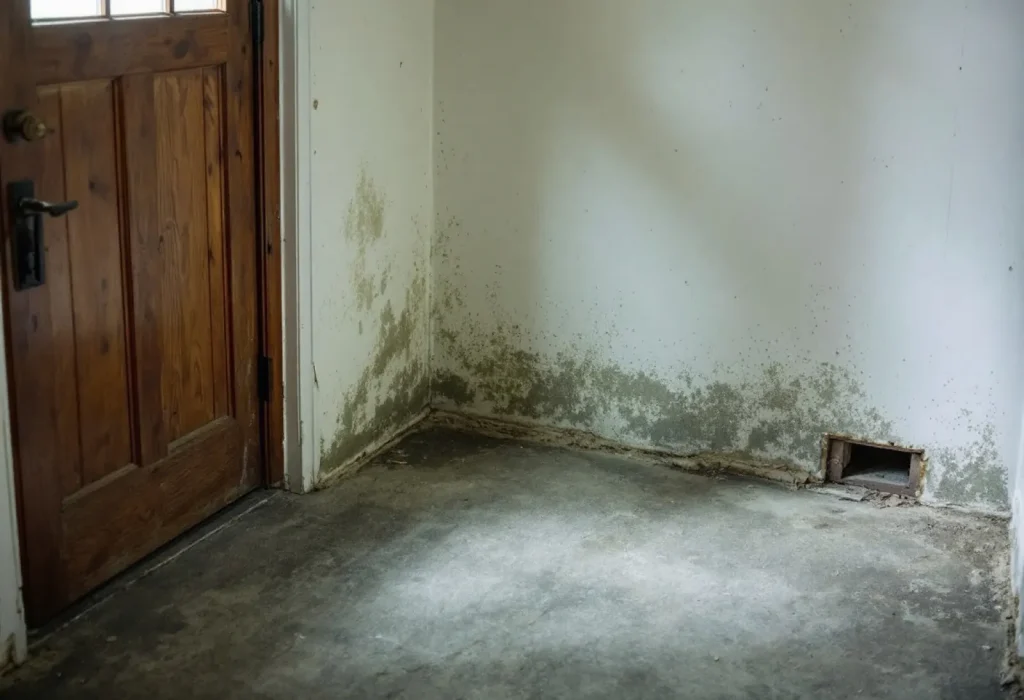
The short answer
Mold disclosure laws are state laws, and they vary widely: we found no federal mold rule like the lead-paint disclosure in 42 U.S.C. 4852d. Of 15 states and D.C. read for this page, 9 seller forms or statutes name mold, Montana makes sellers and landlords disclose known mold and test results, and Virginia makes landlords report visible mold at move-in.
Which states put mold on the seller’s or landlord’s paperwork? 15 states and D.C., read from the text
Each row below comes from the statute or the official state form, opened on 17 November 2026. Where the text we read does not reach one side of the deal, the cell says so instead of guessing. Candidate states were found through the Environmental Law Institute mold law database (2024 excerpt) and then checked against the primary text.
| State | Seller side (what the text says) | Landlord side | Statute or form read |
|---|---|---|---|
| Alaska | Form asks: aware of any mildew or mold issues? | Not covered by the text read | Alaska form 08-4229 (Rev. 05/2024) |
| California | Residential seller text not read here; Section 26140 covers commercial and industrial sellers | Written notice of known mold above limits, conditional (26147); mold booklet (26148) | Health and Safety Code 26147 |
| Colorado | Not covered by the text read | No disclosure item; 96 hour mitigation clock after notice | C.R.S. 38-12-503 (2.2) |
| District of Columbia | Not covered by the text read | No disclosure item; inspect in 7 days, remediate in 30 | D.C. Code 8-241.04 |
| Kentucky | Form asks: aware of mold or other fungi? | Not covered by the text read | KREC Form 402 (12/2022) |
| Louisiana | Form checkboxes: Mold/Mildew and Toxic mold | Not covered by the text read | LREC Property Disclosure Document (01/2026), item 49 |
| Maryland | Statutory list names asbestos, lead, radon, tanks; not mold | Not covered by the text read | Md. Real Property 10-702 (e)(2) |
| Montana | Disclose known mold, prior tests, mitigation; form asks tested or treated for mold | Same duty as sellers | Mont. Code 70-16-703; Mont. Code 70-20-502 |
| New Jersey | Form asks: aware of mold or similar natural substance? (9a) | Not covered by the text read | N.J.A.C. 13:45A-29.1 |
| New York | Form asks: tested for indoor mold? Attach report (27) | Not covered by the text read | Real Property Law 462 |
| Ohio | Form asks: inspected for mold by a qualified inspector? | Not covered by the text read | Ohio Residential Property Disclosure Form (Eff. 6/2022) |
| Oklahoma | Form asks: inspected for mold? remedial treatment? (33, 34) | Not covered by the text read | OREC Appendix A |
| Oregon | Form asks: tested or treated for mold? (9F) | Not covered by the text read | ORS 105.464 |
| Texas | OP-H has no mold line; owner gives buyer remediation certificates from prior 5 years | Not covered by the text read | Occupations Code 1958.154; TREC form OP-H |
| Virginia | Not covered by the text read | Move-in report states visible mold or none | Va. Code 55.1-1215; Va. Code 55.1-1220 |
| Washington | Seller form environmental item omits mold | Give tenants Department of Health mold information | RCW 59.18.060 (14); RCW 64.06.020 |
The pattern is that sellers meet mold through a form question and landlords meet it through a statute. All 9 seller texts that name mold do it through a disclosure form question; only Mont. Code 70-16-703 adds a free-standing duty to disclose known mold to a buyer or renter.
Is there a federal mold disclosure law like the lead-paint rule in 42 U.S.C. 4852d?
The federal disclosure statute that does exist is for lead. 42 U.S.C. 4852d directs the Secretary and the EPA Administrator to write rules requiring that, before a buyer or tenant is obligated under a contract, the seller or lessor hands over a lead hazard pamphlet, discloses any known lead-based paint or lead hazards, provides any lead evaluation report, and gives a buyer a 10 day window for a risk assessment. 40 CFR 745.103 limits that to target housing built before 1978.
Mold has no counterpart in the federal texts we read. EPA states that standards or threshold limit values for airborne mold have not been set and that there are no EPA regulations or standards for airborne mold contaminants. With no federal number to measure against, every mold disclosure question comes back to the state form or statute in the table above.
The pre-1978 housing stock that the lead rule targets is the same stock discussed on houses with asbestos.
Does a form that asks “has it been tested for mold” ask whether mold is there?
No, and the difference matters when reading a completed form. Four of the 9 seller texts ask only whether the seller is aware of mold or whether it is present. The other 5 ask whether the property was tested, inspected or treated, and Montana’s statute adds known mold on top. New York’s form, for example, asks at question 27 whether the property has been tested for indoor mold and says to attach a copy of the report; a common summary online describes the 2023 change as a duty to disclose the existence of mold, which is not what Real Property Law 462 says.
| State | Asks about presence | Asks about testing | Asks about treatment |
|---|---|---|---|
| Alaska | Aware of mold or mildew issues | No | No |
| Kentucky | Aware of mold or other fungi | No | No |
| Louisiana | Contains Mold/Mildew; Toxic mold | No | No |
| New Jersey | Aware of mold or similar substance (9a) | No | Repairs to water or dampness (10) |
| New York | Indoor mold listed as a toxic substance in the note | Tested for indoor mold, attach report (27) | No |
| Ohio | No direct question | Inspected by a qualified inspector | Describe any remediation undertaken |
| Oklahoma | No direct question | Inspected for mold (33) | Remedial treatment for mold (34) |
| Oregon | No direct question | Tested for mold (9F) | Treated for mold (9F) |
| Montana | Known mold (statute) | Tested for mold | Mitigation or treatment evidence |
None of the texts requires a seller to test. Mont. Code 70-20-502 says the disclosure statement must state that the seller is not obligated to investigate the property, and Health and Safety Code 26147(b) says a residential landlord is not required to run air or surface tests. Ohio’s form goes the other way on the buyer side, printing an advisory that every home contains mold and encouraging a mold inspection by a qualified inspector. Whether a home inspection covers mold is a separate question; the scope limits are set out on do home inspectors check for mold.
What does “known” mold mean in these statutes?
The trigger words differ, and they set how much a seller or landlord had to be aware of. Mont. Code 70-16-703(2) applies when a seller, landlord or agent “has knowledge” that a building has mold present. Health and Safety Code 26147 is wider: it applies when the landlord “knows, or has reasonable cause to believe” that mold, “both visible and invisible or hidden,” is present.
Va. Code 55.1-1215 uses a physical test instead of a mental one: the move-in report states whether there is “any visible evidence of mold in areas readily accessible within the interior” of the unit. Md. Real Property 10-702 uses “actual knowledge” for its statutory list, and the OREC Appendix A form defines a defect as a condition that would have a materially adverse effect on the monetary value of the property.
Most forms add an “unknown” box. Alaska form 08-4229 offers Yes, No and UNK; Louisiana’s 01/2026 document offers Y, N and NK. How a court reads an unknown answer against a later mold finding is a legal question for a real estate attorney in that state, not something the form text decides.
Why California’s 2001 Toxic Mold Protection Act disclosure has a condition attached
Health and Safety Code 26147 reads as a firm landlord duty: written disclosure to prospective tenants before the lease and to current tenants “as soon as is reasonably practical” when known mold exceeds the permissible exposure limits or poses a health threat under the department’s guidelines. Subdivision (e) then says the section does not apply until the first January 1 or July 1 at least 6 months after the department adopts those standards. Section 26140 sets the same condition for commercial and industrial sellers, and Section 26148 ties the tenant booklet duty to the department approving a booklet.
The department addressed the limits in its April 2005 report to the Legislature: “sound, science-based PELs for indoor molds cannot be established at this time,” and it did not consider it feasible to develop numeric guidelines. Subdivision (d) of 26147 also exempts a landlord from telling prospective tenants when the mold was remediated under the department’s guidelines.
California’s enforceable mold hook for renters sits in housing code instead. Health and Safety Code 17920.3(a)(13) lists “visible mold growth, as determined by a health officer or a code enforcement officer” as a substandard condition, excluding minor mold on surfaces that collect moisture in normal use. Under that wording, the official who decides whether visible mold makes a California rental substandard is a local health officer or code enforcement officer.
Tenant side: Virginia’s move-in report, Washington’s notice, Colorado’s 96 hours and D.C.’s 7 and 30 days
Va. Code 55.1-1215 is the most specific landlord disclosure we read. The move-in inspection report has to state whether visible mold is present. If it says none, that is deemed correct unless the tenant objects in writing within 5 days. If it reports mold, the tenant may terminate and not take possession; a tenant who stays gets remediation within 5 business days, a reinspection and a new report.
Va. Code 55.1-1220(5) adds that after remediation during a tenancy the landlord gives the current tenant a summary of the mold remediation information, and that once mold has been remediated “in accordance with professional standards,” the landlord is not required to disclose that past incident to later tenants.
RCW 59.18.060(14) is an information duty rather than a property-specific one: Washington landlords give new tenants Department of Health information on indoor mold when the lease is signed, either in writing or posted in a visible public location at the property.
Colorado and D.C. set repair clocks without a disclosure item. C.R.S. 38-12-503(2.2) treats mold associated with dampness that would materially interfere with a tenant’s life, health or safety as a breach of the warranty of habitability unless the landlord, within 96 hours of reasonably complete written or electronic notice, installs containment, stops active water and installs HEPA filtration. D.C. Code 8-241.04 requires inspection within 7 days of a tenant’s notice and remediation within 30 days of the inspection. Repair rules for leaks in rentals are covered on water damage in an apartment.
What a clearance test or remediation certificate does for the next disclosure
In Texas, paperwork is the disclosure. Under Occupations Code 1958.154(a), a license holder gives the owner a certificate of mold remediation within 10 days of finishing; the certificate carries a mold assessor’s statement that the identified contamination was remediated and can note that the underlying cause was fixed. Subsection (b) says an owner who sells provides the buyer a copy of each certificate issued in the 5 years before the sale. The TREC form OP-H seller notice, dated 09-01-2019, has no line that says mold; its closest items are “Water Damage Not Due to a Flood Event” and “Improper Drainage.”
Montana works the same way for tests: Mont. Code 70-16-703(2) says a seller or landlord who knows a building was tested provides the results, if available, and evidence of any later mitigation or treatment, and that handing them over is not a warranty that the test was accurate or the treatment worked. New York’s question 27 and Ohio’s 6/2022 form both point the seller to attach or describe an inspection report and any remediation.
A documented remediation can also end a disclosure. Health and Safety Code 26147(d) exempts a remediated condition from prospective tenant disclosure, and Va. Code 55.1-1220 ends disclosure to later tenants after remediation to professional standards. What a post-remediation clearance report contains is set out on mold clearance testing, and which states license the people who sign those reports is mapped on state mold licensing.
What to ask a real estate attorney and the state real estate commission before signing
This page reports what statutes and forms say; it does not say what any reader has to disclose in a particular sale or lease. The questions below are built from the gaps the 16 texts leave open, and each names the document that holds the answer.
- For a seller form: which version is current (Louisiana’s is dated 01/2026, Kentucky’s 12/2022, Ohio’s 6/2022) and does an “unknown” answer carry any risk under the state’s disclosure act? Ask the state real estate commission that publishes the form.
- For a past remediation: does a Texas certificate under Occupations Code 1958.154, or a clearance report elsewhere, need to be attached, and for how many years back? Ask a real estate attorney licensed in the state.
- For a lease: does the state have a move-in mold report like Virginia’s 55.1-1215, a mold information duty like Washington’s RCW 59.18.060(14), or a repair clock like Colorado’s 96 hours? Ask the attorney, and for code complaints the local health officer or code enforcement office.
- For a buyer: does the contract allow an inspection contingency, as Montana’s model statement in 70-16-703 suggests a buyer use? Ask the attorney before the option or contingency period ends.
Which repairs actually call for professional remediation, as opposed to cleaning, is covered on when mold remediation is required. More standards pages sit in the standards hub.
Out of scope: health effects of mold are not covered here; EPA’s mold pages are the federal starting point.
Questions people actually ask
Does mold need to be disclosed when selling a house?
It depends on the state’s text. Of 15 states and D.C. read for this page, 9 seller forms or statutes name mold, including Alaska, Kentucky, Louisiana, New York, Ohio and Oklahoma. Maryland’s statutory list and Washington’s seller form do not name mold, and Texas form OP-H has no mold line but Texas law requires handing over remediation certificates from the prior 5 years. A real estate attorney can say how that applies to one sale.
How do you prove a seller knew about mold?
The statutes point to documents rather than testimony. Texas Occupations Code 1958.154 creates a remediation certificate the owner receives within 10 days of the work, and Montana Code 70-16-703 covers known test results and mitigation evidence. New York’s question 27 asks whether the property was tested for indoor mold and to attach the report. Whether those records prove knowledge is a question for a real estate attorney.
Is mold considered uninhabitable?
Some states write it into housing code. California Health and Safety Code 17920.3(a)(13) lists visible mold growth, as determined by a health officer or code enforcement officer, as a substandard condition. Colorado’s C.R.S. 38-12-503(2.2) treats mold associated with dampness as a breach of the warranty of habitability if the landlord misses the 96 hour mitigation steps. Other states use general habitability language without naming mold.
Does a Virginia landlord have to tell new tenants about mold that was fixed?
Va. Code 55.1-1220(5) says that once mold has been remediated in accordance with professional standards, the landlord is not required to disclose that past incidence to subsequent tenants. The current tenant during the remediation receives a summary of the remediation information. Separately, Va. Code 55.1-1215 requires every move-in inspection report to state whether visible mold is present.
Does the Texas seller’s disclosure notice ask about mold?
The TREC OP-H seller’s disclosure notice dated 09-01-2019 has no item that uses the word mold. Section 4 asks about Water Damage Not Due to a Flood Event and Improper Drainage. Mold enters a Texas sale through Occupations Code 1958.154(b), which has an owner who sells give the buyer each certificate of mold remediation issued in the 5 years before the sale.
Sources
- 42 U.S.C. 4852d, Cornell Legal Information Institute: Residential Lead-Based Paint Hazard Reduction Act disclosure duties. Retrieved 17 November 2026.
- 40 CFR 745.103, Cornell Legal Information Institute: definition of target housing (built before 1978). Retrieved 17 November 2026.
- EPA, U.S. Environmental Protection Agency, Mold Testing or Sampling: no standards for airborne mold. Retrieved 17 November 2026.
- California Health and Safety Code: Health and Safety Code 26147, Section 26148, Section 26140 and Health and Safety Code 17920.3, text via California.Public.Law mirror of leginfo.legislature.ca.gov. Retrieved 17 November 2026.
- California Department of Health Services, April 2005 report to the Legislature on the Toxic Mold Protection Act of 2001, hosted by the California Department of Public Health. Retrieved 17 November 2026.
- Texas Occupations Code 1958.154 and Property Code 5.008 (text), via Texas.Public.Law mirror of statutes.capitol.texas.gov; Texas Real Estate Commission, TREC form OP-H Seller’s Disclosure Notice (09-01-2019). Retrieved 17 November 2026.
- Code of Virginia, Va. Code 55.1-1215 and Va. Code 55.1-1220, Virginia Legislative Information System. Retrieved 17 November 2026.
- Revised Code of Washington, RCW 59.18.060 and RCW 64.06.020, Washington State Legislature. Retrieved 17 November 2026.
- New York Real Property Law 462, property condition disclosure statement, via NewYork.Public.Law. Retrieved 17 November 2026.
- Montana Code Annotated 2025, Mont. Code 70-16-703 and Mont. Code 70-20-502, Montana Legislature. Retrieved 17 November 2026.
- N.J.A.C. 13:45A-29.1, Property Condition Disclosure Form, Cornell Legal Information Institute. Retrieved 17 November 2026.
- Ohio Department of Commerce, Division of Real Estate, Ohio Residential Property Disclosure Form (Eff. 6/2022). Retrieved 17 November 2026.
- Oklahoma Real Estate Commission, OREC Appendix A, Residential Property Condition Disclosure Statement (2026 forms). Retrieved 17 November 2026.
- Oregon ORS 105.464, seller’s property disclosure statement, via Oregon.Public.Law. Retrieved 17 November 2026.
- Alaska Real Estate Commission, Alaska form 08-4229, Residential Real Property Transfer Disclosure (Rev. 05/2024). Retrieved 17 November 2026.
- Kentucky Real Estate Commission, KREC Form 402, Seller’s Disclosure of Property Condition (12/2022). Retrieved 17 November 2026.
- Louisiana Real Estate Commission, LREC Property Disclosure Document, Residential Property Disclosure Document (01/2026). Retrieved 17 November 2026.
- Maryland General Assembly, Md. Real Property 10-702. Retrieved 17 November 2026.
- Colorado C.R.S. 38-12-503, warranty of habitability, via Colorado.Public.Law. Retrieved 17 November 2026.
- Council of the District of Columbia, D.C. Code 8-241.04. Retrieved 17 November 2026.
- Environmental Law Institute, Database of State Indoor Air Quality Laws: Mold excerpt (2024), used only to find candidate states. Retrieved 17 November 2026.
- The state table and both charts are a reading of the texts above, compiled when this page was built. States whose primary text could not be opened were left out rather than filled from a summary. Our methodology sets out the standing rules.
This page describes statute and official form text. It is not legal advice and does not say what any reader must disclose in a sale or lease. Forms are revised; check the current version with the state real estate commission and ask a real estate attorney licensed in the state.